






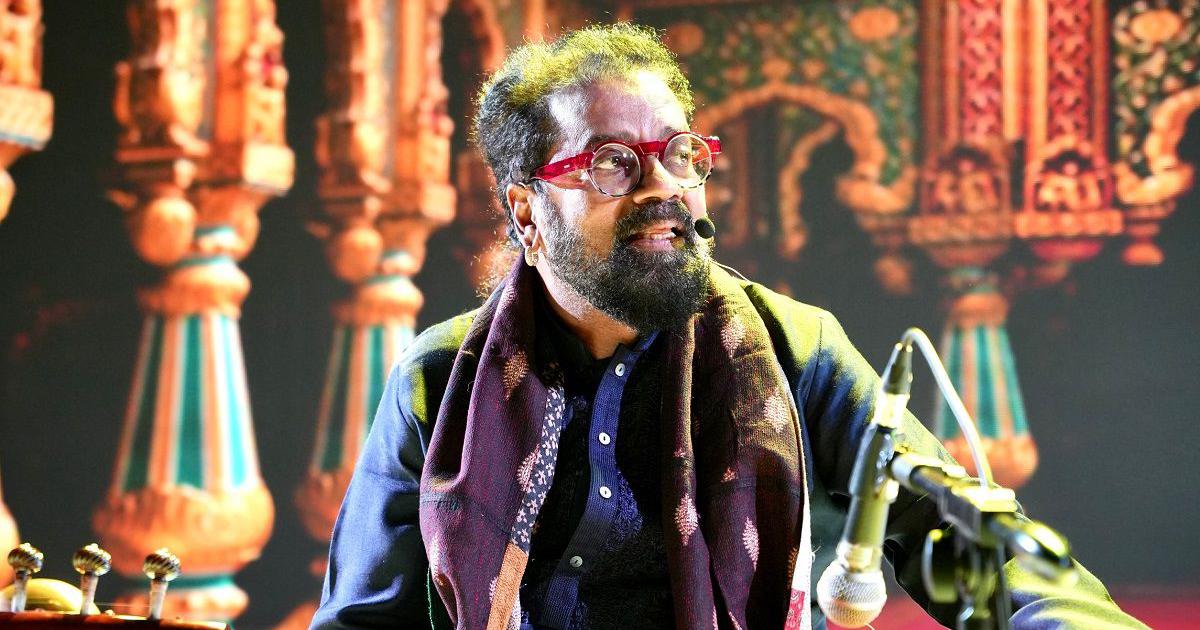
The renowned singer Hariharan has had a prolific, genre-crossing career, but the ghazal remains his heartbeat. His recently released album, Jaan Meri, comprises five ghazals with poetry by Farhat Shahzad. The tracks includes Baat Se Baat, which punches bossa nova into the ghazal.
Hariharan began performing ghazals in the mid-1970s for the Doordarshan programme Shaam-e-Ghazal. He made his playback debut shortly after with the Jaidev-composed Ajeeb Saneha Mujhpar Guzar Gaya from Muzaffar Ali’s Gaman. Hariharan’s brush with wider pop stardom happened in the 1990s, beginning with AR Rahman’s debut movie soundtrack Roja, followed by the Hindipop group Colonial Cousins, featuring Leslee Lewis.
Hariharan’s mastery over the ghazal is evident in the songs Hum Bhool Gaye from Aks (2001), Jaaniya Ve from Dus (2005) and Ay Hairathe from Guru (2007). The ghazal’s popularity isn’t dictated by films, Hariharan told Scroll: “Films today don’t have space for ghazals because they are shorter, the stories don’t require them, and ghazals need to be performed live, but the songs are used as score, not lip-synced anymore.”
What is a ghazal?
Ghazal is a conversation with your beloved. It’s a form of poetry. Not music, like jazz. The words come first. The couplets rhyme, ending with a constant radif, preceded by a qafiya. The first couplet is called a matla, where both lines end with the radif. The second line in each of the following couplets need to maintain the radif.
Each couplet is a shair, but each shair can be about different things; if one is about romance, another can be about a social cause. The poet writes their name, takhallus, in the last couplet, which is called the maqta.
The conversational element in a ghazal lends itself to be composed through a variety of music. It’s also a performing art. Be it in a mehfil or a concert, you can sing for ten minutes to an hour.
Whatever I have learned – khayal, thumri, Carnatic – everything comes to play in a ghazal. The lyrics precede, the tune follows. It’s challenging to compose a ghazal, ensuring musical intricacies remain correct while keeping the words clear.
What are your definitive ghazal albums?
Hazir, Kaash, Waqt Par Bolna, Horizon, Sukoon, Aabshar-e-Ghazal.
What is the ghazal circuit like now?
Very healthy. There’s always a minimum of 2,000 people at my concerts, here and abroad. Independent music is becoming stronger than film music.
A lot of youngsters are singing ghazals. I have launched a new competitive reality show to find the best ghazal singers for Doordarshan called Sartaj-E-Ghazal. The participants will audition in Doordarshan centres in all states. The best will come to Mumbai and sing.
You met AR Rahman for the first time in Mumbai.
I met him six months before Roja started. He was a young boy. I was recording a jingle for him. After the recording, he said he was a fan of my ghazals and had gifted the Reflections album to everyone he knew. He asked me if I’d come to Chennai and sing a song for Mani Ratnam.
I remember I told him how different the jingle was: minimalist, clean, with a nice groove. That’s also how I met Leslee Lewis. We are still the best of friends. We performed as Colonial Cousins again in 2024. It was amazing.
When we began, Bollywood was not ready for independent pop. They still aren’t, since all the songs they pluck are almost always Punjabi.
What makes Rahman so successful?
He meditates when he works. When he is recording or composing, he gives himself up to it totally. Nothing else exists. He is one hundred per cent into it.
I remember for the first 15 years of his career, he never stepped out of the studio. Only met directors, producers, composed, recorded. This kind of singlemindedness is brilliant. It’s genius plus drive.
‘Nahin Samne’ from ‘Taal’, for which Rahman composed the music, has really endured.
My voice was bad during the recording. I got it right on the second try. The song has a lot of silence. It’s about an introverted man singing to himself. But it’s also a high-pitched song, and yet it is not loud. Just one downbeat is maintaining the song’s rhythm.
There’s so much space between each beat and another. The song was tailormade for that scene.
What is the secret to such a long career?
Practice keeps you razor-sharp. You always have to keep composing and performing. If you don’t do that for three months, the adrenaline won’t flow on stage. So much of performance is about responding to the moment, in an instant. You need to stay aligned to the energy.
I also dropped bad habits like paan. I gave up smoking in my mid-thirties, although I do have a couple of drinks sometimes. You need to have seven hours of sleep daily. We take sleep for granted. Vocal chords are delicate and need care.
