






Michael is about remembering and forgetting. Antoine Fuqua’s Michael Jackson biopic is a reminder of the singer-songwriter’s singular genius, his otherworldly dancing skills, his ability to whip a crowd into delirium. The film, which is out in cinemas, is also about memory-wiping.
Michael is set in the pre-scandal times, before the skin-whitening and the child molestation allegations, the bizarre public behaviour and the ultimately fatal painkiller addiction. Michael has the blessings of key Jackson family members, stars Jackson’s nephew Jaafar in the lead role and gives a plum part to the executor of the lucrative Jackson estate.
The film isn’t expected to be objective, nuanced or revelatory, and it isn’t. But it’s also undeniably exhilarating – a modern-day musical fairy tale packed with sing-along, foot-tapping chartbusters that use Michael Jackson’s original singing voice.
John Logan’s screenplay identifies the ogre whom Michael must slay: his father Joe Jackson (Colman Domingo). Joe puts a young Michael and his brothers through gruelling practice sessions. Joe frequently belts Michael and ridicules his appearance. It’s suggested more than once that Michael is himself a victim of abuse, robbed off his innocence at a young age and forced to be the family’s golden goose.
When the band The Jackson 5 takes off, 10-year-old Michael – sweet-faced and sweet-voiced, beautifully played by Juliano Krue Valdi – is the indubitable star. Having introduced Michael as a cherubic kid, the movie challenges viewers to regard the adult Michael (Jafaar Jackson) as anything but adorably eccentric.
Motown chief Berry Gordy (Larenz Tate) and Quincy Jones (Kendrick Sampson) play their part in Michael’s inevitable success, while briefly standing in as his surrogate fathers. A few creases are introduced into the smoothness, left there as evidence that Michael is not a hagiography but a thoughtful chronicle of a life less ordinary.
Games meant for children and exotic animals serve as the friendless, girlfriendless young man’s attempts to relive a childhood he never had. Michael’s bodyguard Bill (KeiLyn Durrel) gets ample screen time is a moist-eyed witness to the singer’s concern for children.
Scenes of Michael hugging young boys are presented without irony. There’s a bit of slyness in other moments, which hint that the thin-voiced singer is more in command of his image than he lets on.
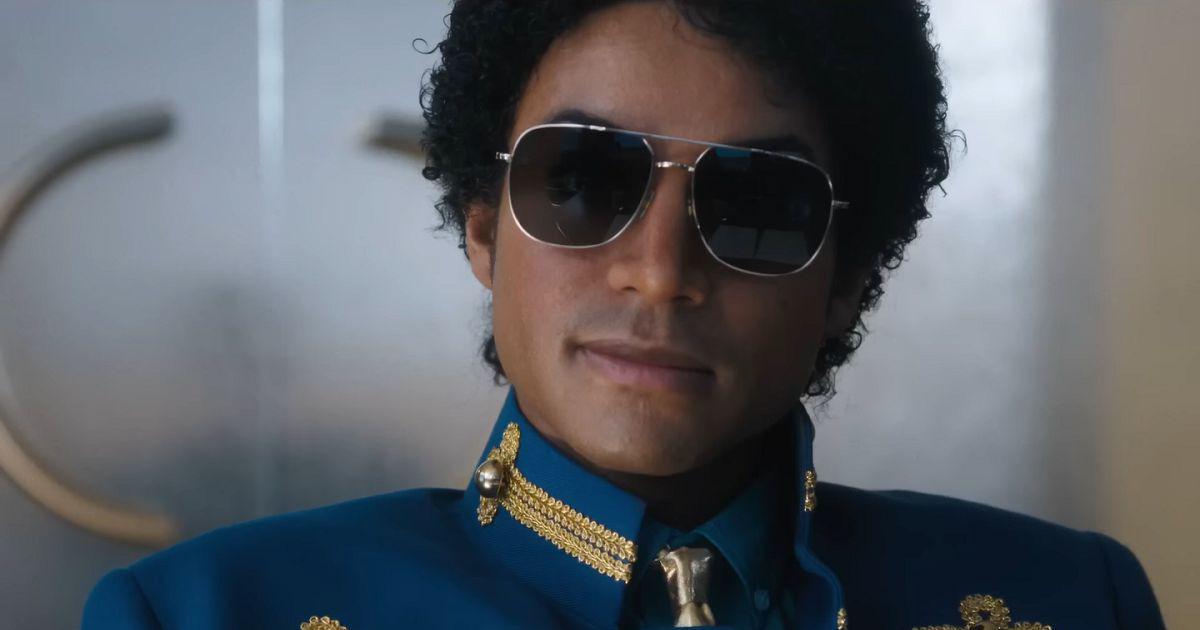
A business meeting for which Michael turns up in his signature blue hussar military jacket results in the lawyer John Branca (Miles Teller) being hired to handle Michael’s growing wealth – and deal with Joe. During the shoot of Thriller’s music video, Michael shows an astute understanding of camera movements and the projection of his astounding moonwalking moves.
Antoine Fuqua and cinematographer Dion Beebe are paying attention too. Some of the film’s most scintillating scenes are the recreations of Michael performing the hits Billie Jean, Beat It and Human Nature. Jafaar Jackson brilliantly transforms into his subject, nailing the body language, shy mien and terpischorean talent. In the stage performances, Jafaar Jackson is so uncannily like his uncle that it is hard to tell them apart.
Jafaar Jackson and Colman Domingo, who’s terrifying as the cruel and grasping Joe, are the main players in a film that reduces Jackson’s ambition to his desire to get away from his father. Other characters, including Michael’s mother Kathrine (Nia Long), are like the background dancers who match Michael’s every move.
The feature-length music video’s insistence on Joe’s villainy and Michael’s innocence flattens a layered build-up to the headline-grabbing item that Michael Jackson became in the post-Thriller decades. The 127-minute movie hints at a sequel. Joe Jackson’s warning to his son, about whether he will be able to survive in a world without his family’s support and governed by sycophants, lingers.
In Antoine Fuqua’s risk-averse approach, the man with the bewejelled silver glove and white socks reclaims his position as a musical maven, who created some of the previous century’s most enduring songs. In Michael, the warts always belong to someone else. Whom will the proposed sequel blame for the distorting plastic surgery, the whiteness that replaced supposedly proud Blackness, Michael Jackson’s sorry transformation into “Wacko Jacko”?
