



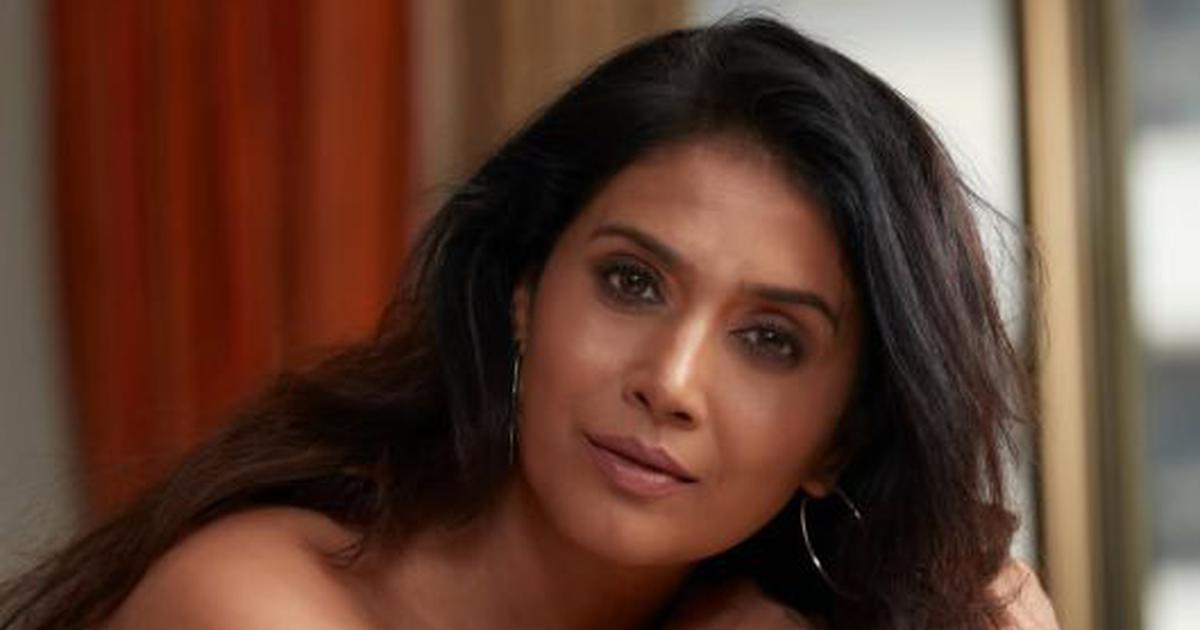
Sonali Kulkarni’s storied career has never been restricted to acting. Alongside headlining films, plays and web series, Kulkarni has been a columnist with the Marathi newspaper Loksatta and continues to be a member of the anti-superstition organisation, the Maharashtra Andhashraddha Nirmoolan Samiti. In her latest role, Kulkarni has turned podcaster.
The Marathi-language podcast Half Ticket Full Nagrik, which Kulkarni hosts and produces, aims to give children the opportunity to freely express their opinions, feelings and desires.
Kulkarni set out her ambition for the show in a press release: “Whether it is making family decisions, travel plans, financial choices, or even simple everyday matters, children are rarely asked what they feel. I feel there is a lot of emotional violence when it comes to younger people. They matter a lot and they bring peace, joy and harmony into the world. We must protect their innocence yet give them a seat at the table.”
Each episode begins with an adult – parents, teachers and psychologists – before moving to a child. For instance, in the first of the two episodes that are out on the Aarpaar platform’s YouTube channel, Bhoopali Nisal speaks about adopting Srujan as a single woman and setting up an engineering business. Srujan too shares her thoughts on why she calls her mother her father, her creative pursuits and tackling loneliness.
Half Ticket Full Nagrik relies heavily on Kulkarni’s talent for putting her guests at ease. Empathy and involvement in social concerns have been hallmarks of the 51-year-old actor since her acting debut in Girish Karnad’s Cheluvi in 1992. Kulkarni was only 18 years old at the time and still in college.
Her next releases in 1994 were May Madham in Tamil and Mukta in Marathi. Since then, Kulkarni has worked across languages and genres, in arthouse and commercial productions, notably Dil Chahta Hai, Dayraa, Doghi, Devrai and Gabhricha Paus. She has even been in an Italian film, Fuoco Su di Me (2006).
Kulkarni has appeared in streaming shows too, most recently Manvat Murders, in which occult beliefs lead to the murders of young girls. Her upcoming films include Madhur Bhandarkar’s The Wives, the Nani-starrer The Paradise, and Vishwas Joshi’s untitled Marathi movie.
Kulkarni spoke to Scroll about turning podcaster and her journey as an actor. Here are edited excerpts.
What inspired Half Ticket Full Nagrik?
Knowingly or unknowingly, I have been talking about younger people. But the real reason is my own daughter, Kaveri. She gives me a wonderful sense of belonging.
Some people feel that they reach the epitome of womanhood with motherhood. I am not of that opinion. I stand away from the glorification of motherhood. I enjoy conversing with co-parents, teachers and friends who don’t want to marry or who are married but don’t want kids.
A podcast made sense. I wanted young people between the ages of six and 16 to speak their minds. I am not saying, this is how you should behave. I am trying to understand how they feel.
What discoveries did you make while hosting the podcast?
If you give kids a comfortable and relaxed atmosphere, they become fearless. They speak about what they like or don’t like. They will casually tell you about how they failed without making a big deal of of it. That’s not the way we were. We were much more restricted.
Children have opinions. They will talk about Donald Trump, for instance. This could be adults being mirrored through the children. But one guest said, why should there be war in the world? She said very confidently, I want to tell Mr Trump, why are you behaving in this way? I don’t know if this can be called political behaviour, but they are able to sense the violence and insecurities around them.
They are not tired of chatting. They don’t miss their mobiles. Kaveri told me, please don’t ask the guests about their mobile phones, they are fed up with the question. I was curious because all adults are concerned about kids using their mobiles. For once, I heard her out.
The podcast is the latest step in a long and fruitful career. What has kept you going?
People. I am absolutely lucky that I got to work with some really fantastic people who didn’t fear connecting with others through their work or storytelling. Such as Satyadev Dubey, or Vijay Tendulkar. Girish Karnad. Jabbar Patel. The subjects that they chose helped me.
Cheluvi was about the environment. You ended up thinking about it. Jabbar Patel made a strong statement with Mukta about the Black struggle in America and untouchability in India. Amol Palekar talked about gender, Sumitra Bhave said things about human emotions.
I initially had an inferiority complex. I grew up in Pune, which was a small city compared to Mumbai. These legends helped me get over it. For instance, Girish Karnad never claimed that this girl has been launched because of me. He was light. He didn’t carry that weight on his shoulders.
They were all towering people. I carry a huge impact of all of them.
You are also a member of the Maharashtra Andhashraddha Nirmoolan Samiti, whose founder Narendra Dabholkar was assassinated by Hindu extremists in 2013.
I would keep arguing with Narendra Dabholkar because I believe in God. I belong to a household where celebrating festivals was a normal thing.
His daughter, Mukta, was in my college. He always invited me to his programmes. I got to hear him and people like Pushpa Bhave and Shreeram Lagoo express their fundamentals and thought processes. This helped me choose my own channel.
You can’t ape someone else. You have to be yourself. You can’t cheat in your behaviour, whether as an actor or otherwise.
I was at the last public event that Narendra Kaka did in Pune. After his death, I forgot my dialogues for the only time in my life.
I was performing my play, a comedy called White Lily and Night Rider. I went blank at one point. I could only hear those three gunshots. It was very difficult for me to come to terms with his death.
You made your acting debut in 1992. Was there a point when you knew that you had arrived?
There was no one breakthrough. I kept discovering the profession, the work and myself.
I was unsure about what would happen to my career after Cheluvi. I didn’t know whether I would get more films. But then I also won awards. It started changing quickly.
In one sense, Dil Chahta Hai [2001] was a breakthrough. It was a different style, even though I had already been in Hindi films, such as Daayra, Jahan Tum Le Chalo, Mission Kashmir and Pyaar Tune Kya Kiya.
How did Farhan Akhtar pick you for Dil Chahta Hai, in which you are paired with Saif Ali Khan?
It’s too filmy. I had done a photo shoot. That was the time when you got a shoot done with three or four looks and you distributed your portfolio with the pager number at the back.
Somebody had my photos and they fell on the ground. Zoya Akhtar [Farhan Akhtar’s sister] happened to see them. They were casting for Dil Chahta Hai at the time. Zoya said, nice face, who is this? When she was told, Sonali Kulkarni, she said, that can’t be true, I have seen her films and she doesn’t look like this.
She kept the photos and called me for an audition. Had somebody been carrying the file properly and the photos hadn’t fallen out, I don’t know what would have happened.
You were also in the Tamil film May Maadham in 1994. How did you get that role?
The director, Balu, is Mani Ratnam’s nephew. The film was produced by Mani Ratnam’s brother, G Venkateswaran. Vineeth had been signed as the hero, and they were looking for a fresh face.
Mani sir had watched Cheluvi and he felt, this was an interesting face. They called me to Madras for an audition, which was shot by the cinematographer, PC Sreeram. My voice was dubbed by Rohini – she did a beautiful job.
I did get offers for Tamil films after that, but then I did Mukta, and many other films.
You started out at a young age. How did you handle the world of filmmaking?
All I knew was that I had to complete the shoot and go back to aai-baba [my parents]. I had no knowledge about payments or taxes.
I wanted to buy a Kinetic Honda. It felt nice that I could buy a new one with my own money because I was fed up of my cycle, which had been used by my eldest brother and then my middle brother before being passed on to me.
I was not overwhelmed by cinema. My family wasn’t overwhelmed with glamour either. The thought was, you got an award, so you must have done a good job.
I had won the Maharashtra state award for best actress for Mukta. My brother Sandeep was working with Godrej in Vikhroli in Mumbai at the time. The awards ceremony was at Rang Bhavan in Dhobi Talao. After the awards ended, Sandeep said, we will miss the last train, let’s rush home.
There were six of us – my parents, Sandeep, his wife, my other brother Sandesh and me. We couldn’t fit into a taxi. We didn’t have the money for it anyway. We managed to get the last train. The journalists and photographers who had covered the awards were travelling with us too. I had my trophy in my hand. Somebody clicked a photo of the family.
We didn’t feel that this was anything special. More than the award, we were relieved that we had managed to get the train and save money. That stayed with me for a long time.
Later in my career, I realised that I couldn’t keep longing for home all the time. Although I had moved to Mumbai, I would keep going back to Pune. I had to take a breather. I guess this is what is called growing up.
What are the challenges involved in becoming a character?
A role is a role. Portraying a character is much easier than attending to the internal conflict.
The challenges are always interpersonal. You never know what to expect. Your co-star might have a particular attitude, or you may do a role out of social pressure, or because your name has made the project attractive. You’re emotionally not there, but you are struggling to be there.
I have to be convincing. I also like to entertain. I have realised that I am an entertainer, whether it’s for a film or a play or even a room full of people.
I like looking after people. I don’t like dragging people into topics that don’t matter to them. At the same time, I don’t mind interrupting stupid conversations. I will take a stand if I feel the need to.
What are some of the differences between Hindi and Marathi productions, apart from the fact that Hindi movies have better budgets?
The dreams are different. Marathi filmmakers are more ambitious today, but back then, Marathi cinema was a stepping stone. The attitude was, let’s do a Marathi film first then then work in Hindi. You allowed yourself to experiment, to fail, to reach the commercial square, which I felt was an absolute no-no.
Directors like Jabbar Patel and Umesh Kulkarni have never considered Marathi films as a corner where they can gamble. But many others feel, let’s make a small film on a low budget and then we will make a big-budget Hindi film later. But why aren’t you making a big-budget Marathi film instead?
Fortunately, multiplexes have bridged arthouse and commercial cinema. And streaming has been a boon too.
You were most recently in the Sony LIV series Manvat Murders. What was the response like?
Manvat Murders was a surprise to me. The casting was very interesting. Nobody would have thought of making me into Rukmini, who is one of the antagonists.
I am overwhelmed with the huge response. I was suffering from chikungunya while performing Rukmini. Hats off to the director Ashish Bende, he is very good.
What about acting continues to enthuse you?
These days, what gives me a high is to just be a character without showing craft or effort. Also, trying to understand what the director is trying to say.
I am very much aware of my limitations as an actor. To tell the story the way director wants it, and to add my own poetry is so much fun.
I always remember that I matter, I am instrumental, so I either get enriched or help others to get enriched. I participate, I am not a mere listener. I don’t just let things happen. More than struggling or fighting, if I can make things work, that is where I put in my intelligence and experience.
I don’t like being in a bubble at all. I also don’t mind bursting other people’s bubbles and making them involved in the work that we are all doing.
