







Grandpa owned two cinema halls – National (renamed Moti) and Nishat – both located in the red-light area of Kamathipura. Both the cinemas, sold by Grandpa during his lifetime, went defunct after the multiplex boom. Kamathipura was divided into roughly fourteen sections according to the regional and linguistic backgrounds of the sex workers active there. Their claustrophobic room-cum-charpoys were known as ‘cages’ since the women were trapped there, with no hope of salvation. For a child, the National and Nishat were barbed-wire zones.
However, Saiba the chauffeur and Bachoo – surrendering to my howls of protest – would sneak me in on the quiet for re-runs of the Dilip Kumar-headlined Azaad (1955) and Kohinoor (1960), Dev Anand’s Taxi Driver (1954) and the action-crammed bone crunchers of Dara Singh.
Naturally, Maaji’s prime mission was to enrol me in the ‘best school’ in town. The New Model Infant High School on Warden Road stopped at the third standard. In her crystal ball, she saw me as a lawyer or, by a quantum leap, as a magistrate or judge. This could have been a side-effect of her crush on both Rajendra Kumar and Ashok Kumar in Kanoon (1960). Desperately I’d swear in the name of Allah that I’d run away to beg Raj Kapoor to cast me as an orphan kid, influenced indelibly by his stark Boot Polish (1954), about two waifs who are finally blessed by Bhanu Pratap’s script with a bright future.
‘See, my dear Papu (her pet name for me),’ Maaji would say in a melting ice-cream voice. ‘Your mother Zubeida has left you in my charge. She died when she was very young in an airplane accident with the Maharaja of Jodhpur. She had converted to Hinduism and was renamed Vidya Rani, may Allah forgive her. Your father Hassan Mohamed, after being dumped and divorced, migrated to Lahore. He was such a fool. I refused to let you go with him. I’m both your mother and father. You’ll wash my feet and drink the water some day. As for Suleman Seth, don’t get close to him. He can be a jinnat, so evil.’
No Cathedral and John Connon School for me, I wept. Grandpa was about to land a tight slap on my face. I flinched. Maaji pulled me into her arms, admonishing Suleman Cassum Mitha, ‘No one will ever lay a finger on my child. Remember, our nikaah was performed at the Nakhoda Masjid. There were scores of witnesses. I will leave from here with all that I can lay my hands on! Your lousy, ungrateful children won’t be able to do a thing. You will be all alone. Understand?’ Grandpa shrivelled, characteristically. ‘Fayazi, I won’t tolerate any pampering and spoiling of this boy silly. I have raised ten children with an iron hand. I may tell you, they were educated at reputed boarding schools in Panchgani.’
Scoffed she, ‘Tchah, I don’t want to hear about those namak haraams. Do what I ask right away, or we’ll pack up and leave this very moment.’ Perpetually scared of isolation, her command sounded as if it had been a diktat from the colonial era’s Queen Victoria. End of argument, an open-and-shut case. He acquiesced in a nano second. ‘Jaan, if you want I’ll get the moon from the skies for you.’
Next day, Maaji had dolled me up in a frilly white shirt and black knee-pants and combed my curly hair inherited from my mother, sprinkled it with gallons of perfumed oil, brushing hard till it resembled a plateau. Bernard Gunnery, the principal, and Ezekiel, whose first name was unpronounceable, the English language teacher of the Cathedral and John Connon School at Outram Road, Fort, were dropping by for tea. Strawberry cake and scones had been ordered from the must-go-to Palmer’s Bakery. I was instructed by Maaji, ‘Don’t you be shy and if you have to call them by their name, don’t forget to say Mr So and Mr So-and-So.’
At the garden tea ceremony, the ruddy-faced, tall-as-a-tree Bernard Gunnery inquired, ‘Young man, would you like to be at our school?’ I glared like the saucer-eyed child actor Daisy Irani would have. Not for all the tea in the Nilgiris. Grandpa darted a sour-lime glance at me. I had to speak up, ‘Yes, Mr Gunnery, I want to be at your school.’ The English teacher, believed to be from Mauritius, chortled, ‘Young man, what are your hobbies?’ That was easy. I spoke up. ‘Mr Ezekiel, it’s watching movies, music, painting and gardening.’
‘What kind of movies?’ Ezekiel grinned. ‘Movies, any movies, sir, but I do like the fairy-tale Hatim Tai (1956), Boot Polish and any movie with Shakila.’
‘Who’s Shakila?’ Gunnery quizzed. ‘I thought everyone’s crazy about Madhubala.’
‘Shakila is the most beautiful girl in the world,’ I pouted.
Magnanimously, Gunnery concluded, ‘Your boy will be enrolled in the third standard next term – that’s just a fortnight away. Get his uniform ready – the tie, shorts and belt can be bought from the school shop. The blazer you can buy from Moses and David at Crawford Market. We do hope the boy has his meals with a fork and knife. The meals are catered by the Bombay Gymkhana. I hope he likes shepherd’s pie and peach Melba. Fruit salad and custard on Fridays.’
With not a clue about my culinary preferences except for chicken biryani, I nodded enthusiastically like Noddy in Custard Land. Gunnery and Ezekiel were seen off in the Dodge, but not before they were gifted red-ribbon-wrapped boxes. I wasn’t allowed to know the contents of the boxes, probably pedhas or laddoos. Or could it be cash? ‘No need for this,’ Gunnery had fussed. ‘Your grandson is in our charge now. He has the makings of a Cathedralite.’
Undeterred, my joys were the clandestine escapes to the cinema halls. Over weekends, the Cathedralites introduced me to Jerry Lewis, Charlie Chaplin, Laurel and Hardy, Charlton Heston, Rock Hudson, Doris Day, Lana Turner, Joan Fontaine, Elizabeth Taylor, Lee Remick, Marlon Brando, Paul Newman, Jerry Lewis, Dean Martin – the crème de la creme of Hollywood constellation.
A Mrs Usha Menon, staying in Arun Apartments opposite 35, Lands End, would ply me with books by Enid Blyton and the adventures of Biggles and Billy Bunter. I’d spin packs of yarn that I had gone for my tuitions in Latin, the name of the epic poem book Ora Maritima (The Sea Coast) is all I can remember. Plus, Maaji began sneaking me to the Hindi films—till then Hatim Tai had been rewatched a dozen times at least, followed by all the Raj Kapoors, Dilip Kumars and Dev Anands.
Through a telephone call (our number was 40756) to Alamai, a dekko was organised at a film shooting in a circus tent pitched on a Gymkhana maidan opposite the Marine Drive boulevard. Agha and Chand Usmani bounced on the trapeze net. ‘Such a sweet boy. Will you have a Coca-Cola?’ went Chand Usmani robotically, putting me off film shoots. The films were so much better, they had dances, songs, fights and plots. The first of which I could grasp was that of the Dev Anand–Nutan film noir Baarish (1957), which I was to later learn was an askew adaptation of On the Waterfront (1954).
Time moved at tortoise pace till Grandpa passed away, when I was all of fourteen years old, after an attack of paralysis and failure of multiple organs; his will bequeathed us a pittance out of sadistic spite. There went my secretly nursed ambition to study art after school was done with, somewhere on the bohemian Left Bank of Paris.
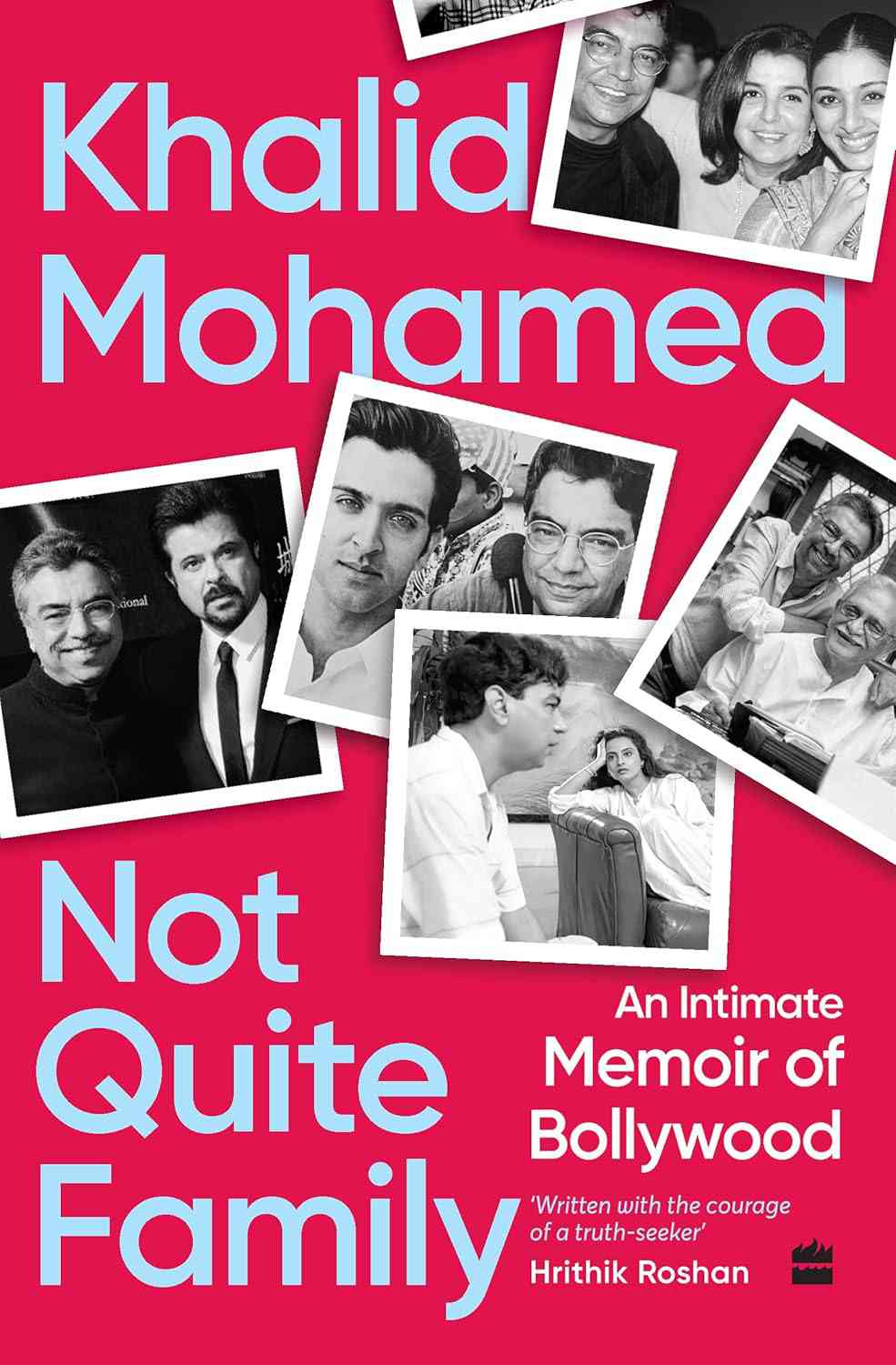
Excerpted with permission from Not Quite Family – An Intimate Memoir of Bollywood, Khalid Mohamed, HarperCollins India,
