








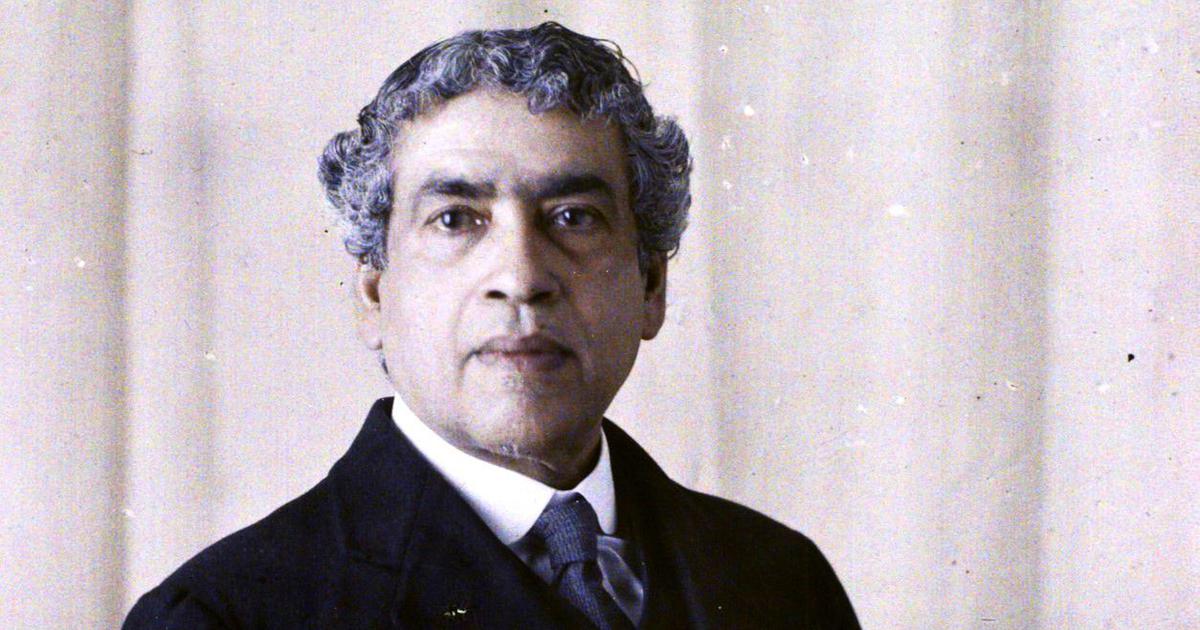
In 1898, Jagadis Chandra Bose acquired a new friend. Margaret Noble (1867–1911), an Irishwoman, had first met Swami Vivekananda in London in November 1895. She became Vivekananda’s disciple even before he left London in December 1896. Noble went to India in January 1898, and in March she was initiated into the Order of Ramakrishna, the monastic order founded by Vivekananda the year before. She took the name “(Sister) Nivedita”. According to Romain Rolland, Vivekananda’s French biographer, she was the first Western woman to be accepted into an Indian religious order.
Nivedita first met Bose near the end of 1898. She was “horrified”, she recollected, to find that there were those “about him” who took every opportunity to prevent Bose from pursuing his work. Presumably, though she does not name names, she was referring to the British authorities and others both in Presidency College and the government. She was “amazed”, she wrote, to see this “great scientific man” working so entirely alone. But Nivedita became more than just an admirer. Soon after she came to know Bose, she became, in effect, his editorial assistant.
Yet, despite her logistical involvement in Bose’s life from 1898 till her death in 1911, Nivedita may have seriously misunderstood the historical originality of his work. Her scientific background may not have been adequate, or her admiration of Bose may have warped her judgement. If Rabindranath Tagore came to misunderstand the nature of Bose’s scientific work, Nivedita may be held partly responsible. In her lengthy letter to Tagore in 1903 – who had apparently requested from her an “account” of Bose’s discoveries – she referred to Bose as the “discoverer of Etheric Waves”. Her knowledge of the history of “Etheric Waves” was clearly at fault. Later in the letter, she spoke of Bose having anticipated, by some two years, the Italian engineer and inventor Guglielmo Marconi (1874–1937). This may well have been one source of a major myth which came into being: the myth of Jagadis Bose as the unrecognised, unacknowledged inventor of wireless telegraphy.
Bose must have been aware of the possibilities of radio telegraphy – that is, communication by means of electromagnetic waves – from the moment he began his first experiments. He may or may not have read the popular article written in 1892 by the English physicist (later Sir) William Crookes (1832–1919) – whom Bose would come to know well later – in which Crookes talked of ‘the bewildering possibility of telegraphy without wires, posts, cables …”
But Oliver Lodge had demonstrated the signalling power of electric waves in 1894 some months before Bose began his own research. And in 1895, Bose had himself publicly demonstrated, with some panache, such communication in the Town Hall in Calcutta in the presence of the Lieutenant-Governor of Bengal. He must also have taken note of The Electrician’s observation that his coherer could serve as the basis for a “practical” system of electromagnetic “light-houses”. And much before Crookes, the relevance of Hertz’s discovery for telegraphy was mentioned by GF FitzGerald in his presidential address to the British Association in 1888.
The origin of radio telegraphy has a convoluted history which historians are still trying to unravel. Bose has a definite place in this history, but by no means the one Nivedita claimed for him and which became folklore in India. On the other hand, the fact that Bose has a niche in the history of the beginnings of radio is a matter which many modern chroniclers of radio telegraphy have chosen to ignore. Bose’s situation is, thus, very curious. On the one hand, a myth prevails in India that Bose “invented the radio” but was not given credit for it in the West; on the other, his legitimate place in the history of radio telegraphy is virtually “forgotten history” in Western writings on the subject. Neither situation does justice to Bose.
To accord Bose a proper place in the history of radio, it is first necessary to comprehend something of the essential nature of the act of invention – its “ontology”. To invent is to create an artificial product – an artefact – which is original in some significant sense. To invent in the realm of technology also entails that the artefact has some significant utilitarian value. Utility and originality are, then, the two litmus tests of technological invention. Technological problems arise primarily from a practical need or from a sense of dissatisfaction with the way the utilitarian world is in some respects. Such need or dissatisfaction is translated into a goal – to produce an artefact which meets the need or obliterates the sense of dissatisfaction. The invention of an artefact is a response to that goal.
Invention is “goal-driven”. Furthermore, the act of invention is deemed satisfactory to the extent the artefact produced satisfies the originating goal. There is yet another important feature of the act of invention: artefacts very seldom arise de novo. Almost every invention builds upon prior inventions. More broadly, every new artefact has a “phylogeny” – a network of ideas, discoveries, principles and other inventions which historically preceded it and influenced, in one way or another, the creation of that artefact. Yet, the elements of the phylogeny of an invention should not be mistaken for the invention itself. That William Crookes imagined the possibility of wireless telegraphy, and that his article may have influenced others who came later, simply means that Crookes’ ideas were part of the phylogeny of some later invention. It does not mean that Crookes invented the radio. Nor did Eduard Branly whose coherer contributed so significantly to later events. Branly invented a receiver of electric waves, not a system for wireless communication.
It is in the light of these factors that the origins of radio and, in particular, Bose’s place in this account must be considered. In the period under discussion in this chapter, he invented transmitters of electric waves and several detectors or receivers of such waves. However, the goal or need addressed by his inventions was not that of wireless communication. Bose invented so that he could discover. His artefacts were instruments of scientific discovery. They exhibited some of the characteristics of a wireless telegraphy system. It is conceivable that had Bose pursued the improvement of these characteristics, he may well have “invented the radio” or some version of it. But that was not the path he followed. It was not a path he was even remotely interested in. The distinction between Bose’s goal and that of Guglielmo Marconi is important not only because it helps elucidate the Indian scientist’s place in the origins of radio, but also because of the light it sheds on the distinction between the respective goals of scientists and technologists in general.
Nowhere in Bose’s scientific papers on electric waves is even the possibility of radio telegraphy discussed – not even in the lengthy and comprehensive Royal Institution lecture of 1897. The need that prompted him to invent his spiral-spring coherer was that the “capriciousness” of Lodge’s metal-filings coherer was “the greatest drawback … in conducting experimental investigations on the optical properties of electric radiation.” His later improvements to the receiver, such as the use of waveguide, lens and collecting funnel, were intended to enhance the receptiveness of his receiver for his polarisation experiments.
Marconi heard of Hertz’s experiments in the course of a summer holiday in 1894 from an article written by the Italian scientist, Augusto Righi (1850–1920), whose lectures he had attended at the University of Bologna. He was immediately drawn to the technological possibility of wireless telegraphy for “signalling across space.” One of his biographers quotes him as saying, years later, that he found it hard to believe that no one had thought of putting this idea into practice.
All of 20 years of age, Marconi began his experiments soon after. Thus, Bose and Marconi, the former 16 years older than the other, began their respective experiments at roughly the same time. They were both concerned with the generation and reception of electric waves, but for entirely different purposes. Marconi’s goal was avowedly technological, and Bose’s, avowedly scientific. The one wanted to develop the “hardware” for signalling across long distances of space; the other to devise instruments for revealing the optical properties of electromagnetic radiation. Marconi’s vocation was what would later be known as radio engineering; Bose’s was microwave optics.
The differences in these goals had inevitable consequences for the later trajectories of their respective pursuits. Bose’s first paper describing his transmitter and receiver was read before the Asiatic Society of Bengal in May 1895. Some time during that year, he gave his public demonstration in Calcutta. For the purpose of this demonstration, he devised antennas attached to both transmitter and receiver. According to his Scottish biographer, he even planned to place one of the antennas on the roof of his house and the other at Presidency College, “a mile away”. But Bose never executed this plan.
In December 1895, Bose’s article “On a New ElectroPolariscope” appeared in The Electrician. That same month, his paper “On the Determination of the Indices of Refraction …” was read before a meeting of the Royal Society. Thus, December 1895 was when the results of Bose’s first experiments and the specifics of his apparatus were first publicly available in England. The issue of The Electrician carrying Bose’s articles (there were three) also carried an editorial noting the feasibility of using Bose’s coherer for receiving communication on a ship, transmitted from shore.
What Bose achieved by way of his Calcutta demonstration in 1895 was a “proof of concept” of radio telegraphy across distances. But then, as already noted, Sir Oliver Lodge had produced a proof of concept in 1894 by way of his demonstrations at the Royal Institution in June and at the British Association meeting in August. So Bose was not even the first to produce such a proof of concept. Lodge had preceded him. Moreover, Bose’s demonstration was, properly speaking, a demonstration that electric waves could be transmitted across appreciable distances – in his case it was 75 feet – and still be detected by his receiving device. There is no indication that the transmitted waves constitute signals, that is, encoding of alphabetic messages.
Oliver Lodge’s public experiment at the Royal Institution in June 1894 also demonstrated the power of transmission of electric waves across space. In his case, the transmitter was placed in the library of the Royal Institution and the receiver in its lecture theatre, forty yards away, with three rooms and a staircase in between. But here too, there was no attempt to transmit “intelligence”. In August 1894, Lodge repeated his demonstration in Oxford at the annual British Association meeting. In this case, the evidence that alphabetic messages were signalled is contradictory.
According to Lodge’s own recollection over forty years later, he claimed to have used a form of Morse code. Based on this and other pieces of evidence, the historian Hugh Aitken believed that Lodge did indeed demonstrate radio telegraphy and that, therefore, he “invented” radio telegraphy. However, another scholar, Sungook Hong, has argued that Lodge’s claim, 43 years after the event, was false; Morse code equipment was indeed a part of Lodge’s apparatus, but it was not used as a telegraphic device but, rather, as an automatic “tapper” to reset the coherer at regular intervals.
As for Marconi, his proof of concept for telegraphy without wires was achieved, according to one biographer, some time late in 1894 when, in the presence of his parents and brother, he transmitted a signal from one part of their house to another and thereby caused a bell to ring. Soon after, he transmitted signals outside the house. He was able to encode Morse code as “dots” and “dashes” in his transmitter by causing long and short bursts of sparks to cross the spark gap. Precisely when Marconi performed his first outdoor experiments is not clear. According to one source, it happened in the spring of 1895; according to another, it was in the summer of that year. Marconi’s daughter, Degna Marconi quotes her father recalling the event years later as the end of September 1895.
Sister Nivedita’s assertion to Tagore that Bose had anticipated Marconi by two years is clearly wrong even in the matter of proof of concept. Strictly speaking, Bose and Marconi had been both anticipated by Lodge in this respect. Bose and Marconi worked on their respective initial experiments at virtually the same time: It is very unlikely that either knew of the other’s work. It is true that Bose’s article appeared in The Electrician in December 1895 – Marconi may well have chanced upon it. But by then the Italian’s own experiments were well underway. And thereafter their paths diverged. Marconi forged ahead in the pursuit of his goal of a practical system for radio telegraphy; Bose pursued the physics of microwave optics.
In the spring of 1896, Marconi had made sufficient progress to move to England with his “secret box”. This was announced by (later Sir) William Preece (1834–1913) – chief engineer of the Post Office, an influential and bitter opponent of the “Maxwellian” physicists who pursued electrical phenomena by way of theory rather than “practical” engineering – at the Liverpool meeting of the British Association, in September 1896 as a “quite new system of space telegraphy.” Indeed, as already noted, Preece made this announcement at the discussion of Bose’s own paper presented at the same meeting, a fact not without some irony in the context of this discussion.
Yet here again, the contrast between Bose’s style, dictated by the idea and ideal of “pure” science as knowledge for its own sake and the manner of Preece’s announcement of a potentially patentable, commercially viable technological artefact is revealing. Bose demonstrated to his British Association audience a “Complete Apparatus for the Study of the Properties of Electric Waves”. The arrangement of the transmitter, the coherer-receiver and other “various accessories for the study of different phenomena” was unveiled. Not only was the function laid bare, but so was the structure. Preece told his audience of what Marconi’s “secret box” could achieve, but revealed nothing of its inner workings – a fact which moved The Electrician to hope, somewhat dryly, that “Mr Preece [sic] will be merciful and before long give the electrical world something more substantial” about this apparatus of Marconi’s “now shrouded in mystery and hidden away in Salisbury Plain.” Bose and Marconi had quite different aims and followed quite different pursuits.
In June 1896, Marconi filed for a patent based on a “provisional specification” of his system. The complete specification for his patent was filed in March 1897 and was accepted in July.

Excerpted with permission from Jagadis Chandra Bose and the Indian Response to Western Science, Subrata Dasgupta, Jadavpur University Press.
