




At the mention of the daen, the 12-year-old boy reappears briefly in the 40-year-old man’s face. Yes, he knows of the daen. He has seen it. The memory is filed away as a scene from a movie.
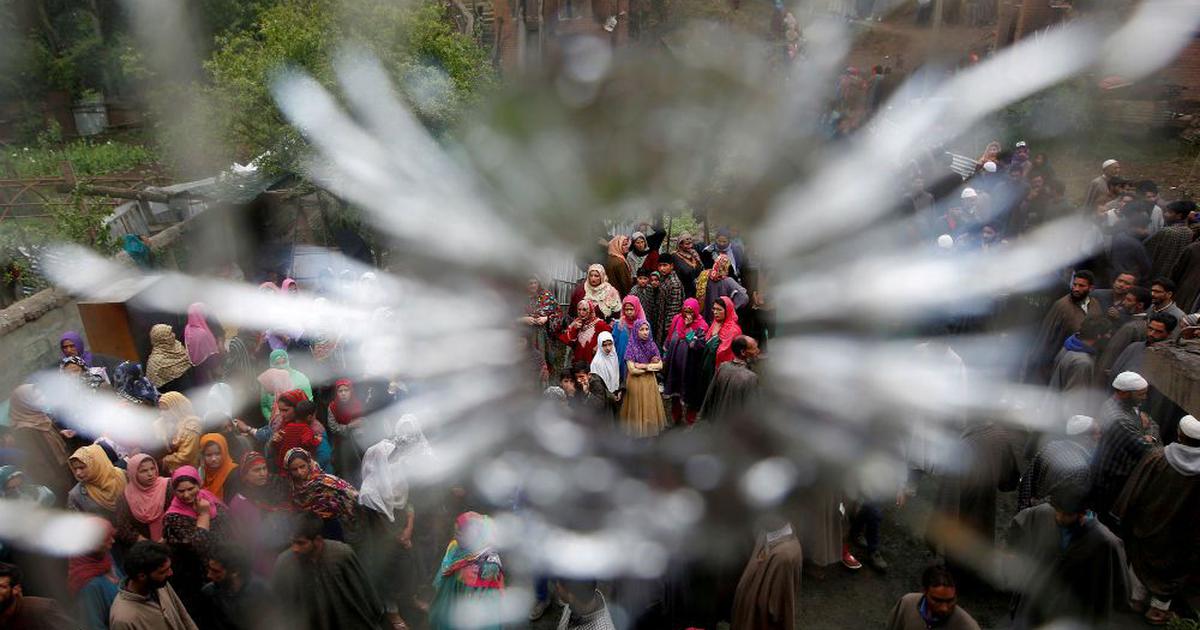
It is night, sometime in 1993. For weeks, ZM and his family have been sleeping in one room on the ground floor. Everyone sleeps early. They live in Dalgate, a neighbourhood in Srinagar where the Dal lake trails off into a channel that meets the Jhelum. It takes its name from the sluice gates that guard the Dal. Their house is in the lower reaches of the Takht-e-Sulaiman, the hill that rises from the banks of the Dal lake and looms over southern Srinagar. They sleep with knives and hammers under their pillows. ZM is very pleased with the small pocket knife he has squirrelled away under his own pillow.
That night they hear something in the street outside. It is a robotic noise, something like a mechanical roar. Everyone rushes upstairs, one of his uncles leading the way armed with a meat cleaver. A window is opened, and ZM sees something leaping away. It reappears about thirty metres away, a black shape clinging to their neighbour’s first-floor window. It did not climb but jumped straight up. Then it drops to the ground in one smooth movement. It is like Batman or some other comic strip superhero.
If he saw it now, he would not believe his eyes; he would laugh.
In those days, no one laughed. Uncanny events were reported. A young man in the neighbourhood had gone out one evening telling his family he would not return that night. But late at night they heard his voice outside the door, his and a woman’s. Something did not seem right, so his father decided against opening the door. When the young man got home the next day, they asked about the nocturnal visit. But I only just got back, he said.
The mountain had always been prone to haunting. Everyone knew the story of the stranger who had turned up at a local supply shop one night to ask for oil. Eyeing him warily, the shopkeeper said he would not let him in but could hand over the oil at the gate outside. The stranger took the oil and lit a small lamp that was perched on his head. When the lamp was lit, the shopkeeper later said, he lost his senses. He must have followed the stranger for he woke up screaming high up on the mountainside several hours later. That would have been a bram bram chok, everyone concluded.
But that was in the 70s or 80s, before the haalaat. This new haunting was different. It started around ten or eleven every night with knocks on the door and stones hurled at windows, forcing families into a single room where they ate and slept or just waited out the dark. If they needed to use the toilet, which was usually in an outhouse in the courtyard, they had to go in groups. It is said, the haunting forced a permanent architectural change in Kashmir. Toilets have moved from outhouses into the main house ever since.
The creature stalking the neighbourhood was called a daen. It was very tall; some said it was three storeys tall. It often wore “spring boots”, weapons-grade footwear that enabled it to jump to the height of several storeys and walk up walls. Many called it a steel daen as they could swear they had seen a metal carapace beneath the black sheath. Others said it had long, steel claws, curved like those of a bear.
Two features of the haunting were noted in Dalgate. First, even the street dogs stopped barking at night. In the morning, their necks were ringed with scorch marks, leading everyone to speculate that the daen drank their blood. Second, many reported that when an alarm was raised, the daen disappeared into the mountain above. A military camp lay in that direction.
“We used to call it a daen,” says ZM. “But this much is certain – it was not a bhoot daen.” It was not a ghostly ghost.
“In a new anti-‘Freedom Movement’ campaign, the authorities have adopted a fresh strategy in which the Kashmiris have been deprived of their nocturnal sleep and rest for about three months now,” says an article in Greater Kashmir dated 19 August 1993.
This would put the date of the daen’s first appearance sometime in May 1993. It started in Bemina, then a suburb of Srinagar, close to the Jhelum river. A “strange dressed creature” was entering homes to molest women and slash men’s faces and bodies, the article continues. When neighbours tried to give chase, they got beaten up.
Curious affinities had been noticed in several localities. When anyone tried to wrestle down a bhoot or a daen, it seemed to disappear into a bunker or scoot off on a security vehicle. In Rainawari, an escaping ghost backed into a mosque and brandished a small gun at an angry crowd before it was rescued by the forces. In downtown Srinagar’s Wazapora, a badly beaten ghost was able to send a signal through a watch-like transmitter before passing out. Within minutes, Wazapora and the neighbouring Maharajganj were under a security cordon, men, women and children dragged out and beaten while the ghost was smuggled away. In Dalgate, the ghost had killed. It had pushed a man off a three-storey building before vanishing into a security bunker.
The director general of police had ‘coolly and blatantly’ passed it off as the work of “miscreants”, the article continues, its sentences taut with rage by now. The ghosts roamed at night. Even beggars and dogs who wandered at night were shot down by the forces; how come nobody had managed to shoot a ghost yet? Quite clearly, this was aimed at creating a “fear psychosis” among people. Some claimed the ghost was a ploy by government agencies to split public opinion and cut down support for the movement. Others claimed ghosts were unleashed at night to provoke militants into reacting. Once they revealed themselves in pursuit of the ghost, security forces would rush to the spot and lay a cordon. The article works up to a grand and blistering finale. “Do they think that in this age of modern technology, Kashmiris would believe in superstitious nonsense like ‘Bhoot’?”
Several articles blaze with the same rage, that Kashmiri stories should be turned against Kashmiris themselves, that they should be taken to be slaves to superstition. They were no longer the illiterate public of centuries past. An editorial published in Greater Kashmir, entitled ‘The Kashmir Horror Show’, is scathing. It seemed the Zee Horror Show, a popular television serial of the time, was no longer “restricted to the idiot box”. Its vampires, which had “developed a fancy for the fairer sex”, now appeared in crowded localities at night, even areas turned into “fortresses” by armed forces. The government had released a statement saying these apparitions were aimed at fomenting disaffection; the editorial writers are plainly sceptical. Unless the government could actually prove who the ghosts were, it could be assumed that these creatures who appeared in curfewed nights were manifestations of another “ill-conceived security gimmick”. Kashmir may be a “land of Fairies and Ginnies”, but it was certainly not a land of fools.
Excerpted with permission from Dapaan: Tales from Kashmir’s Conflict, Ipsita Chakravarty, Context/Westland.
