









Maanas drove his jeep. Samika sat next to him, while Nivaan made himself comfortable in the backseat. The bags were dumped at the back of the vehicle. It was barely 7 am, yet the mid-May sun had already begun throwing fire. The wind hitting their faces did nothing to allay the rising feverish warmth in the air. Maanas reassured them that it would be better once they left the Jaipur city limits and got on the national highway that led to the Aravallis.
Pleasantries were set aside quickly. The comparisons of the cousins’ lives in Jaipur and Delhi were dispensed with, each party thinking that their city was leagues ahead of the other. The conversation would have gained some debating heat if the cousins knew each other better, but their unfamiliarity proved advantageous, and things didn’t escalate to conflicting arguments. But their lack of familiarity had its flipside too – their conversations fizzled out rather quickly.
There was also the question of their ages – at 26, Maanas was six years older than Samika. Plus, their interests were poles apart. While Samika was the studious, introverted kind, Maanas was outdoorsy. Samika’s interests went way beyond what was shoved in front of her eyes; she had the curiosity to explore and find out about things. Maanas, on the other hand, relied on learning only what was needed. Samika wasn’t surprised that her royal cousin didn’t know half the things she spoke about – not many did – but she didn’t expect him to be so reticent and, in fact, boring.
If this had been a date, Samika would have walked away by now, citing some excuse. But this was family; it had to be endured.
Soon Nivaan went back to his phone, muttering something about making the most of it till it had network, and Maanas focused on driving, with old romantic songs blaring on the jeep’s radio. Samika now had time to think and contemplate; she could not recollect the last time she had been on a trip outside the city.
“The haveli, Maanas,” she said, breaking the silence between them, “tell me about it.”
“It’s a haveli like a haveli.” Maanas lowered the volume of the radio and laughed. “Endless rooms and windows, the smell of dust and damp everywhere. Quaint, maybe not suitable for your modern tastes. The wires are old, the switches are those round push-up-push-down ones, the metal bathtubs and faucets are all ancient. There’s a lot of art everywhere – statues and paintings and all of that.”
“Art…art is nice,” Samika said. It was a sufficient answer to the question, or a good description, rather. But there was no soul in it. Samika had had enough experiences with Nivaan who needed everything to be spelt out explicitly. Maanas seemed to be an older version of Nivaan.
“I have also heard some nasty stuff about it,” she said. Maanas’s cheer deflated like a balloon. Samika observed his profile as he stroked his fashionably manicured beard, as if deciding on a response. “What have you heard?”
Samika chose her words carefully. “There’s talk about an ancient queen who is still in the haveli.” In the mirror, she noticed that Nivaan had fallen asleep.
Maanas’s eyes narrowed for a moment, but otherwise he did not flinch. “Yes, I know. I have heard those stories. There are tons of websites mentioning our haveli as a haunted location, some even listing it among the top ten haunted havelis in India. But, let me put it this way,” he said, his eyes on the road. “I’ll be happy to see the haveli get converted into money.”
“So you believe the legend is true…”
“Over the past year, Papa has been sending me to Samantipur often,” Maanas said. “He was hesitant initially, but since the offer for the haveli’s purchase came along, he has become more casual about it.”
“What happens at the haveli, Maanas? I don’t believe in ghosts, so you may feel free to tell me.”
Maanas’s face darkened. For a moment, he lost control of the steering wheel. Struggling to bring the jeep back in control, he said, “I don’t know what to tell you. I mean, you shouldn’t be hearing this from me.”
“Hearing what?”
The atmosphere turned deathly silent as Maanas uttered in his slow, calculated baritone, “The Maharani is very much in the haveli; that much I can tell you.”
Samika realised that she had stayed silent too long.
His pronouncement shook her; it made things all the more real. “What do you know about it?” she said, shaking herself out of her stupor.
“Okay, it’s a long drive, and since we are headed there anyway, I better tell you about it. I don’t want to scare you unduly but consider it a fair warning. Things are going to happen at the haveli. Weird things. It’s better you be prepared.”
Samika couldn’t say if her cousin was scaring her silly or simply stating the truth. “Tell me then,” she said. She turned slightly to face Maanas, loosening her seatbelt a bit.
Maanas kept his eyes firmly on the road ahead and began.
“Our great-grandfather, Maharana Ambuj Pratap Ruhera, ruled Samantipur in the 1920s. Samantipur was an independent princely state then, its governance extending to about a hundred small villages. The British did not interfere much in our local politics. They did not care for the small, isolated princely state tucked away in the hills. Ambuj Pratap was married to the daughter of a king from up north in Himachal. She was Maharani Urvashi, the infamous queen of the haveli and now its resident ghost.
“Maharani Urvashi was as talented as she was beautiful. She took great care of the haveli and the Maharana and participated in the affairs of the kingdom. She held meetings with the farmers and settled disputes. She was quite loved. But it didn’t last.
“Maharani Urvashi had a daughter, Anamika. When she turned twenty-one, Anamika went missing. Since that day, it is said, Urvashi was never the same again. Somehow, she got it into her head that her husband, the Maharana, was behind her daughter’s disappearance. She descended into insanity. She would scream and throw things and attack the servants. One night, she woke up in bed and bit her husband so brutally on his arm that a chunk of his flesh came away in her mouth. It must have been horrifying for the Maharana to wake up from sleep in blinding pain and see his wife with a bloody piece of his flesh in her mouth. From that night, the Maharani was kept confined in a room on the fourth floor of the haveli. Sometimes she’d have more violent spells, and she had to be kept restrained too. The servants were terrified to go on that floor, which echoed with the Maharani’s screams and abuses.
“To further complicate matters, Ambuj Pratap married again. His second wife was Pallavi – Chhoti Maharani as she was called – our great-grandmother. Within a year, Pallavi bore a son, Karanveer. For this whole year, Maharani Urvashi was confined to her room. The Maharana never asked about her; the servants took care of her as much as they could. Even while she was alive, there were rumours that the Maharani came out of the locked door somehow and walked the corridors at night.
“Maharani Urvashi came to know that Ambuj Pratap had married again and had a son. When Karanveer was a year old, the Maharana organised a huge celebration to announce Kunwar Karanveer as his heir. This celebration was held in the haveli’s lawns and all the neighbouring royalty and even a few British officers were invited to the event. But this joyous occasion turned into a devastating tragedy.
“The Maharani was to be kept fettered in the fourth-floor room during the ceremony, but the servant forgot to lock the chains. Hearing the music and fanfare below, and witnessing the spectacle of Kunwar Karanveer’s coronation from the window of her room, the Maharani snapped. Letting out a tirade of the worst abuses ever, she blamed the Maharana for hatching a conspiracy to murder her daughter and marry a younger woman so that he could have a male heir. Then she broke out of her room and charged up to the haveli’s terrace, the iron chains dragging behind her feet.
“From the lawns below, the hapless royal and imperial guests looked up at the Maharani, now maddened with rage, standing on the terrace. She tore her hair and clothes and spat on the people in the lawns, shouting that she would lay a curse upon the entire Ruhera dynasty. That she would kill herself but never die. That she would make sure every male member in the family would die a violent death, but she would prolong the curse for generations. So, the men would die only after they became fathers of sons, so that the surviving son could grow up and the curse could continue into the next generation when he became a father. And then she jumped off the terrace and killed herself. Those weighty chains on her hands and feet ensured she fell like a heavy rock.
“Despite being cremated with all the proper religious rites with fifty-one Brahmin pundits in attendance, the Maharani’s soul did not attain salvation. She was sighted in the haveli by the servants shortly after her death. Within days, Maharana Ambuj Pratap fell prey to a dreadful sickness. Pieces of flesh began to shed from his body at night, as if bitten off. His body was soon full of gaping wounds. Driven to insanity himself, he claimed that the ghost of the Maharani came to him every night and bit his flesh off, just as she had done once when alive. He died shortly thereafter. His corpse was found on his royal bed, full of blood, his limbs contorted at an impossibly bizarre angle…”
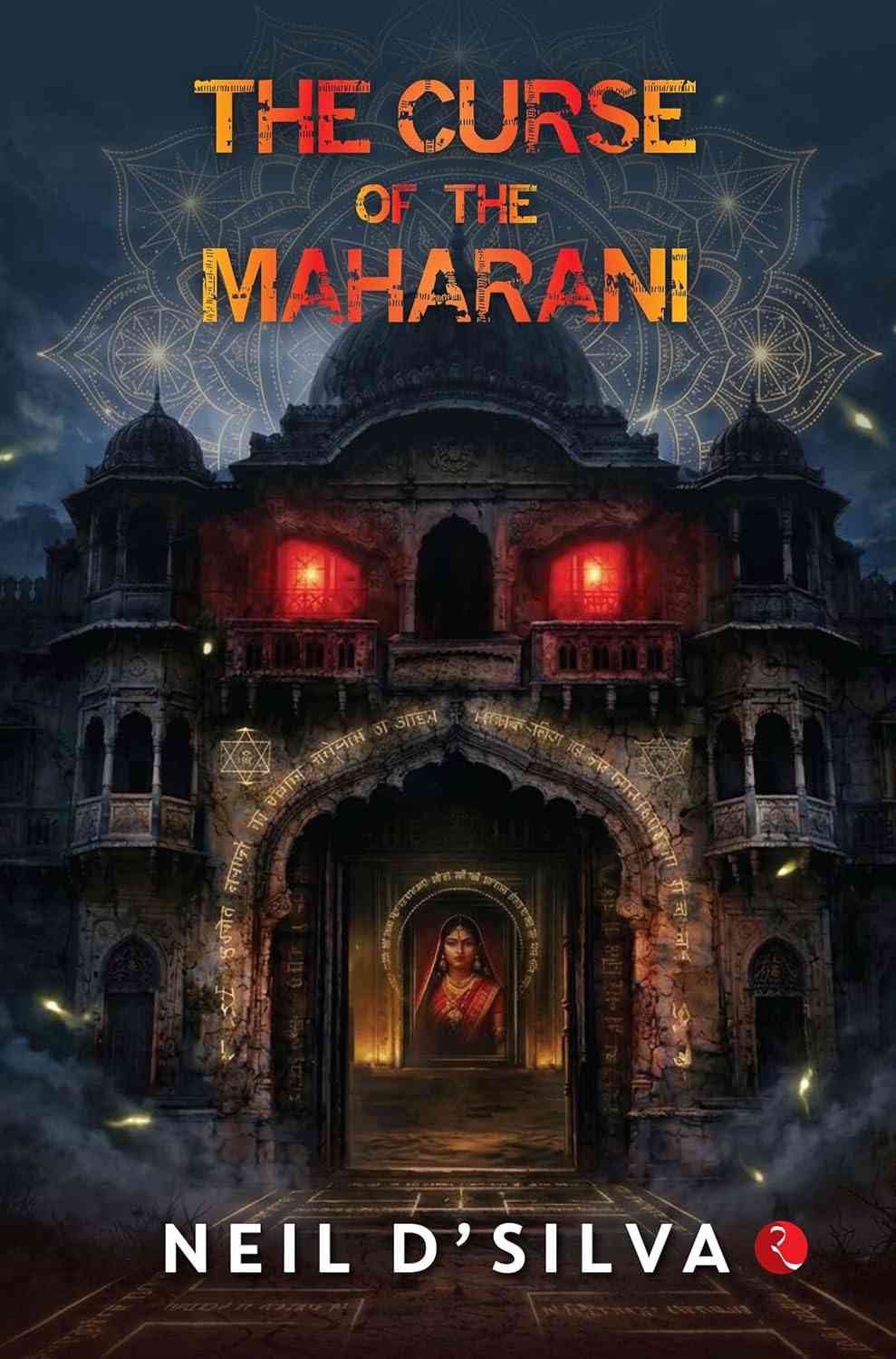
Excerpted with permission from The Curse of the Maharani, Neil D’Silva, Rupa Publications.
