











The genre-cum-aesthetic of “Dark Academia”, once familiar only to Tumblr users in the 2010s, has garnered a wider fanbase since the pandemic. Its trademark features include candle-lit libraries that house sinister spell-books, towering gothic buildings with castle-like silhouettes, and gloomy winter nights that amplify the inherent moodiness of dark academia. Darkness, as one can assume prosaically, is inherent to the style, and at the core of this narrative template is the veiling and unveiling of secrets.
Although academic institutions continue to exist in the real world, the genre itself operates in a time that is relegated to the past. While Rebecca F Kuang’s latest work Katabasis does technically align itself with this particular aesthetic-tenet, the message of the novel speaks to some timeless – and ugly – truths of these institutions.
Kuang is no stranger to the world of academia. She completed her master’s at Oxford, got an MPhil from Cambridge, and is currently pursuing her PhD in East Asian Languages and Literature at Yale. Outside her personal life, her previous work too has explored (and deconstructed) the alluring realm of academic institutions. Set in Oxford in the late 19th century against the backdrop of the British imperial empire, Babel, or the Necessity of Violence (2022) develops an intricate critique of how academic institutions generate structures of power through the guise of knowledge. The novel also offers a compelling (and dare I say radical) perspective on the stakes of decolonisation, and the dual role played by translation in sustaining and undoing the Empire.
Journey to Hell
While Babel offers a macro-level perspective of the institution at large, Katabasis is an exposé of the discomforts embodied by the grad student in all their manic glory. We begin with a conundrum: Alice Law, doctoral candidate of Analytic Magick at Cambridge, has accidentally killed her academic supervisor, Jacob Grimes. However, beyond the moral concerns of having committed manslaughter, Alice has more significant problems to contend with. As any grad student will attest, Alice cannot possibly live on without her committee chair – his existence is the essential requirement to her long life as an academic. So she arrives at the most common-sensical solution to the mess she put herself in; Alice will journey to Hell and bring back her professor. Cakewalk.
Unfortunately for Alice, she has some unwanted company. Peter Murdoch, Professor Grimes’ other advisee and Alice’s sworn academic rival , has decided to tag along, for he too understands that the death of his advisor, especially one as reputed and well-connected as Grimes, essentially implies the death of his academic career, and by extension, himself. What follows is the duo’s descent into the domain of Yama, a journey that will unravel everything they thought mattered and leave them hanging on the edge of losing their minds. Repeatedly.
“They made camp in the shadow of the wall. The literature had been split on whether day and night existed in Hell – the more dramatic accounts claimed endless night- but it turned out that the too-dim sun did eventually set, and the air did chill, and about half past six Cambridge time (Alice’s watch still worked) everything turned pitch-black. It seemed Hell had no moon, or if it did, she was hiding. They sat alone in the solid dark, and their only comfort was the silence – for if anything lurked beyond, at least they did not know.”
What is particularly striking about both Babel and Katabasis is Kuang’s ability to introduce elements of fantasy almost matter-of-factly. As readers, we are not held hostage to learning in depth the workings and limits of the magic worlds in her books; we are eased gently into it, and adapt to its logic intuitively. Rather than get carried away with the spectacle of High Fantasy (which is not to be scorned upon by any means; only when used as a distraction from a lack of storytelling), Kuang leans on fantastical elements as tools to help address very real, familiar, and tangible concerns in new lights. Babel had its silver, and now Katabasis has chalk.
The decision to use chalk as the source of magic for a novel about students and professors at Cambridge in the ’60s is such a delightfully aesthetic one. Poetically speaking, chalk, as an instrument of writing that seeks to share and transmit knowledge (through blackboards in classrooms), does hold a magical capacity in a very real sense in the lives of lovers of learning. As the one writing on a blackboard, we momentarily hold power in determining what kinds of knowledge will be taught and hence, as well as what kinds of knowledge will not. Chalk in the novel operates under the same premise as it does in real life – except, of course, that unlike in real life, what is written out in chalk could potentially end up acting as a portal to the underworld. Chalk derives its magical qualities from being composed of the remains of prehistoric sea creatures, operating as “a link to the abyss of the remote past, the natural product of the forces originally possessed by the substance of the universe”.
Perhaps by having been so deeply ingrained in academia herself (most notably the Oxbridge prestige), Kuang has an uncanny ability to draw the reader in by aestheticizing and romanticizing the attractive aspects of the world. At first, Babel seems to promise the glory of the payoff of having worked your entire life to get into your dream university. In Katabsasis, we are roped in from the very get-go by the most hallowed trope of all in the genre (especially for young readers who have had a history of shamefully devouring Wattpad novels in the dead of night)- academic rivals to lovers. Kuang delivers a masterstroke, strategically dropping all the signs of these well-known and deeply loved narrative templates, only to turn our bibliophilic lust against us by revealing the horrors that lurk underneath.
The background academic-rivals-to-lovers trope also indirectly sets up a comparison between the more prominent romance in the novel- that of Alice’s with academia itself. Unlike her relationship with Peter (while turbulent in its own ways), what we see in Alice’s relationship with her work cannot quite be characterised as love. To anyone who doesn’t suffer from the same affliction, it may even seem like masochism. Kuang signals the nature of this relationship at the very beginning by invoking Plato, in which he conceptualises something very much akin to what later came to be understood as the death drive by Freud and other psychoanalysts: “For I deem that the true votary of philosophy is likely to be misunderstood by other men; they do not perceive that he is always pursuing death and dying”.
Soul-sucking academia
Kuang’s descriptions of how Alice’s mind functions are particularly discomforting for those who are similarly (toxically) attached to their work – especially other students. In many ways, the novel documents the network of lies we tell ourselves to cope with just how much suffering our studies demand of us. The source of suffering isn’t necessarily located in one’s workload, but in the emotional and mental circus that students perform all to impress and remain in the good graces of their professor.
Granted, at times, this may be a product of self-imposing hardship for the sake of being overworked, which has become an aesthetic in and of itself- skipping meals, foregoing sleep, surviving on ungodly (certainly unhealthy) amounts of coffee, the promise of someday being able to quote Heidegger correctly, and Spotify’s “40 Hz Binaural Beats for Focus, Memory, and Concentration”. There is a gross neglect of the body, as it is rendered a mortal inhibitor to how much knowledge one can master in a finite lifetime.
When everyone around you performs being un-bodily, our own muscles and bones begin to weigh down like titanic anchors holding down a dinghy. Alice repeatedly expresses a desire to be rid of her somatic self and exist purely as an unburdened mind, free to consume information endlessly. Despite her best efforts, she is unable to efface herself.
Alice’s portrayal suggests that, beneath it all, there are greater currents that our supposedly “personal” masochistic inclinations feed into. What Katabasis reveals is that academia, despite its insistence on being superior to the corporate world, thrives on, at the very least, a small degree of sucking the soul out of its patrons. Especially in the era of neoliberalism, where the mantra is to maximise productivity at all costs (pun unintended), there appears to be a tangible shift in the very mentality with which students engage in their higher education.
Even if not overtly encouraged, this approach certainly isn’t sufficiently scrutinised. The provocation then is that even those who teach subjects that are invested in progressive notions of equality and unpacking/questioning power may be engaged in the internal systemic violences of academia, perhaps even wilfully becoming non-practicers of what they preach.
The authority to which Alice must submit to in Katabasis is that of Professor Grimes. The novel makes it quite explicit how influential (particularly male) academics manipulate their positions to extract their students’ labour, capitalising on their mindspace with taunts of recommendation letters, positions in study groups/labs, and coveted invites to exclusive dinner parties. Rather than characterising Alice solely as a victim of a system, Kuang turns the gaze back onto the figure of the student and reveals our complicity in willingly submitting ourselves to being treated in this manner.
In this regard, we can draw parallels between Alice and June Hayward -the protagonist of Kuang’s other best-seller, Yellowface (2023). When it comes down to their self-preservation in their respective domains, neither Alice nor June are too phased by breaching standard ethical norms. Alice is not necessarily a likable character- but whether we like it or not, she is relatable. Especially for those of us who study power and ideology, we blind ourselves to the hierarchies we entertain, maybe even participate in, for the delusion of someday becoming a professor emeritus at an Ivy League-equivalent.
“[M]agicians lived in air, dancing on tentative staircases of ideas, and it was a source of endless delirium… All it took was to tell a lie- and to believe despite all the evidence to the contrary, that all the rules could be suspended. You held a conclusion in your head and believed, through sheer force of will, that everything else was wrong. You had to see the world as it was not”.
And it is this description of how magic works as per Katabasis that it all comes down to; the fantasy we coax ourselves into believing that comes in the way of challenging, even revolutionising the institution of academia. In recent times, both inside and outside our country, we have borne witness to the upsetting priorities of premier academic institutions. Even those universities that have proclaimed to be the torchbearers of progressive thought have either stood still and watched their students and faculty be targeted by external authorities or have taken their punishment into their own hands. The standard excuse, practiced and delivered to perfection, is that no one or nothing is above the law. But what happens when a democratic society en masse begins to take the legal world of a particular moment as absolute and final? And whatever happened to education being the instigator of such change?
Taking both Kuang’s academia-inspired novels together along with Yellowface, we begin to understand the tapestry of systemic violence that govern the processes of knowledge production. Through Babel, we begin to reflect on the intentions of academic institutions and how challenging it is to disentangle them with those of coloniality. In Yellowface, we learn about the games of performativity involved in the publishing world- the space in which it is determined what kinds of knowledge, from who, are deemed acceptable for broader access and in what form.
Now, with her latest work, Kuang forces the reader to acknowledge that the supposedly noble pursuit of knowledge - at least as it exists today - necessarily requires those participating in it to dabble in some dubious modes of perceiving themselves and those around them. The message of Katabasis cuts like a knife through butter: accountability begins with the students. Only once we wake up to the cruelty, perhaps even insanity, that we come to prioritise can we even begin to dream of revolutionising academic institutions.
Pulari Meera Baskar completed her undergraduate from Ashoka University with a double major in English and Political Science, and her master’s in Anthropology from the University of Chicago. Her academic interests include identity politics, film analyses, and literary theory. She currently works in the public education sector in Tamil Nadu.
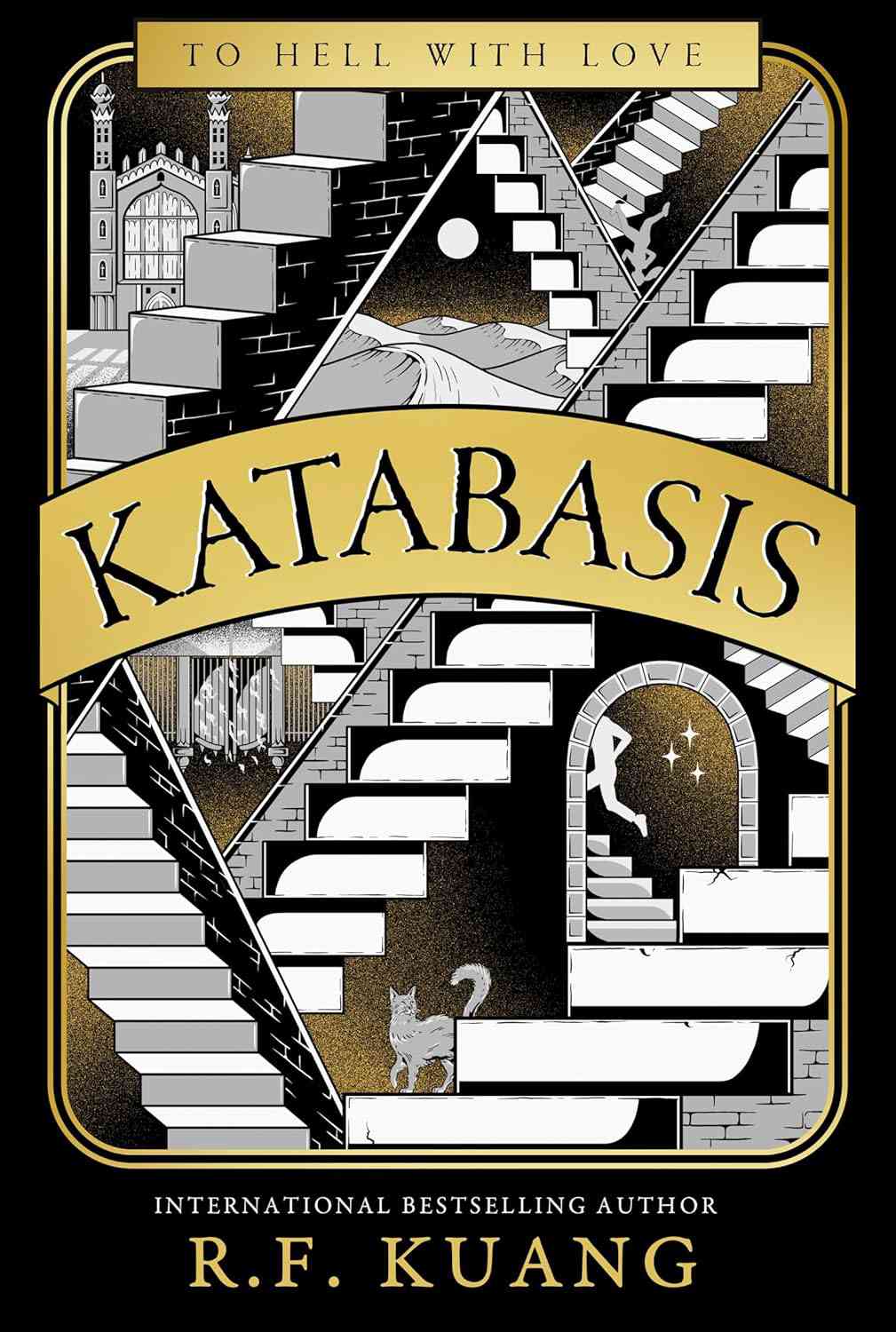
Katabasis, RF Kuang, HarperVoyager.
