







Why Would I Want Daffodils When I Can Have Sunflowers?
What meaning do “dadfodils” hold for a Tamil girl
whose first association with flowers was ammama’s fingers
redolent with jasmine and white cotton thread?
I know the cheerful yellow of an entire field of sunflowers,
glowing, growing on a summer’s day, more than ten thousand
at a glance.
But the English textbooks are not interested in my experiences.
They want me to appreciate woods on snowy evenings when
all I’ve ever enjoyed is the warm red oxide terrace and ghost stories
in the moonlight.
There is injustice in a language that does not reform,
that does not re-form,
that just continues.
I tell my students the rain smells better as mannvasanai or mitti,
not petrichor.
That a river sounds like an angry family confronting
star-crossed lovers.
It does not only babble or roar.
That poetry often falls short to explain
matters
of the heart and soul.
But that we still have to try.
The injustice of language is that it assumes
it knows best.
Occipital Stroke Observations at Ramzan
My father dreams in Urdu.
He asks how to read the English paper –
right to left, he starts.
Co-mmand.
ees.
After the fact, he has forgotten:
The days of the week.
The word for sugar. And water.
Where he lives. What he ate in his last meal.
The family cat and the dog.
His friends from a few years ago.
The names of his daughters.
He uses words to fill in the spaces in his speech.
Item
Advertisement
Unit
At 77, my father has discovered “appalling.”
His eight degrees look on from the walls,
patiently waiting for him to catch up.
No Place Like Home
In a poem I wish I’d read as a child,
a math teacher does not chastise me.
A tuition teacher does not pity me as I struggle to make sense
of logarithms and debentures, my dyscalculia sitting
on my shoulder, switching addends and numerators,
making light work of the heaviness in my head.
In this childhood poem, history is a trip, geography a voyage
and language a way to understand,
not abuse.
Holi is not marked by terror,
friends don’t leave for others,
and a boy gifts
me a porcelain heart.
I long for a place I’ve never known.
Where the bathroom light is on
the inside
where I ride a blue cycle and don’t fall off.
Where I am pretty enough, smart enough.
Just. Enough.
Where I am safe.
From neighbours who pretend.
From men who want to teach me.
I long for a place I’ve never known.
Where my first kiss is not onion-scented,
darkroom demoned.
Taken.
Without my permission.
Fever Poems
Bless these hours of wait.
As I wait by the phone, millions dream of home.
These days, they play tag, and the spirit, is a chequered rag.
What of this wearable pain?
It is sought out, and found wanting again.
This love is hardly unreachable.
It is not a village, after all, and these fingers are not feeble.
There is no mirage on the road.
I see faith, and it worships alone.
The dun road is bleached white.
The sun shines; the desert is respite.
The family has abandoned all pretence.
A glass of water is the map reference.
At home, the steel wool is an intractable beast.
It plays spoilsport to a game of ease.
The vegetable garden is stripped bare.
The carrion, consumed with care.
high above
sarus cranes take flight
on empty wings
Body of Work
for Keki Daruwalla
Have i written every love poem that i could write
about, “the man who always leaves?”
Have i written about that tooth enamel
intellect that hurts when you swallow
About those coloboma eyes that make you trust
the old trope of window and soul
Am i done with surgeon fingers
that expertly extirpate castles in the air
Have i remembered that razor-edged scapula
that gently shoves words out of lips
Did i forget that Jumper’s Knee that rose
when you changed direction
And those Meniere’s ears
that misheard sobs as salutations
Perhaps i have already spoken about the flora
in the gut, the borborygmus that desire awakens
That gout slowness of limbs, not yet satiated
and yet reluctant to roll over and reach
i am certain to have spoken about the femur-length
love some think they possess, but don’t.
The skin of this love poem is grafted
on other poems,
this anatomically inaccurate
heart.
Cornflower Caresses
In Coonoor, childhood tumbles
down a hill to find its way home.
The cobra lily has made a comeback.
The gardens are bursting with crowds and
the commotion hurts delicate
camellia ears.
The varki is especially good
with a tumbler of cardamom tea.
The churches see more charlatans
than the courthouse.
The temples clamour for
your sleep on a cold morning.
The cold is
a man with a mind of his own.
A ghost
lives in the castle behind your house.
These hills call out to you.
And the kurunji is a perfect
lover.
It appears so rarely, almost reluctantly,
in a burst of Crayola blue
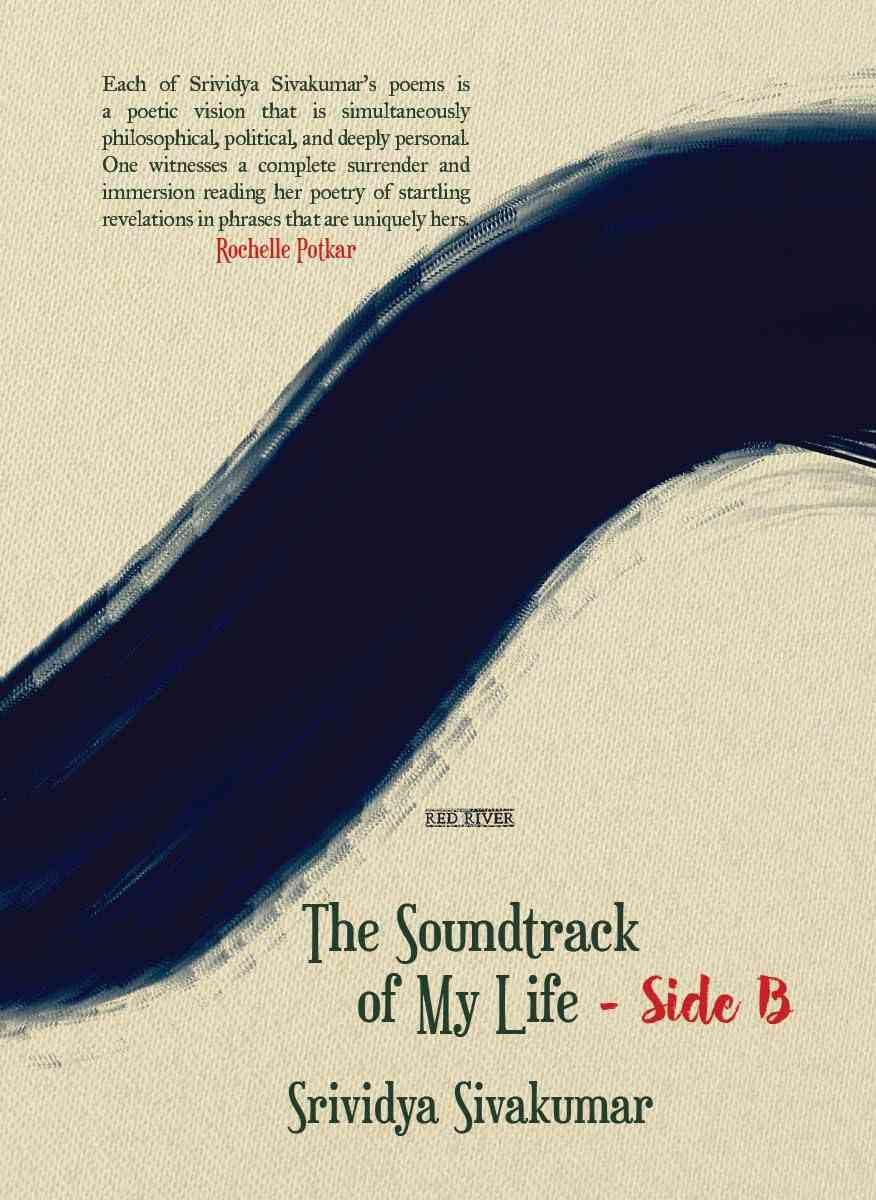
Excerpted with permission from The Soundtrack of My Life – Side B, Srividya Sivakumar, Red River Press.
