






Durga Puja in Kolkata got into the UNESCO’s global representative list of the Intangible Cultural Heritage of Humanity in 2021 but its significance as a cultural phenomenon goes well beyond its inscription in a tag. Over the years, celebrated artists of Bengal (along with unsung but equally brilliant artisans) have actively participated in the Pujas to provide an aesthetic edge to the idols and puja pandals that turned the usually drab city to a wonderful assemblage of installation arts.
Creating an immersive experience
It seems like a recent phenomenon but the tradition goes way back to 1975, when the celebrated painter Nirode Majumder was involved in shaping the idol of Ma Durga for Bakul Bagan Puja in Kolkata. Later, a generation of artists like Shanu Lahiri, Meera Mukherjee, Bikash Bhattacharyya, Niranjan Pradhan, Isha Mohammed and others artistic (re)created the idol at various pujas across the city. The turn of the millennium marked a shift, as artists like Bhabatosh Sutar, Sanatan Dinda, Partha Dasgupta, Susanta Pal, Pradip Das and others went beyond mere idol-making, increasingly got involved with every aspect of work around the pandal to create a theme-based presentation. They actively involved trained art-college students who would collaborate with craftsmen to provide an immersive experience for the spectators. It has now become a norm that every Puja committee has an artist under whose guidance thousands work with a substantial budget for almost a year to create a visual “experience” – a spectacle that draws millions every day from Mahalaya onwards. This year is no different. Different Pujas under the watchful eyes of artist mentors have reimagined idols, artisanal innovation, imposing structures, visual pyrotechnics, and even spectacular performances that defy commonplace imagination.
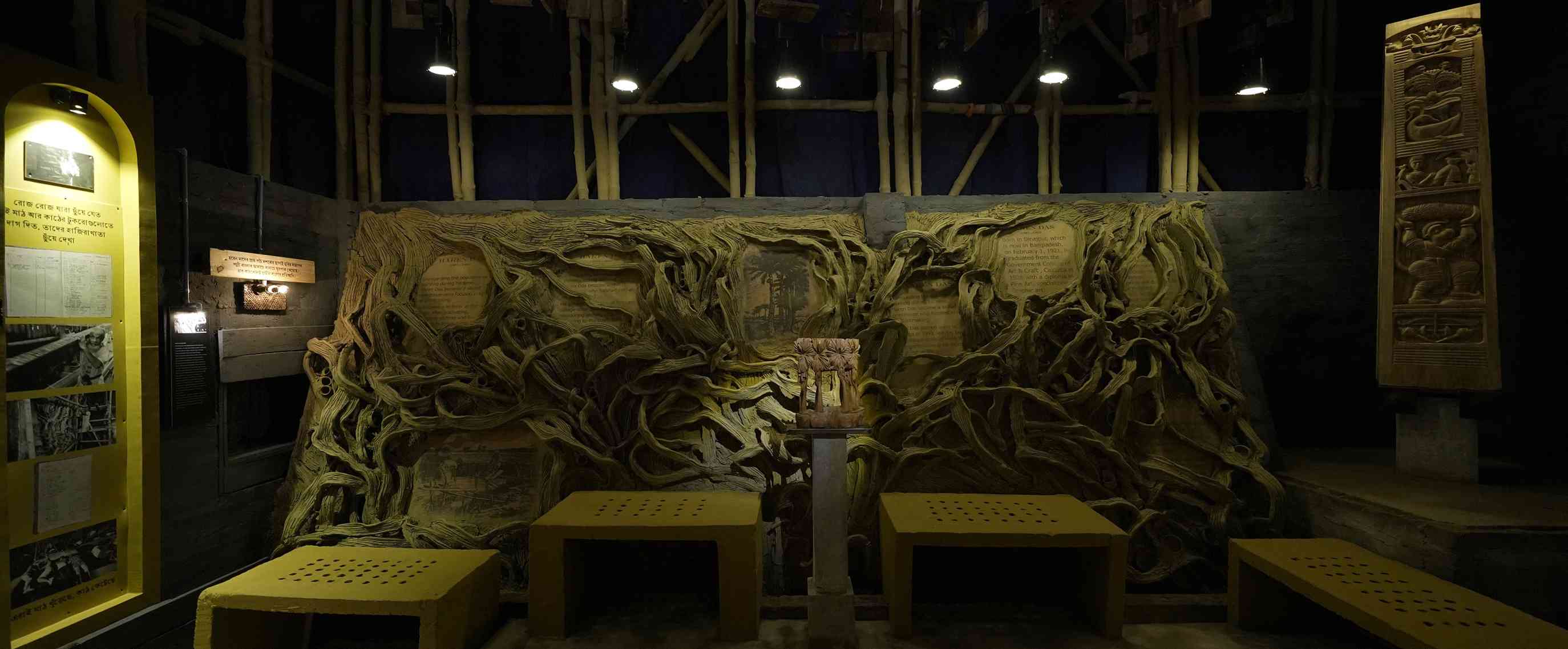
Then what is so special about a particular puja organised by Purbachal Shakti Sangha under the mentorship of Partha Dasgupta? To me, it signals a silent shift in public art practice that may get lost among the noise of pomp and grandeur. For the first time, I saw a separate gallery space created for seven individual artists, each working independently, following a cue from the mentor, to evoke the memory of the legendary printmaker Haren Das (1921–1993). Dasgupta has taken the word “barowari” (the Bengali word for “collective”) literally and metaphorically to showcase old and new artists working in their respective media to contemplate on the post-memory of Haren Das’ engravings, linocuts, etchings, lithographs and especially woodcuts. What stands out is the seamless way in which “the galleries” created at multiple levels of the “excavated” site merge together to provide a holistic experience for the audience. Dasgupta has also imitated the processes that form the nuts and bolts of an art gallery show within a space which is normally meant for a religious congregation without compromising on the spiritual dimension of the puja itself. He has virtually dragged the artists’ studio out from the closet to unravel a normally quiet, reticent private space to the public. It is a bold move in a world where everyone else is looking for a visual feast.


The project, in itself, is a structural engineering feat. Nirmal Mukherjee, the Secretary of the Committee, explained that the allotted space was first “excavated” and then gridded with 4500 bamboos and iron supporting props with practically no pillars to facilitate an unhindered field of vision. It creates a sense of hidden vertical space as the spectators navigate different levels of height while seeing the works of art before they finally get to see the idol.


‘All those who toiled with sweat’
The title of the work – “Māṭkhodāi Kāṭkhodāi” (Etching the Earth, Carving the Wood) – fuses the terminology associated with the technical processes that an institutionally trained woodcut artist like Haren Das would employ and a traditional idol-maker would use in order to give form to Ma Durga from a clod of earth. It also links the “labour” of a farmer/worker who tills the land, which leads to the cycle of crops being planted and cut. The fact that everyone – whether an artist, an idol-maker or a farmer dig, reshape raw materials (earth or wood or even cloth), acts as an umbilical cord to the entire project. It is aptly dedicated to “all those who toiled with sweat.” Significantly, Durga Puja is also associated with the season of harvest and the rural labour of harvest is thus integrally bound with it.


Art researcher Debdutta Gupta, who calls himself a “kathakar” (story-teller), explained the rationale to choose Haren Das as the bridge-artist who triggered a bigger idea of an art that breathes and perspires at the same time. His woodcuts of men and women working in rural Bengal (he originated from Dinajpur) were ironically done at his city studio in Kolkata. Although most of his famed works depicts bucolic scenery, one particular woodcut shows the ominous fumes of factories looming in the background. So when the individual artists were given the brief by Dasgupta, they could use contextual imagination to play around the images and contemporise them. That helps their art to have an imprint of the times we live in although they are playing on the similar remnants of left-over memory that Haren Das may have in his own work.
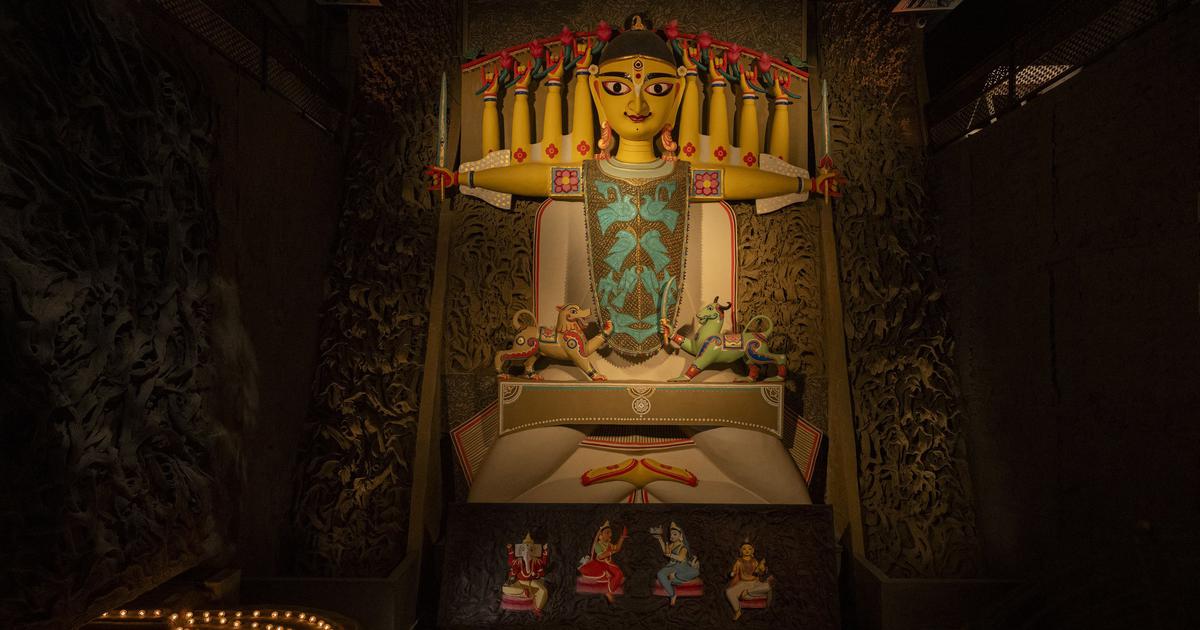
Dasgupta ensured that the curated artists have a signature of their own, which in normal circumstance is regarded as incongruous to a dominant theme that binds a project together. Ashish Ghosh, the veteran sculptor and engraver sprang a surprise with imposing vertical and horizontal woodcuts blocks that transformed the rural vista into a three-dimensional work of unusual density. Equally exciting is Bijoy Chowdhury’s photography where he is able to find metaphorical equivalent of Haren Das’ frames though his lens in urban surroundings. It is medium that is unlikely to be equated with a project of this kind but it fits in beautifully within the ambience. Tanmoy Chakraborty’s panels, using veneer ply and gammari wood, features the figure of Shiva as a farmer. It is installed cleverly to read like a sequential narrative of labourers in different scenarios. Sayandeep Kanshabanik’s acrylics on 14x 16.5 ft canvas, hanging from the ceiling, is an intricate geometry of foliage that can eerily look like excess garbage, giving a strange sensation of visual overload. It also gives a peek into the afterlife of seemingly useless things. Partha created a no-man’s land-like space within iron girder which houses the prints of Sourav Bandopadhyay made iridescent by the light design of Soumen Chakraborty. Milton Bhattacharya’s printmaking in cloth is an ode to his experience as a performing artist. Just like the studio, there is also an artist-in-residence, Abhijit Halder. Picked by Dasgupta after seeing his art as an external examiner at the student exhibition in Kala Bhavana Santiniketan, Halder’s huge 20 x 10 feet panels of sinuous earth with pots made from fire clay integration binds the space together. Even, the idol, that Dasgupta himself designed, takes inspiration from wooden doll-makers of Nabadwip who shifts to clay during the Pujas while giving form to the Eternal Mother. Dasgupta and his researcher friend Gupta got hold of one such person, Suman Karmakar who gave final shape to complete Partha’s vision.




“What spurred the selection of these particular artists and the medium that they work on?” I asked Dasgupta. He replied rather facetiously, “Everything is so organic about the project that I instantly knew who may work in the space(s) that I have created.” However, the amount of research, and hard work that he put behind this project, made it difficult to believe that the selection process was that smooth. It must have taken years of observation and intuition to home in on these particular group of artists. Moreover, it is not easy for someone who is India’s leading ceramic artist and sculptor to relinquish his control over space(s) within the pandal and give authorship to fellow artists and revel in shared glory. He effortlessly slid into a different role of a curator-mentor of the project. His meta-imagination galvanises everything but he also takes a leap in belief to provide space and identity to fellow artists.
The committee members of Purbachal Shakti Sangha deserves a lot of credit as well. Arijit Das Thakur, the president of committee, said that they are giving a scholarship of Rs 50,000 to a chosen artist to work on their project in an independent capacity. This year, Rahul Sarkar, specialising in Printmaking, of Kala Bhavana Santiniketan won the award. Again, the aim is to imitate the gallery practice of nurturing young art talent. Rituparna Roy, an art enthusiast, sums it up succinctly, “This kind of project starts a new conversation between the Puja pandal and the artist’s studio. Dasgupta has now assumed the role of curator. And the club, in a way, took on the role of an academic institution by supporting the independent practices of the artists. The artists displayed their work, interacted with a huge audience who usually don’t visit galleries.” This project also gives way to interesting possibilities in the way the afterlife of art objects can be thought of. It is a pity that the temporary installations are dismantled and disposed unceremoniously as there is little possibility of keeping them permanently within any space where people may admire them all round the year. “Māṭkhodāi Kāṭkhodāi” may well be distilled into a standalone art exhibition within a gallery setting where all these art objects can stand on its own, even without the divine presence of Ma Durga.
Photographs by Ridhwik Dutta, Agnibha Chowdhury, and Partha Dasgupta.
Pinaki De is a graphic designer-illustrator who regularly works for renowned publishers across the globe. A member of the Society for Preservation of Satyajit Ray Archives, his layout designs of Satyajit Ray’s books based on the archival manuscripts are an important contribution that helps to preserve his legacy. A Charles Wallace Trust Fellow, he holds a PhD in comics theory. De is also one of the editors of the comics anthology Longform, published by HarperCollins India in 2018, and Penguin Random House India in 2022 and 2025, respectively. He also writes on art in Marg and Critical Collective. De is also an Associate Professor of English.
