






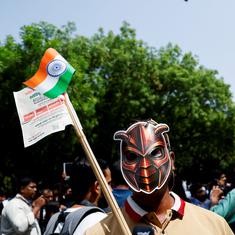
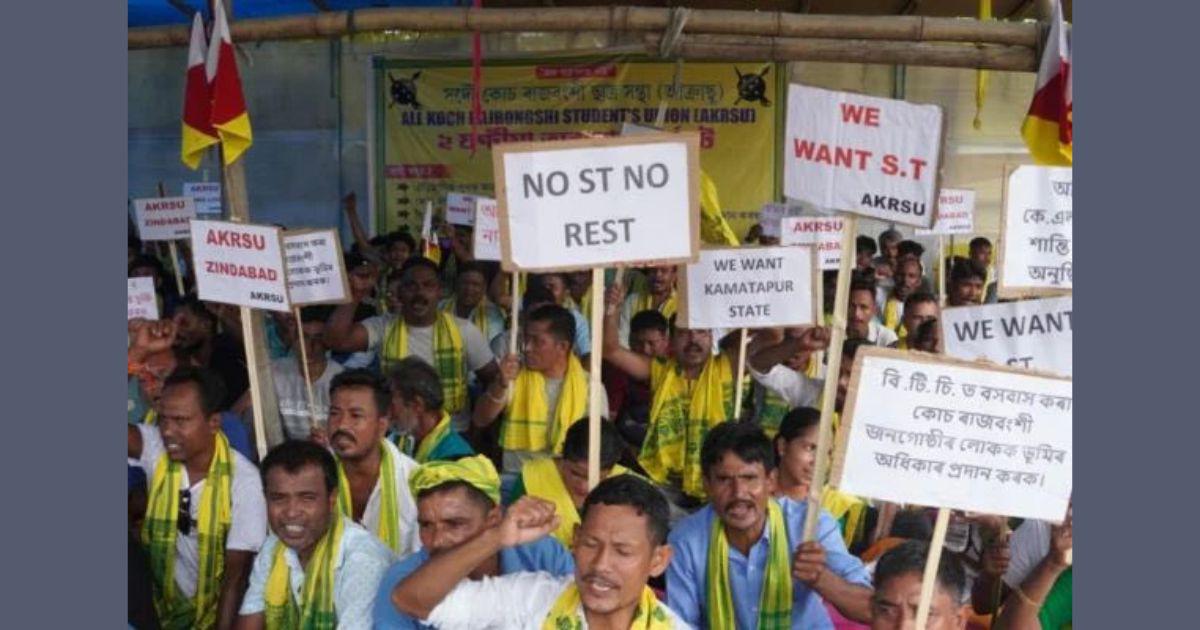
On September 26, a stretch of a major road at Sadiya cutting through Tinsukia district in Assam was flooded with the light of thousands of bamboo torches held up by protestors shouting slogans against the state’s Bharatiya Janata Party government.
“The BJP has failed us,” they said. “No ST, no rest.”
The protestors belonging to the Tai Ahom community, native to this part of Assam, were demanding ST or Scheduled Tribe status which would give them access to reservations in educational institutions and government employment.
Milan Buragohain, the president of All Tai Ahom Students’ Union, said it has been over a decade since the BJP’s top leadership first promised to classify the Tai Ahoms and five other ethnic communities as tribal groups. In power in Assam since 2016, the party has consistently projected itself as the champion of “indigenous” communities, pitting them against Muslims of Bengali origin. But its claims rang hollow, Buragohain said.
“They talk about the protection of jati, mati and bheti,” he said, using the Assamese words for community, land and homestead. “But they have not done anything. This is shameful.”
The Tai Ahoms are one of six communities demanding that they be classified as Scheduled Tribes. The others are the Moran, Muttock, Koch Rajbongshi, Sutia and the Adivasi or tea tribes.
In September, most of these communities staged massive protests in Tinsukia, Dibrugarh and other places in eastern Assam, also known as Upper Assam.
“If we are given the ST status, Assam will be a tribal state,” Buragohain said.
Assam has 3.1 crore people, according to the 2011 Census, with Scheduled Tribes accounting for 40 lakh or 13% of the population. If the six communities are given Scheduled Tribe status, the tribal population share could rise to nearly 50%.
“If Assam becomes a tribal state, our major issues like land rights, political rights and illegal Bangladeshis will be solved automatically,” Buragohain said. “Because there will be no threat to us.”
Muslims of Bengali origin in Assam are often falsely accused of being illegal immigrants from neighboring Bangladesh.
Leaders of the six communities often argue that recognising them as Scheduled Tribes would significantly address the issue of so-called illegal immigration from Bangladesh as it would lead to more constituencies getting reserved for candidates from ST communities. This would diminish the electoral influence of the Bengali Muslim population, they contend.
But the BJP government is unlikely to recognise them as tribal, Buragohain noted, since this would spell the end of its Hindu-Muslim politics. Besides, “the chief minister is himself a non-tribal Brahmin. If we are given ST status, he would not become the CM anymore.”
A series of failed promises
All the six communities demanding Scheduled Tribe status are currently included in the state’s Other Backward Classes list.
The Muttock, Moran and Sutiya communities are primarily from upper Assam. The Koch Rajbongshis, considered a Scheduled Tribe in Meghalaya and a Scheduled Caste in West Bengal, largely live in the western part of the state, while the Tai Ahoms live in Sivasagar, Jorhat and Charaideu, among other districts of Upper Assam.
Their demand to be granted ST status has faced opposition from the state’s existing Scheduled Tribes. “These communities do not possess characteristics which denote tribals in India as they are fairly advanced communities,” said Aditya Khaklari of the Coordination Committee of the Tribal Organisations of Assam, an umbrella group of organisations representing Scheduled Tribes in the state. “These six communities are not economically, socially and culturally backward.”
However, in the run-up to the 2014 general elections, addressing a public rally in Assam, Narendra Modi, then the BJP’s lead campaigner, not only acknowledged the demands of the six communities but also slammed the Congress-led United Progressive Alliance government for not recognising their demand.
In November 2015, minister of state in Modi’s government Kiren Rijiju said that the proposal to recognise six communities in Assam as Scheduled Tribes was with the prime minister and was likely to be approved before the 2016 assembly elections in Assam.
The BJP’s vision document or manifesto for the assembly election also stated that if elected in the state, the party would work in “close co-operation with the central government towards providing ST status to the six communities of Assam in a strict time bound manner”.
In January 2019, months before the Lok Sabha elections that summer, the Modi government announced that a Bill would be moved in Parliament granting ST status to six communities of Assam: Tai Ahom, Koch Rajbongshi, Chutia, Tea Tribes, Moran and Matak. “Government has waived the requirement of Cabinet approval. A Bill is being introduced in the current session of Parliament,” the home ministry said in a statement.
But no such legislation was introduced.
Despite forming the government in Assam twice, the BJP did not keep its word. In January 2021, Himanta Biswa Sarma, then the state health minister, while addressing the 20th martyr’s day of All Koch Rajbongshi Students Union, said the process for granting ST status to the six communities had begun.
The same month, BJP national president JP Nadda claimed in a public rally in Silchar that the Centre had already granted Scheduled Tribe status to six communities. Stepping in to do damage control, Sarma said Nadda had only “reiterated our commitment to grant ST status to the six communities”.
Sarma is now the chief minister of Assam. Faced with a renewed campaign of protests by the six communities, he said on September 12 the process to grant them ST status is “moving smoothly with positive efforts” but appealed to them to suspend their protests, warning that the agitation could “only delay the process”.
This has only enraged the leaders of the six communities further. “The BJP government is lying repeatedly,” said Polindra Borah who heads the All Moran Student’s Union. “We are just tired and exhausted at the lies of the government.”
According to local estimates, the community has about 3 lakh population primarily living in Tinsukia district and plays a decisive role in all five constituencies in the district. Two MLAs from Tinsukia belong to the community. Both are from the BJP.
“Morans have been voting for the BJP,” said Borah. “But they can’t take us for granted anymore. They have betrayed us with lies and false promises. If they talk about the protection of the indigenous population, why didn’t they give us ST status?”
Buragohain, the president of All Tai Ahom Students’ Union, said if the BJP does not fulfill its promise before the 2026 election, “we will think of another option”.
Dhiraj Gowala, who heads the Assam Tea Tribes’ Students’ Association, said the tea tribes have been voting for the BJP and have six legislators and two MPs from the party. “Despite that, the government is not fulfilling our demand and so we are forced to hit the streets,” said Gowala. “We will protest on October 13 in Dibrugarh.”
In Assam, as many as 96 communities are classified as tea tribes. The tea tribes and Adivasi groups are commonly referred to as Bagania – tea plantation workers and their families. But Assamese tribal communities have opposed their demand for ST statues because tea tribes are not considered as “indigenous” to the state. They are recognised as STs in their states of origin
The tea tribes and Adivasi groups are recognised as scheduled tribes in the states of their origin – Odisha, Madhya Pradesh, Bihar, Andhra Pradesh and West Bengal – from where they were brought by the British in the early 1800s. The tea garden community, spread across about 1,000 estates in Assam, play a decisive role in electoral outcomes.
They were Congress supporters traditionally, but shifted loyalty to the BJP since 2014. Amarjyoti Surin, general secretary of the All Adivasi Students’ Association of Assam, said that ahead of the 2016 state elections, the BJP widely shared pamphlets promising ST status for the tea tribes and Adivasi groups, who “overwhelmingly voted” for the saffron party. But this core demand remains unfulfilled.
“Adivasi people in Assam should get ST recognition as we fulfill all the five criteria [custom, religion, culture, language] under Article 341 and 342 of the Constitution,” said Surin, referring to the Articles that empower the president to notify groups under the Scheduled Tribes or Scheduled Castes categories.
“But the BJP government has no political will to give us ST status,” said Surin. “Instead of that, they are giving free rice and cash.” The minimum daily wages of tea garden workers is Rs 250.
The BJP government has deprived us of our constitutional rights, said Surin.
Political fallout
A post-election survey by Lokniti of the Centre for the Study of Developing Societies showed that 49% of the population of the six communities seeking Scheduled Tribe status had voted for the BJP.
But nearly a decade later, this support may be wavering. Political observers told Scroll the protests are strategic, aimed at pressurising the ruling BJP ahead of state elections due in 2026. However, the party may yet find a way around by giving in to some demands, diluting the bargaining power of the communities.
“It’s about plain patience wearing thin,” said Mridugunjan Deka, a senior research fellow of political science at Gauhati University. “We are seeing the same pattern in Ladakh, which is now on edge. One cannot keep promising the moon and come up with a new deadline or obfuscation forever.”
A political scientist from Dibrugarh University, who did not want to be identified, told Scroll that the groups had recognised their advantage since “ruling parties are more responsible to public dissent during electoral cycles, even if only symbolically”.
They were also leveraging the government’s sensitivity to dissent in a state where identity politics is central to electoral success, he said. He argued that while the BJP has positioned itself as a protector of tribal and indigenous interests, its governance model, perceived as “top-down and disconnected” from grassroots realities, has fuelled resentment.
“Failure to address demands risks alienating a critical voter base, potentially fracturing the party’s support ahead of the 2026 elections,” he said.
“The long-term impact hinges on the BJP’s responses,” he said. “If dissent evolves into organised electoral resistance, it could erode the party’s narrative of inclusive governance and complicate its path to re-election.”
However, the BJP’s organisational resilience and tendency to deploy symbolic concessions or welfare schemes may mitigate backlash.
Deka pointed out that ahead of the 2021 assembly elections, at least three ethnic communities, the Moran, Matak and Koch, had been granted autonomous councils – which gives for more administrative and political autonomy.
This followed protests against the Citizenship Amendment Act 2019, which fast-tracks Indian citizenship for undocumented non-Muslim migrants from Bangladesh, Pakistan and Afghanistan. In Assam, the law sparked widespread fears and protests over a threat to the state’s demographic and identity. Scroll had reported then how the saffron party brought them back into its fold.
“For now, ditching the BJP remains unlikely,” said the political scientist.
Voting in India is shaped by a “complex interplay of identity, pragmatism, and opposition viability,” said the political scientist.
“The protests instead reflect a recalibration of political leverage testing the regime’s limits while leaving the door open for negotiation,” he said. “Whether these demands are dismissed as a threat or embraced as an opportunity for accommodation will ultimately determine the BJP’s electoral fate in Assam.”
