






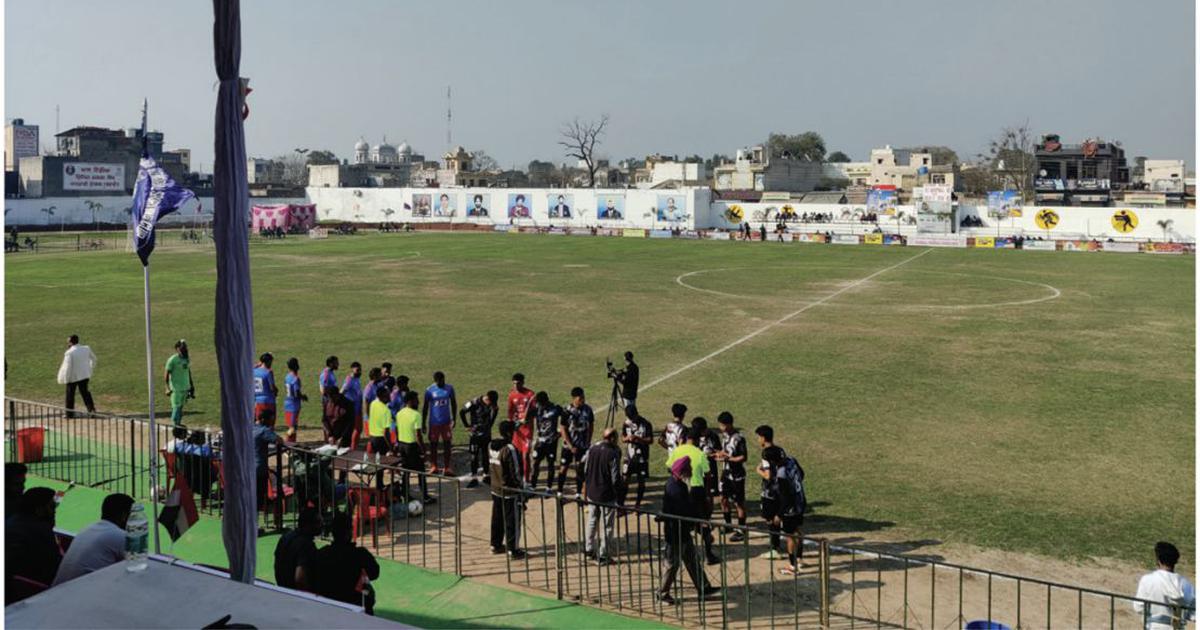
Mahilpur is neither a town nor a village. It falls somewhere in between. The villages around are surrounded by acres of green, flat cultivated lands with a few coniferous trees in between. You also find football grounds. The landscape is conducive to making grounds, and nearly every village has one. If they don’t, they share it with their neighbours. With little else for entertainment in the years past, football took a major role in the community. The facilities provided ample opportunity for the villages to play tournaments against each other.
The physical contest also resonated with the people. Punjab has witnessed many wars and skirmishes, and it was an entry point for invaders into what we now call India. They were not afraid of aggression, which even forms a part of their folk arts. The harsh summers and winters made the people tough while hard work, in agriculture or elsewhere, was second nature. “Everyone born in Punjab is born with one hand on a sickle and the other on a sword,” an army officer watching football insisted. It reflects in their football too. The football that is played is wantonly tough and physical while attacking and fiercely brave and protective while defending.
Punjab players dominate in defence and goalkeeping positions, though they have produced attackers as well. It is not surprising to many Punjab players either. “Yes, they think we are tall, strong and brave. So these positions are the most obvious,” one of them told me. In the 2023–24 season, five of the starting goalkeepers for Indian Super League (ISL) teams were from Punjab. The following season, five of the top fifteen in the Golden Glove (best goalkeeper) were from the northern state. The Indian national team has two goalkeepers from Punjab in the race for the number 1 jersey and three for first-choice centre halves. Of the five Arjuna Award-winning footballers from the state, only one is an attacker. “Technically they are not among the best. They are physically strong and mentally tough. So these positions suit their strengths. That is their legacy,” a Tata Football Academy coach reckons.
Half a century after making waves with their direct style of football, it has, while remaining effective in the right circumstances, become somewhat antiquated. Even now, the belief is that Punjab has tough, strong and physical players. It has become a bit of a caricature. There has been an evolution, at least at the top level of the game, from the rugged and robust defenders known for their ability to stop the opposition. The leading light has been Sukhwinder Singh, who not only used his skills and strategies over physicality as a player (he never earned a yellow card despite playing for well over a decade) but also instilled the same into the teams he coached, particularly at JCT in the 1990s.
Football season is in the winter, and a slew of tournaments are held between October and February. The winters are a comfortable time for football games in the sun. In a more recent trend, evening tournaments, often seven-a-side, are held during the evenings in the summer. Almost every third village hosts tournaments – the Doaba Tournament, the Bhagat Singh Tournament and the Jarnail Singh Memorial tournament being a few. Among the early famous tournaments is the Mango Season football tournament which was started during the summer months. Thanks to the abundance of mango orchards, the winners were given fruits. The tournament continues under the name of the Sant Baba Hari Singh Football League with evening games on the college grounds. The most famous one, however, is the All India Principal Harbhajan Singh Memorial Football Tournament. It was the competition (between villages) that had nurtured football in the area.
These competitions between districts and villages carry with them the same sense of an “us against them” feeling regardless of the sport as well. In a recollection from a player who played hockey for Jalandhar before migrating abroad to the British Isles, he talks of being only “half a man if you don’t like sports” and the pressure he felt to perform against Phagwara with his future in-laws watching from the stands. “Our district’s honour was at stake … you win with your district, then your district is more honourable,” he believes. Unfortunately, his team lost the game, but thankfully, his alliance remained unbroken.
Power sports in Punjab were a necessity; running, weightlifting, wrestling and kabaddi were all extremely popular as another way to build strength for the physical labour in the fields. Football had been hugely popular in undivided Punjab since the early 1930s, its stronghold being largely in regions now in Pakistan and extending from Amritsar to Ambala, a garrison town, during the colonial era. But constant competition and the love and enthusiasm for football saw Mahilpur take over as the powerhouse.
In fact, it was in Lahore that the North West India Football Association was founded in 1932, and almost all the great players of the time came from this region. The likes of Hafiz Rashid, Bachchi Khan, Jumma Khan, Kale Khan and Usman were part of the great Mohammedan Sporting side in the 1940s. The first Punjab team that played the maiden Santosh Trophy tournament in 1941 had all but one player in the eleven that participated from the West Punjab region.10 Following the partition of Punjab in 1947, the East Punjab Football Association was formed, which was replaced by the Punjab Football Association affiliated with the All India Football Federation (AIFF), in 1951. Post-Independence, initially, it was around Ambala where football thrived – this region has since become part of Haryana.
Football rose to prominence in Punjab in the second half of the 20th century. When the Leaders Club came up in Jalandhar in 1960, it helped many youngsters from universities in Chandigarh, Amritsar, and Patiala to pursue their footballing dreams. The team unexpectedly reached the semi-final of the DCM trophy in 1962, which was a big moment for football in Punjab. The team was highly competitive through the 1960s before it folded up nearly a decade later. The period overlapped with the rise of institutional teams. Punjab Police, an institutional side that had been in existence since the 1950s, shifted their focus to football. They won the DCM trophy in 1966, beating Leaders 2-0 in an all-Punjab final. The Border Security Force (BSF), which established a strong presence in the state after the mid-1960s following the India–Pakistan War, also played football. They unexpectedly won the Durand Cup in 1968 and repeated the result in 1971 and 1973.
A year later, Punjab won the Santosh Trophy with a crushing 6-0 defeat over perennial favourites, Bengal, which saw a huge boost in football interest, especially in the rural areas. Punjab’s footballing ethos is personified in particular by BSF. With their robust approach to the game – hard tackles, hard running, long balls, long shots and crosses into the box suited the physicality of the players – their football was tough to negate. The hardiness resonated with the people. “BSF’s brand of direct football (sic) attracted a new generation of fans to the stadiums, who were more interested in action than the subtleties of the game,” Kapadia wrote. Football thrived in the region from the 1960s onwards, and though there was a slight decline because of the political unrest in the 1980s, the sport remained immensely popular. The Punjab Football League began in 1986, very late considering the status of the game in the region. The clubs and affiliated units played together in one state championship before the advent of the league. To an extent, the lack of outlets for clubs to play has always, and continues to, hamstring the region’s football development.
All this had a major role in nurturing a strong football culture across Punjab, with the famed Chandigarh Football Academy starting in the new millennium. In Mahilpur, things went into overdrive when Jagatjit Cotton & Textile Football Club (JCT FC) was established in 1971. According to Sukhwinder Singh, the owner of JCT was inspired to start a club after watching the passion of the fans and the craze for football in the region. It was on his insistence that the club was headquartered at Phagwara, which made it easily accessible to the people and players of the region. The club, which reached four straight finals between 1974 and 1977, won the Durand Cup in 1976 (joint winners with BSF) to announce their arrival on a national stage before winning the tournament four more times.
Over the next three decades, the club won the IFA Shield, Rovers Cup and many other trophies, including the National Football League, where it was the lone side from Punjab as the country shifted away from a tournament model to a national league one. The club also hired Sukhwinder Singh as its coach, which further opened avenues for players from Hoshiarpur into the team. JCT also started an academy in the district in 2007, though the club closed down in 2012 in a huge blow for Punjab football. Although Minerva Punjab FC won the I-League in the 2017–18 season and Punjab FC gained promotion from the I-League to the ISL in the 2022–23 season, the old fervour has yet to return to Punjab.
In Mahilpur, a love for the place you are from runs deep. Following a visit to the gurudwara in Kaharpur, the native region of Sant Baba Hari Singh Kaharpuri, I came out conscious of a great sense of camaraderie between those who lived in the village. The people visit and speak with the Granthi about all matters of their lives, like you would to a long-lost friend. The Granthi, who officiates over gurdwara rituals, has a great influence on the lives of the people.
This sense of community drives the pride of one’s village into the hearts, which translates on to the football field when players represent their villages. The tournaments also force youngsters to compete against older and stronger people. “It gives you confidence,” says Balwant Singh, former India striker. “You can understand how good you are and if you have that fire in you.” Bragging rights during these village tournaments are also greatly valued. An erstwhile player told me with a booming laugh about the days of beating their neighbouring village and going around singing songs on loudspeakers. They would travel from one village to another, often playing in two or three tournaments a day during the winter. Researcher Paul Dimeo, in his paper, described the Punjab of the 1960s as a place where “neither club or league structure was available … The sport never had the local rivalries in Punjab that proved such a catalyst to its development in many parts of the world.” In the Mahilpur region, rivalries existed and football thrived.
Players who made it – professionally or by getting a job through football – give back to their community. They take up the role of coaches, sometimes taking two to three villages under their wing, and conduct tournaments in their villages with aplomb. Balwant is working on football in his village, coaching and conducting tournaments. In Kaharpur, Harmanjot Singh Khabra has built a football ground and conducts summer tournaments for the people nearby in which he participates. “How can you not give back to where you come from?” Balwant asks me, bewildered at the thought.
From his facility, Khabra’s father, former footballer and well-known coach S Harnandan Singh Khabra, pointed to a village on the far side, saying, “That is (an ISL goalkeeper) Arshdeep Singh’s village. There are tournaments there also.” Mahilpur was also helped by the namesake football academy, where many – including Anwar Ali and others plying their trade in the ISL now – came down for coaching under Ali Hassan, who coached for over three decades.
The presence of an institution and a strong sporting foundation provides Mahilpur with the opportunity to be more prosperous. Principal Singh had seen sports as an opportunity for employment, and he drove home that point. With their history, there was already a predisposition towards joining the armed forces, but with the combination of education and football, many joined as officers and Class One gazetted officers.
“Many students were prepared to compete in exams so that they could get a government job or join the services,” retired wing commander and former junior international footballer HS Dhillon informed me. “Because this area had education and football, you could do that. There was a source of income. Even if you didn’t become a footballer, you had an option to be in the armed forces.”
The sense of community meant that all those who moved up to high places continued to care for their society. The tournaments are well-funded. While there is a financial crunch in many parts of the country when it comes to organising football tournaments, there is little trouble in Mahilpur, thanks to the huge contingent of people overseas. Money flows in through local supporters and charitable trusts. The Principal Harbhajan Singh Memorial Football Tournament, elevated to the all-India invitational level, has trusts in Vancouver, British Columbia and England supporting it. Other tournaments too are conducted with great financial backing.
For Punjabi Sikh immigrants, football remains a major part of their social lives, be it in Europe, Canada or Australia. As early as 1966 in Britain, football was seen as a way of connecting to the immigrant subsection who were just finding their feet in a foreign land. An all-Punjabi football team was established in the West Midlands in 1966, the same year when England won the World Cup. The all-Punjabi-Sikh teams often adopted the names of the gurudwara that was local to them as well.
In the stands, I observed many former players and coaches who had flown down for the few days of the tournament to show their support and meet their old friends. Many were former footballers or college students, while a few were retired from the armed forces and had since moved abroad with their children. One among them was the father of the Canadian Member of Parliament Parm Bains, who had left Mahilpur for England in the 1960s before settling in Canada.
Excerpted with permission from Sacred Grounds: A Journey Through People’s Football in India, Sandeep Menon, Penguin India.
