











“The uncanny is that class of the frightening which leads back to what is known of old and long familiar.’
— Sigmund Freud
There are books that walk up to you politely, clear their throat, and begin to speak. And then there are books that arrive like a temperature drop, quiet, invisible, startling only when you realise the air has changed. Sanjoy K Roy’s debut, There’s a Ghost in My Room: Living with the Supernatural, belongs to the latter. It unsettles gently, intimately, not through theatrics but through the slow revelation that the world is less solid, less sealed, than we assume.
Most ghost stories operate like fireworks: bright, quick, eager to shock. Roy’s book, however, behaves more like a lantern carried through an old house. It shows corners, glimmers on forgotten staircases, catches the shape of something moving just beyond your field of vision. It is a memoir built not on fear, but on familiarity, with presences that appear, disappear, and often linger in the mind long after they’ve left the room.
The haunted house as homeland
Roy’s journey into the supernatural begins early, in his ancestral home in then-Calcutta. As a child, he lives not in fear, but in an odd companionship with the unseen. Spirits do not seem to be intruders in his world; they are part of the very walls that hold him. Later, in the family’s sprawling bungalow in Lutyens’ Delhi, the veil thins again. Mischievous footsteps, inexplicable movements, figures sensed more than seen, these become the gentle punctuation marks of his childhood.
What struck me, as a reader, is Roy’s ease in accepting these occurrences. Where many memoirists would tilt toward exaggeration or melodrama, Roy chooses restraint. His stories are delivered the way one describes old neighbours, familiar, peculiar, but never impossible. In this, Roy exhibits the rare gift of the supernatural narrator: he neither pleads for belief nor argues against it. He simply offers the reality as he has lived it.
The book unfolds like a travelogue of the uncanny. Roy takes readers through Calcutta, Delhi, Rishikesh, Jerusalem, Edinburgh, and several cities that seem touched by histories thicker than their present. At each stop, something stirs, a presence that refuses anonymity.
There is a beautiful sense of period detail in these sections. Roy’s memories are shaped by time as much as place: the softness of old curtains, the whir of antiquated fans, the lingering dust of unspoken stories. The supernatural becomes interwoven with the texture of living, as if the past has refused to vacate the premises.
In the hands of a lesser writer, such an international catalogue of hauntings might feel overripe; with Roy, it feels organic. The ghosts do not chase him; they simply coexist with him, as though following the lines of his life with their own quiet agendas.
One of the most compelling sections of the memoir recounts Roy’s time in Rishikesh, where a rafting expedition brushes him against something darker, something that enters him and changes the rhythm of his days. The possession lasts two weeks. Roy writes about it with the tone of someone describing an illness, or a prolonged dream – vivid, destabilising, but not entirely frightening.
What does possession feel like? Roy does not dramatise. Instead, he gives the reader fragments, sensations, disorientations, that eerie awareness of being simultaneously yourself and not yourself. His approach mirrors what I admire in certain strands of literary nonfiction: the refusal to reduce an experience to a clean metaphor. Some things, his prose seems to whisper, are meant to remain slightly unfinished.
Crafting the memoir of the unseen
But if the supernatural marks Roy’s own life in distinct ways, it touches his son Avik’s childhood with a sharper edge. Avik, barely two, begins seeing an elderly female ghost. More disturbingly, streaks of blood appear on his pillow and white bedsheet, an image that lingers like a bruise in the reader’s imagination.
Here, Roy’s tone shifts. The raconteur becomes a father, helplessly watching his child navigate an invisible world. The writing turns tender, even anxious. The memoir’s gentlest passages are often those in which Roy confesses his inability to protect his son from what he cannot see, control, or rationalise.
This section is the emotional core of the book. It moved me not because of its supernatural content, but because of its human tremor, the vulnerability of a parent confronted with the unknown.
Throughout the memoir, Roy positions himself as someone who hears occasional messages from beyond. They are not prophecies, not warnings, not dramatic revelations. They are quiet nudges passed through dreams or sudden intuitions, meant, more often than not, for other people. Roy resists becoming a conduit. But life, he suggests, sometimes insists.
In these passages, the book acquires a philosophical undertone. What does it mean to receive knowledge we did not ask for? What responsibilities come with it? Roy does not moralise. He simply listens, interprets, and steps aside. The supernatural becomes less an event and more a form of awareness, an alternative frequency on which life communicates.
Stylistically, the book maintains a steady, quietly luminous register. Roy writes with humour, curiosity, and a certain worldly lightness, qualities that keep the memoir from sinking into the gloom usually associated with ghost narratives. His descriptions are crisp, often playful, and always anchored in the sensory.
The strength of the book lies not in its individual episodes but in the cumulative effect they create: a sense that the world is deeper than it appears, that memory has dimensions we seldom acknowledge, and that the line between presence and absence is far more porous than we care to admit.
There is no attempt at theorising the supernatural. No grand claims. No occult posturing. Roy remains, by his own admission, neither mystic nor sceptic. He writes from a third space – a liminal position that allows the mysterious to coexist with the mundane, the unexplainable with the everyday.
What makes There’s a Ghost in My Room memorable is its refusal to explain itself. The book does not try to convince the sceptic or reassure the believer. It behaves like a window accidentally left open on a windy night: the curtains move, the room breathes, something shifts, and you are left wondering whether it was the wind or something older, something unnamed.
To read this book is to sit with one’s own thresholds of belief. Roy invites readers to walk beside him, but he does not lead. He hands you a lantern and lets you decide what shadows you see.
I found myself returning to Freud, the idea that the uncanny is not foreign but intimately familiar, a forgotten room within ourselves. Roy’s book, in that sense, becomes less about ghosts and more about memory, presence, and the invisible grammar of life.
I leave the rest to readers: to enter the book, inhabit its silences, and decide for themselves what is real and what returns from long ago.
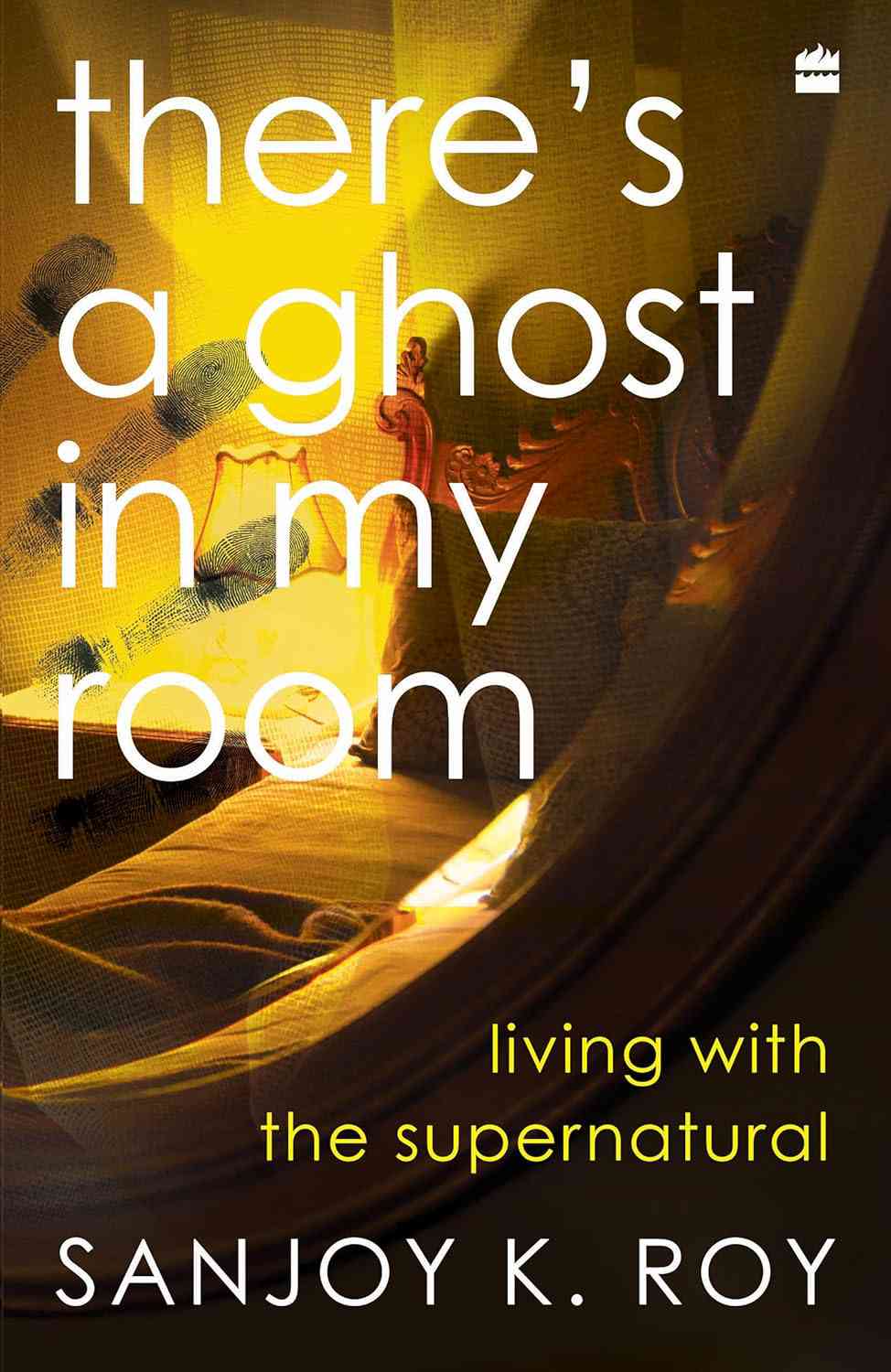
There’s a Ghost in My Room: Living with the Supernatural, Sanjoy K Roy, HarperCollins India.
