




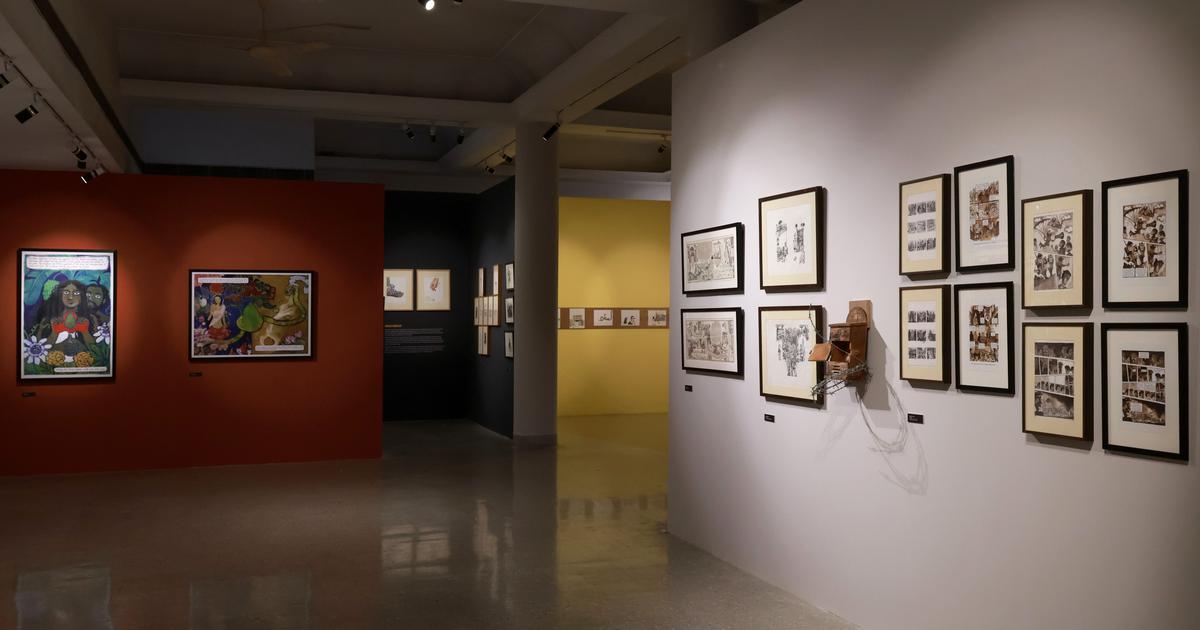
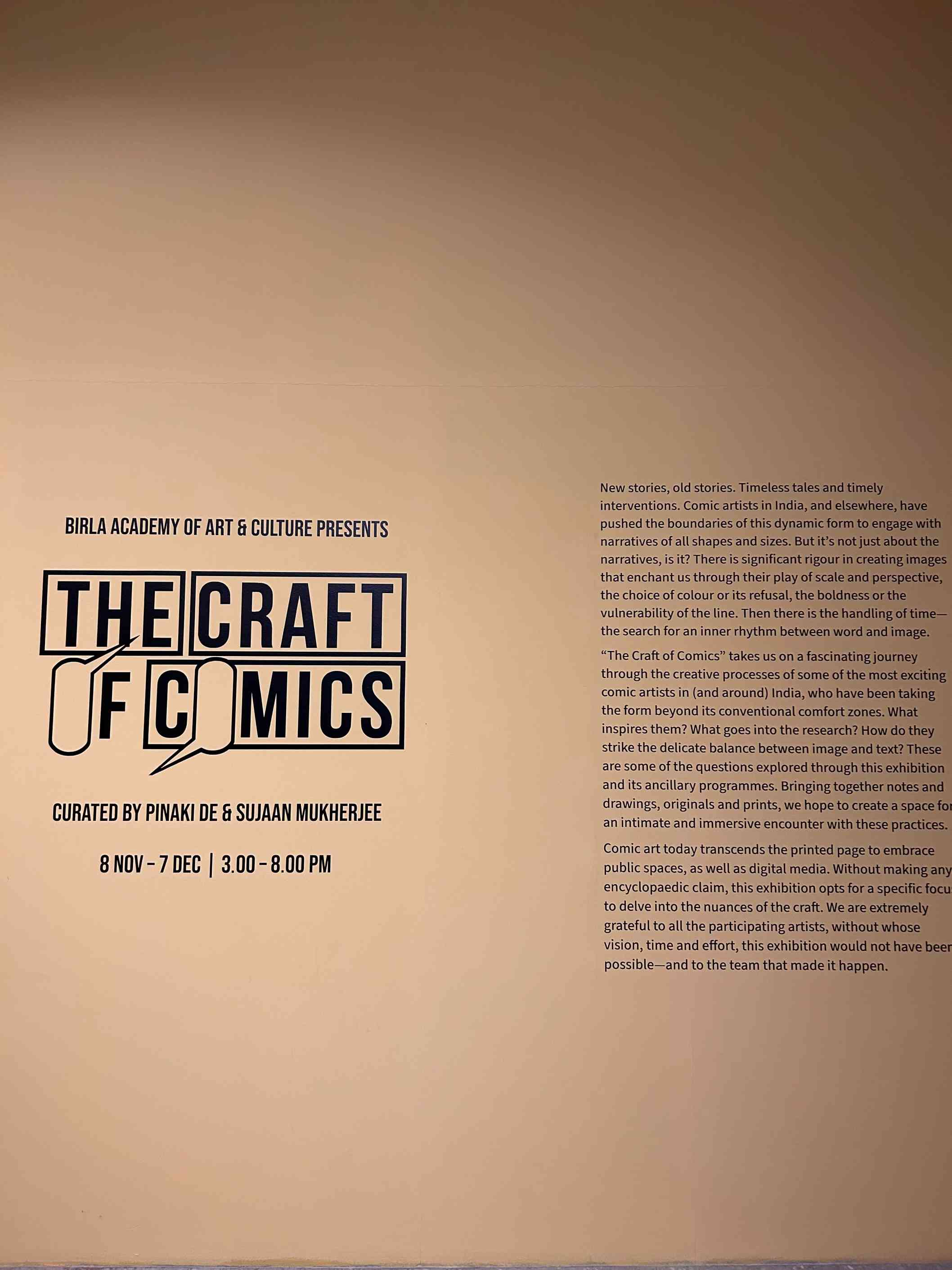
Over November and December in 2025, Kolkata laid the canvas for multiple art events and exhibitions. Among them, The Craft of Comics, presented by the Birla Academy of Art and Culture, stood out both in its style and its spirit.
It is important to note that comics as a form is supposedly a rogue form of art, one that is supposed to find readers among teenagers, flipped through at independent pop-ups, and distributed at local book fairs. It is especially not one that’s seen in active display at galleries, or that attracts the patronage of art enthusiasts in a metropolis. In defence of the comic, however, it is no longer regarded as a juvenile art form – which, in fact, it never actually was. The form has been under scrutiny for a while now, with theorists theorising it, students studying it, and artists experimenting with its boundaries to engage with narratives of all shapes and sizes. But, as the exhibition manifesto notes: “It’s not just about the narratives, is it?”
The comic-making enterprise
“Why would someone leave the comfort of their home and come to a gallery to see comics?” said exhibition co-curator Sujaan Mukherjee. “This question drove us to imagine the exhibition as a space for immersive, intimate encounters not just with the images but with the processes of image-making.” Mukherjee and fellow curator Pinaki De have been clear about the ethos of the exhibit right from its conception. The idea was to focus on the comic-making enterprise – the vision behind each character, the labour behind each panel, the craft behind each comic – and nudge people to turn back a page, peel back the layers, look at the skeleton at the base of it all.
It is fair to say the exhibition did achieve what it had set out to do. Not only has the event laid bare the grind behind this extremely popular yet deeply underestimated art form, but it has also created the space for its audience to engage in relevant discourse and led new artists and non-artists alike to create as well. Through the day-long workshops, which were discernibly organised with care and guided by the exhibited comic artists themselves, one got to witness and even practise the art form in person.
For instance, the “History in Comic Art” workshop hosted on November 15, and mentored by Argha Manna, was an intimate affair, with the mentor and curators offering personalised attention to each participant. By the end of it, one had managed to not just get an understanding of how comic artists bring history to life, but also taken a deep dive into reimagining and translating their pasts into a visual story. Following suit, Sankha Banerjee’s “The Graphic Novel Blueprint” (held on December 7) guided creators in mastering narrative rhythm and crafting compelling stories.
To add to this, sub-events of the exhibition, such as detailed walkthroughs executed by the curators themselves, and talks titled “Visualising Mahabharata: Text, Image, History” with artist Sankha Banerjee and historian Kanad Sinha, “Life in Comics: Stories and Experiences” with Sarbajit Sen and Amritah Sen, “Kafi Khan @ 125” with Biswadeb Gangopadhyay, and “Picture Stories” with Debashis Gupta geared the audience towards meaningful and sustained conversations.
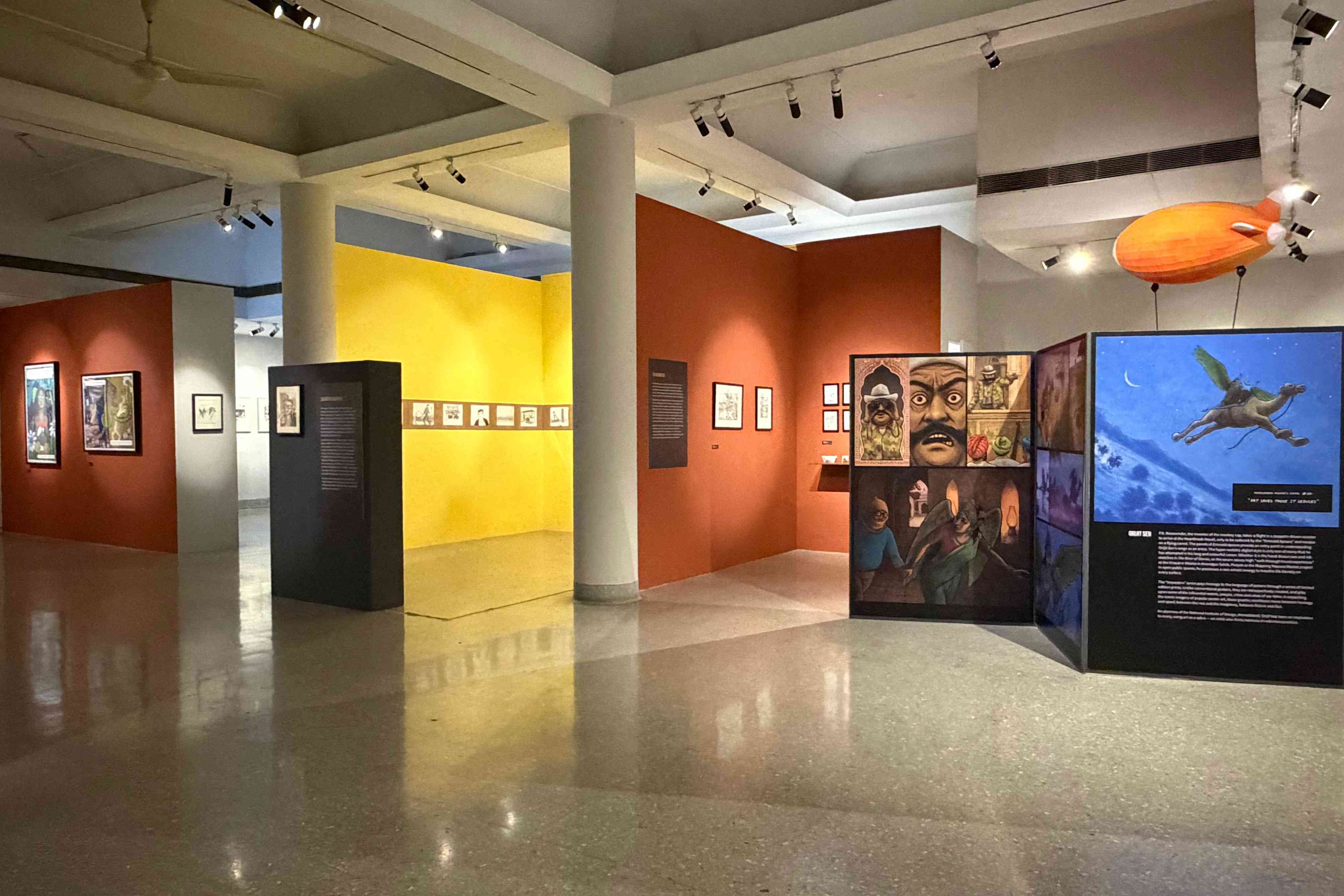
The works exhibited at The Craft of Comics – those of Appupen, Amruta Patil, Argha Manna, Chitra Ganesh, Priya Kuriyan, Orijit Sen, Ikroop Sandhu, Joshy Benedict, Sankha Banerjee, Ita Mehrotra, Sarbajit Sen, Sarnath Banerjee and Vishwajyoti Ghosh – are undoubtedly diverse in their artistry. What is new to the audience here is how distinct each artist is in their craftsmanship as well.
The audience as an active asset
For example, while Sarbajit Sen is singular in his use of khoyer (catechu) as colour, Sankha Banerjee’s excellence reveals itself in his intensive and extensive research of the excavation of Hastinapur, whose map he represented through a projector for the exhibition. Argha Manna’s workdesk was not just represented through his art, but wholly presented in its entirety, as an artefact of his praxis. Priya Kuriyan’s sketchbooks are on display, exhibiting her modus operandi, and not just the finished pieces.
Several artists not only gave their permission to display prints of their work, but lent their actual originals, which added to the splendour of the exhibition. Each artist’s work, through careful illustration and precise display, made the audience not just a passive spectator or a cosmetic character, but an active asset in the process of the narrative progression. As the viewer walked on from one enlarged page to the next, they undeniably become not just a meaning-maker, but a tool of meaning-making, one that’s central, critical, indispensable.


Heartfelt gratitude is due to the venue, the Birla Academy of Art and Culture, Kolkata, for not only housing this exhibition but for making the medium of visual storytelling so approachable, accessible. The response has been nothing short of vibrant. The exhibition struck a resonant chord with the youth, drawing in a refreshing majority of students. It is a testament to the universal language of comics that the show maintained a high level of general appeal, buzzing with the energy of new audiences discovering the depth of graphic narratives.
Deya Bhattacharyya is an independent scholar, personally and academically interested in writing on art. She runs a digital art zine named Chhuri on women artists all over the world.
