









At half past 11 on the night of October 11, 1886, revolver shots pierced the dark of night, alerting Doctor Edward John Baxter of the Church Mission Society. Baxter, as a missionary doctor, travelled frequently to the interior and was no stranger to violence. In fact, he was about to embark on another trip. As Baxter tells it, the nearby donkey-keeper informed him that “there was a man in the unoccupied house on the side of de Souza,” this being CR Souza’s house. As Baxter approached the scene, he saw a scrum of policemen dotting the dark with lanterns. They made their way upstairs and returned with the “almost lifeless” body of an unnamed African man who died a minute later. Baxter being a medical man examined the body and found a bullet wound. He took it upon himself to go upstairs to examine the scene, only to discover the man had been on the scaffolding preparing to enter De Souza’s house.
Just minutes before, inside CR Souza’s shed in Shangani, two clerks employed by him, 23-year-old Caetano Felicio Souza from Anjuna and Toletino de Sa, were asleep when awakened by a noise. Toletino went to look out the window but saw nothing. Felicio sat quietly on his voltaire and after a while, he saw um homem preto sem roupa, a Black man without clothes, wearing only a small piece of cloth around his waist, standing on the scaffolding across from CR Souza’s house, undoing a rope. As Felicio tells it, Toletino asked the man, what is it? and getting no reply, Toletino got the revolver. They tried to cry for help and seeing none arrive, Felicio fired two shots indiscriminately into the darkness and the man retreated out of sight. Then, they saw Baxter enter the house, and when at last they enquired with Baxter, he confirmed the man was indeed a thief.
In the tense week that followed, Barghash was informed by Brás about the situation, and a consular court was convened by Brás as vice-consul in charge of the consulate. He had been authorised by Portugal to judge the case. He put together a jury comprising DB Pereira and João Pedro Souza to try Felicio for homicide. Felicio readily admitted to killing the unnamed Black man. He had been terrified, he confessed, panicked, fearing for his life. After all, this was a land in which even the police admitted, n’esta terra não haver disciplina, nem ordem, in this land there is neither discipline nor order. Whether the police had actually said this, given that they were responsible for law and order, or if it was an embellishment by Brás in the sentencing report, we will never know. Certainly, the idea of lawlessness in Zanzibar was one Brás repeated elsewhere. DB Pereira and João Pedro were of the opinion that Felicio had been brutally honest about his own culpability, that he had not tried to hide the incident, that certain witnesses – the jamadar Dindial, and two of Barghash’s police guards Datradin and Aryasingh had deliberately perjured themselves, while other witnesses, Dr Baxter, Naique Gopal, the guards Fahrani and Hamsini, and fellow clerk Toletino de Sá had given honest accounts. Felicio, they reasoned, had genuinely feared for his life, considering that CR Souza’s house had been burgled just three months before, and the constant “insecurity of life and property in this land.” Under these mitigating circumstances, Felicio was found not guilty of voluntary homicide and sentenced to ten days in prison, redeemed at the rate of one rupee per day. It is in this case that Brás first proves his mettle in defending jurisdictional rights. Barghash was put out; he found Brás’ verdict “impossible.” After all, one of his subjects was dead and the Goan had killed him. But it is a fight Brás won and Caetano Felicio Souza, an educated man, went on to lead a respectable life with a thriving business of his own in Zanzibar.
By the 1880s, with the Portuguese consulate firmly established in Zanzibar, the character and composition of Goan society begins to emerge, thanks in large part to the lengthy report consul Neves e Melo compiled in 1889. Melo found the Goans to be a community generally respected for their hard work and sincere nature, and not given to disorderly conduct. Five years on from the time the consulate was established, Melo had found just one criminal case recorded, that of Felicio, and that too a justifiable act of self-defence.
To their credit, Goans conducted themselves admirably, despite life in Zanzibar being chaotic and brutal, where men carried revolvers and violence was frequent. It was not unusual for Goan domestic staff to suffer violence at the hands of their European employers or for Goans to be assaulted by Arab-owned slaves on the orders of their owners. Flogging of non-Europeans by Arabs was common. In 1886, two Goans were assaulted by a slave belonging to Ali bin Vazir employed by the American consulate. (Arabs frequently worked for either the American or European consulates in Zanzibar as interpreters.) Even as late as 1895, when policing was more vigilant, the “feeble and innocent” Damião Menezes was thrashed by Sayid Khalifa’s slaves as Khalifa watched on. In this manner, the owners could escape justice, especially if sultans made half-hearted overtures towards justice and were inclined to look the other way. On occasion, an indemnity was paid to the victim; in this case 30 rupees paid to Damião.
Goans, nonetheless, consistently displayed their own hard-edged racism against Black populations. In 1895, there was the instance of A D’Souza abusing a head-guide boy named Khamise or “sea-breeze.” Even the presence of the police could not restrain A Souza from calling Khamise a son-of-a-bitch and a bloody fool. Also in 1895, there was the even more damning incident of Roque Valladares kicking a young Swahili girl. The girl was idling in the street when Valladares offered her a “bottle sodawater and told her to come in and take it.” The girl, rather wisely, insisted if he wished to give it to her, then she would come to the door. At this point, a Swahili servant struck her with a stick hard enough to leave bruises on her body. Valladares then took it upon himself to kick her. When questioned by the police, Valladares, thirty and single, from the Goan village of Verna, admitted to kicking her, and offered by way of explanation that he did not know there was any order to prevent him from doing so.
The pretexts used to inflict punishment were usualy trifling – on one occasion Goans beat a native boy for possessing a tin of milk which belonged to his “master” – and were reminded by police officer G Hatch that “they must not beat the natives,” as the offender would naturally be punished by the authorities. Although Hatch appeared conciliatory when he assured them that “they were of course quite right in lodging the complaint against the boy.” Even Goans who were just passing through or newly arrived felt emboldened as in the instance of the unnamed Goan who in April 1888, struck someone whilst residing in a hotel near Dr Oswald’s house. While instances of common affrays in the street between Goans and Africans can be put down to ignorance, Valladares at the time of accosting the Swahili girl, was Brás Souza’s assistant and pharmacist at Medical Hall, and later he held a senior position in the government veterinary department, rubbing shoulders with Zanzibar’s elite. Apart from the physical assault, there is a hint of impropriety in Valladares’ behaviour, which, no doubt, was prevalent among Goan men, living as single men or married but away from their wives for long periods of time. At least one Goan photographer in 1894, was charged with selling grossly indecent photographs, and sentenced to one month rigorous imprisonment. The photographs and negatives were ordered to be destroyed.
Even though Goans did not engage in the slave trade on the Bagamoyo-Zanzibar slave route, equally reprehensible was the blurring of lines between servant and slave. For all the cases that may have gone unaccounted, two are recorded for posterity by their registration of contracts at the consulate. In 1887, Masih bin Ali readily handed over his slave to merchant João Pedro Souza. The slave was the barely 14-year-old Hamisi who had probably never ventured beyond the blue horizon of Zanzibar and yet his owner had sold him to a man who could take him as far as India. That too, not a short sojourn but for a contracted period of ten years. If the terrified boy were to run away while in Zanzibar, Masih would find him and bring him back. If he tried to flee while in India, João had every right to look for him and force him back. The boy, with no say in the matter, had been sold quite literally for 36 pesos of silver, an advance which had to be worked off, and on condition that he must be fed and clothed. Perhaps, the only mitigating note in all this was that when Hamisi was returned to Masih, a fully grown man by then, Masih was obliged to set him free or Hamisi could choose to stay on in Goa.
An equally disturbing and similarly worded contract was registered in March 1889, whereby Hamid bin Suleman leased Amina to the pharmacist Paixão Noronha. Here too, the word slave appears without any effort to disguise it. For an annual sum of 45 pesos Amina would live with Noronha for two years during which time Noronha was responsible for feeding and clothing her. And just like João Pedro’s contract, this too involved chattel ownership with a clause which entitled Noronha to take her with him wherever he went. These were the same contracts unscrupulous European and Indian merchants used to disguise slave labour and fly under the radar of British vigilance.
This might well have been standard practice for employing domestics in Zanzibar in the 1860s. Islamic tradition allowed for the adoption of impoverished youth, a practice which concealed slavery. But these practices by the 1880s fell afoul of the law and were very much frowned upon by civil society. While litigating the past is futile, the actions reflect poorly even in the times they lived in. Slavery was vehemently opposed by both the Anglican and Catholic missionaries. Goans while being staunch supporters of the Catholic Church seem not too morally conflicted by the contradiction of owning chattel labour, whose free will and movement they could restrict, who they understood in every sense of the word to be property. Their shenanigans had come to the notice of the British authorities. In 1890, the British reported a “case of slave holding by a Portuguese subject.” Not just the British, even Portuguese Consul Crespo was appalled on reviewing these contracts, writing in 1891, “Portuguese people residing here may have slaves in their service, over whom they exercise the rights of masters or owners, by virtue of the same contracts.” A trace of the Africans who arrived in Goa as servants, slaves and soldiers remains, now integrated into Goan society through miscegenation.
Although no great volume of evidence exists and doubtless it was infrequent, but Goans were hired to lead caravans of porters into the interior. Caravan leaders were known to be brutal; a caravan journey with hundreds of men carrying heavy loads walking into Africa’s interior was fraught with deprivation, disease, death and desertions. Discipline was enforced with harsh punishments, the most common being flogging and chaining. In 1899, charges of “cruelty and neglect, the offenders being chiefly Goanese or half-caste contractors,” caused grave concern and forced the British authorities to suggest new caravan regulations, which made it clear no native caravan leader could flog porters. Flogging could only take place if the caravan was under European supervision and could not exceed twenty strikes.
In all these instances the internalised racism against Black populations is evident, for no South Asian in Africa would ever have been sexually inappropriate with, assaulted, flogged or enslaved a European or Arab. Much of this prejudice can be deduced from the Goan oral tradition. It survives to present times in anecdotes, crude banter, comedic songs, blackface sketches, and other forms of casual racism. The variegated grading of human beings by skin colour was understood to be an accurate representation of character and civilisational values.
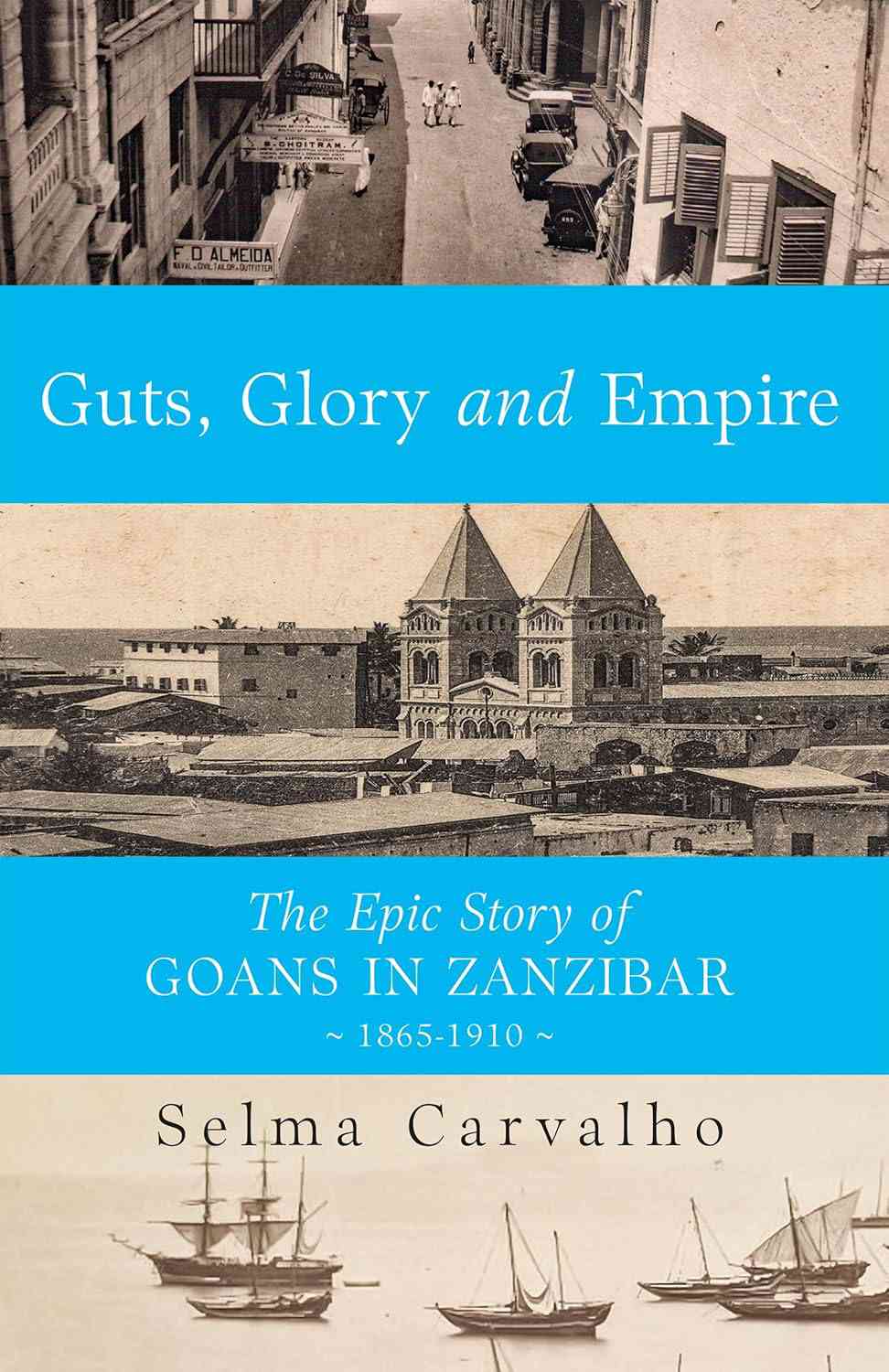
Excerpted with permission from Guts, Glory and Empire: The Epic Story of Goans in Zanzibar, 1865–1910, Selma Carvalho, Speaking Tiger Books.
