



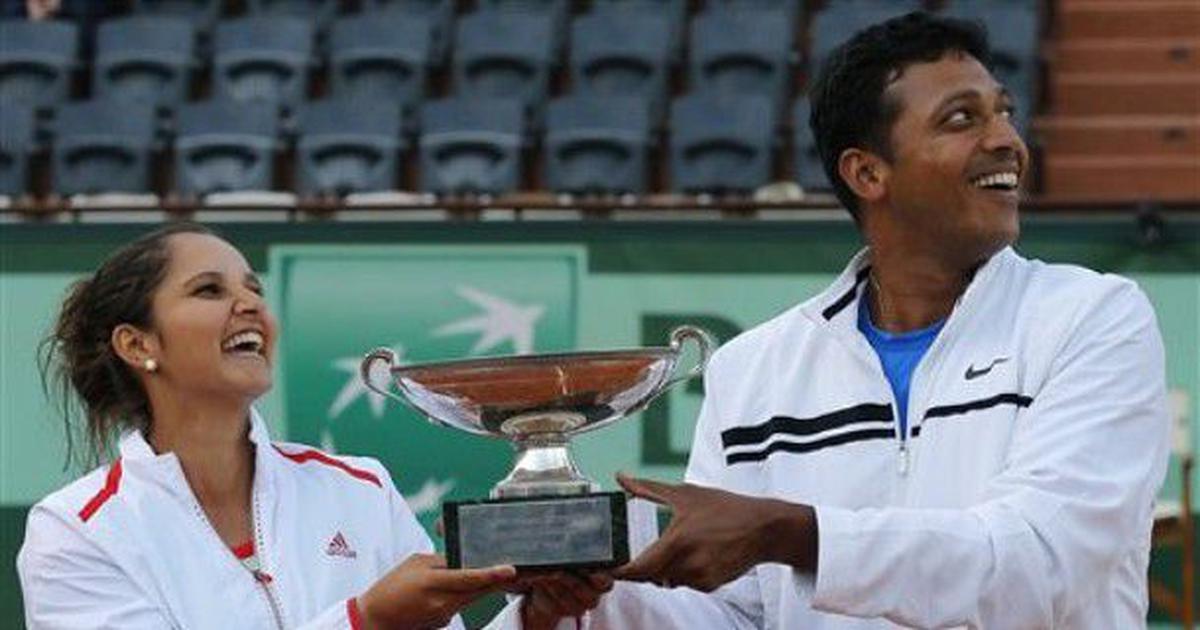
Before battling for the coveted Australian Open title in mixed doubles, Sania Mirza had already won the hearts of tennis fans worldwide, especially those from India. Her determination to challenge herself during tough times was something that her followers couldn’t help but admire. And her flamboyance on the court could not be missed. Young girls and women who did not follow tennis still knew her for her fashion sense, and it gave many a reason to start watching tennis, since Mirza had established herself as a rising sensation.
Players like Leela Row Dayal, Nirupama Mankad and Nirupama Vaidyanathan were early trailblazers in Indian women’s tennis. And following in their footsteps was Sania Mirza, with her remarkable talent and grit. She created a niche for herself and ponytailed girls flooded the tennis courts across the country to emulate the unparalleled ambassador for tennis in India.
Mirza was born in Mumbai, and her parents were from Hyderabad (colloquially known as the “city of Nawabs”). After many ups and downs, the family shifted to the US sometime in 1990. But they did not enjoy their time there, and finally, her father, Imran Mirza, decided to move back to India.
On returning to Hyderabad, Mirza’s mother made her sign up for tennis classes at the Nizam Club almost immediately. She wanted to ensure that her daughter would be set up for the successful life they could not afford in the US. The club’s coach, Srikkanth, a former national player, tried to refuse because Mirza was too young. But her mother was insistent, and that was how Mirza began her momentous journey towards learning the art of tennis.
Initially, she was determined to succeed in singles, which was the most popular event in the sport. But this proved to be quite difficult. Luckily, it appeared that destiny was leading her down a different but no less eventful path. She found her footing in doubles as well as mixed doubles. On becoming a professional player in 2003, she went on to clinch the Wimbledon girls’ doubles title with her partner Alisa Kleybanova. In February 2005, Mirza was crowned the first Indian woman to win a Women’s Tennis Association (WTA) Tour title at the Hyderabad Open, defeating Alona Bondarenko in the singles final.
In 2005, she made her Grand Slam debut at the Australian Open and reached the third round. The following year, she became the first Indian woman to be seeded (or designated a skilled player, to be met at a specific time in the contest) in a Grand Slam tournament at the Australian Open. She returned to the Rod Laver Arena for the 2009 Australian Open, partnering with the revered Mahesh Bhupathi. They began climbing the ladder of the mixed doubles tournament, one step at a time.
On reaching the quarter-final, they let the first set slip away when they lost 3-6. The sweltering heat was partially to blame. They also dropped serve twice. From there, they could only go up. There were seven breakpoints in the second set, and the pair could turn three of them to their benefit. They held their nerve in the deciding super tie-break, winning it 10–5. With that, they wrapped up the match with a score of 3–6, 6–4, followed by the super tie-break instead of a full third set.
The semi-final was a relatively easy affair, and the duo secured a spot in the final with a score of 6–4, 6–1 against Iveta Benesová and Lukáš Dlouhý. A title clash against Andy Ram of Israel and Nathalie Dechy of France was what lay ahead.
Mirza and Bhupathi were reasonably confident, having secured a coveted spot in the final of a prestigious tournament. Even though he was recovering from a loss in the doubles final the previous day, Bhupathi brought his top game to the court. As the match began, Mirza took the lead. Bhupathi later said that he had been fortunate because Sania had been playing great and had carried them through the early part of the match. After gaining momentum in the first two games, they unfortunately lost ground in three straight games, giving their opponents a 3–2 lead.
Mirza was always chirpy on the court, and Bhupathi, being much quieter, welcomed her optimism. They shared an easy camaraderie and truly enjoyed their time together on the court, but they never lost sight of the goal. Mirza was a ferocious player, and this translated into some well-placed shots, which gave Bhupathi the required space to add some finishing touches across the net. A forehand down the line closed the first set.
Even though the second set was comparatively easier to win, the duo came under pressure when Andy Ram delivered some powerful shots. But they weren’t enough to disrupt Mirza’s focus. Mirza and Bhupathi broke their opponents twice: Dechy in the fourth game and Ram in the sixth. Claiming games on the opponent’s service is always good for morale. After Mirza served next, the duo established their supremacy in front of a delighted audience and won the set 6–1.
No one can erase the data etched into the memories of millions. “Sania’s first Grand Slam title, coming at a time when she has been troubled by injuries, is a heart-warming one. Overall, it has been good news for Indian tennis, particularly for the youngsters,” Indian Davis Cup captain Ramesh Krishnan said.
“Sania was already a name on people’s minds,” noted Bhupathi. But with this victory, she became a household name as well. She was now a player of influence, and India was proud of her. Indirectly, Mirza and Bhupathi’s hard work also helped the textile industry in some parts of India, like Surat, where the demand for T-shirts printed with her name on them went up exponentially. This helped the industry stay afloat when the world was trying to overcome the impact of the 2008 recession.
Mirza’s success led to a massive rise in the number of girls enrolling in tennis lessons in academies nationwide. The demand for junior tennis rackets grew as Mirza scaled new heights with her dedication to the game. She became the flag-bearer for women’s tennis in modern India.
Sania Mirza went on to win mixed doubles titles in the 2012 French Open and the 2014 US Open. She also obtained three doubles titles by winning at Wimbledon in 2015, the US Open in 2015 and the Australian Open in 2016. But that particular win with Bhupathi as a partner holds a special place in Mirza’s heart. It was her first Grand Slam title, a historic moment on that hot Sunday in Melbourne.
Excerpted with permission from We Are the Champions: 40 Iconic Moments in Indian Sports, Akshay Lokapally and Vijay Lokapally, Penguin India.
