










Playing one’s natural game, one move at a time, is the key to performance at elite levels, and playing against players not facing these financial pressures adds an extra element of hardship to what is already a brutal climb. Once again, women in chess face even more in the way of disadvantage. “If you take a 16-yearold boy, he’ll play tournaments continuously. Parents usually can send the boy alone abroad and make him play. Whereas, when it comes to a girl, they might feel restricted. Financial expenditure could be more if you travel with a girl,” Koneru Humpy, former women’s World Champion and India’s highest-rated female player, once told ESPN in an interview. Expenses like international travel only exacerbate a situation that is barely comfortable for the average Indian parents and the society. As a result, more women players are forced to quit the sport than their male counterparts.
However, on or off the board, sponsored or not, some challenges are universal for kids playing in international tournaments. Surprisingly enough, the most common one cited in my interviews is gastrointestinal: cuisines in different countries can be wildly different, and finding satisfying, healthy meals can potentially be a tournament-defining factor. Heena Sadhwani, Raunak’s mother, recalls stories of stealthily cooking rice inside a hotel room (where cooking was strictly prohibited) when Raunak was younger and couldn’t or wouldn’t tolerate much diversity in his favourite meals. All the prodigies’ parents have similar stories dating back to when they were younger, and all the kids travelled to tournaments with a parent (almost invariably their mothers).
Another common constraint is the problems associated with air travel, especially from a country like India – which doesn’t have a strong passport. Besides jet lag, which has been known to spoil many tournaments early on even for super GMs, issues as supposedly trivial as visas can be make-or-break things for young players. In 2024, Arjun Erigais almost missed the World Rapid and Blitz Championships in New York because his visa was stuck, despite the fact that he was India’s highest-ranked player at the time. For players who are resident in states like Tamil Nadu, where the government is closely involved with chess, such incidents are often handled much more expediently than in Arjun’s home-state, where state-support is almost non-existent. Thankfully, the rising profile of chess in India has also led to widespread government attention and roadblocks involving bureaucratic red tape tend to be solved more quickly these days. Regardless, the most significant challenge for young players is internal, not external. Despite travelling to so many novel destinations even before they are teenagers, these prodigies hardly ever see anything outside of their rooms, computer screens and playing halls, even when they are visiting exotic destinations for the first time. While computers have democratised the information easily accessible at one’s fingertips, they have also generated an exponentially larger amount of theory for each player to review in preparation. Prepping for a new game is like preparing for an exam with an infinitely wide syllabus, since you are never sure what your opponent might have studied to surprise you. It is like attempting to cram as much material as you can in last-minute preparations before the clock starts ticking.
This has also been the reason that players of each new generation are objectively stronger than their predecessors – theory advances and they know more. The result: the number of hours spent studying and training the game has remained roughly the same across generations (according to Svidler and Ganguly), but the amount of knowledge crammed into those hours has grown manifold. Even before they are 10, children must submit to the rigours required of their trade in the face of temptation that even most adults would find irresistible when travelling. To anyone who has ever travelled with curious kids, the focus and willpower displayed by these prodigies can stretch credulity, especially when both players and their coaches confess that they don’t see it as an enormous exercise in will and focus. They enjoy it. Kids and adults alike, chess keeps them engaged.
“It’s a very natural reaction, I would say. If you are a child without any particular passion or ambition, you just go to school, get some good grades, get into university and so on. There is a minuscule population who are given that space to explore what they like, and they are just doing it,” says Ramesh. “The average child would probably want to go out…I think chess players have a tendency to get lost in the game,” GM Nihal confirms, looking back at his earliest tournaments.
Similarly, a 12-year-old Pragg confirmed the same in monosyllabic responses to my questions in 2018:
“Do you ever go around, see places?”
“No.”
“Did you want to go around?”
“No.”
“Any favourite country or spot?”
“No, only the playing.”
Attitudes like these run counter to our expectations of globetrotting child-geniuses, and further cement the perception of a monkish lifestyle. In an interview, Ramesh reiterated his point that the average person, especially an adult, has trouble understanding the single-minded obsession children can display when allowed to turn their passion into their profession. Beyond guiltily acknowledging the odd moment of distraction and perhaps expressing a fleeting regret while looking backwards, the prodigies I interviewed largely agreed with Ramesh’s assessment that they did not miss sightseeing, or the normal foreign attractions of cuisine and culture alike.
However, Negi seemed to have a contrarian, and perhaps more controversial, opinion looking back at his childhood with the eyes of an adult who’s now no longer a tournament player. “Children can be moulded to behave any way the adults teach them to be,” he says. You may take an unbridled love for the game for granted but the environment surrounding the child impacts their beliefs and behaviours. For children from less fortunate backgrounds, a lot of financial and logistical risk-taking on the part of the parents is involved in bringing the child to the tournament in the first place. This dictates the narrative around participation that the child imbibes. For players like Rustam, their performance was not a sporting but an existential proposition – the difference between them being able to feed their families or not as the sole breadwinners at a tender age.
Besides parents, the attitudes of the prodigies’ earliest coaches can have a huge impact on their behaviour as well. An indication of this can be seen in Ramesh’s thoughts. When I asked about the Fab Four’s answers about their childhood attitudes, Ramesh told me: “It’s a choice they make, not a sacrifice…the successful ones, they understand they have to choose between sightseeing and playing chess while travelling, and they choose chess. That’s why they succeed. If they would have chosen sightseeing, probably you would not be interviewing them.” Ramesh believes that average children succumb to distractions like sightseeing due to their lack of ambition, passion and self-belief. He attributes this inability to shut out distractions (“in over 95% of the common masses”) to lack of noteworthy achievements in life.
When pressed further, Ramesh goes so far as to say that the “choice” is not a choice at all but a child’s natural response to their passion. However, not every coach is in agreement with him. Rustam (Arjun’s coach), for example, disagrees with Ramesh’s assessment of the internal dynamics behind the child’s seemingly all-encompassing focus on the game. He said, “I actually just disagree. I don’t think that the life spent with a chessboard is a life, even if you get to be 2,800. And I’m not even sure that this works … if you take somebody like Pragg and you raise him like a monk, I don’t think he will be a better player for it.” His views are similar to Srinath Narayanan, coach of India’s Olympiad teams, besides being the regular trainer for Nihal and Arjun. “I personally differ from this [Ramesh’s] philosophy,” Srinath says, hesitant to explore this deeper.
Needless to say, the philosophies of parents and trainers have a decisive impact on the trajectory and psychology of a child, and we are not referring just to chess here. What appears as a child’s passionate pursuit of excellence and all its attendant benefits from the outside (reiterated as such in interviews to the media) may in fact be a product of extreme pressure that results when elders transmit their sky-high expectations to a child who puts their complete faith in them. This seems terrifyingly similar to some of the worst stories from the IIT and pre-medical exam rat-races made infamous by burnouts, mental health issues and suicide in extreme cases.
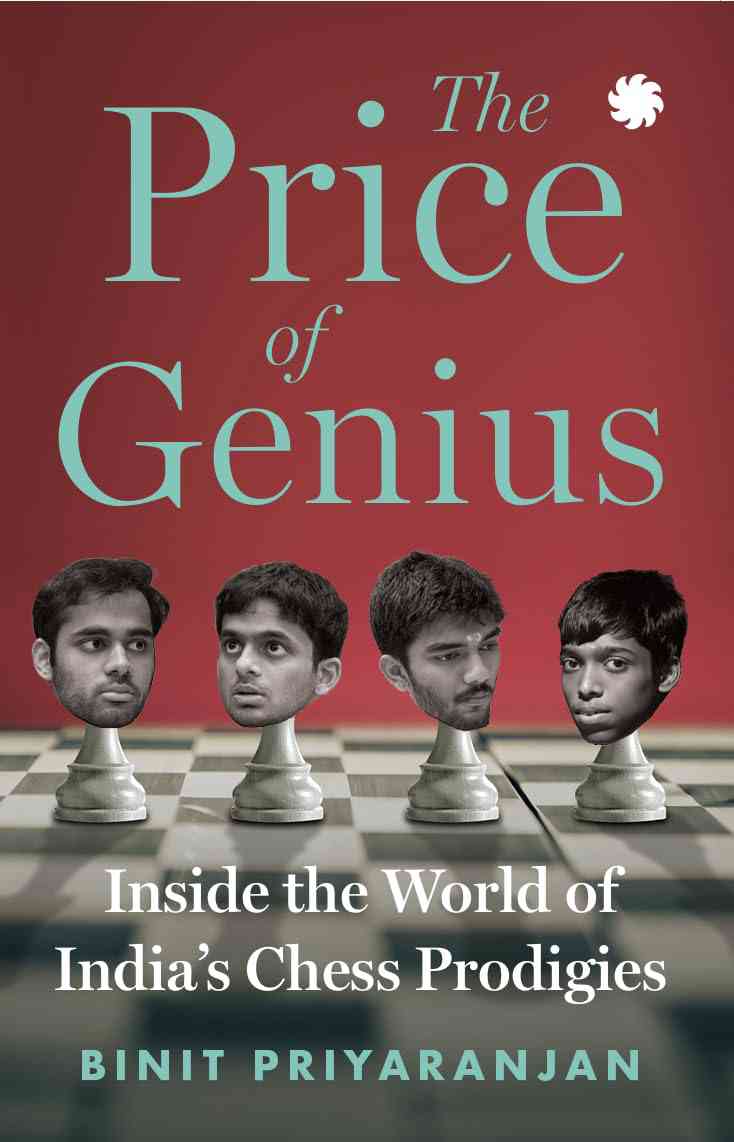
Excerpted with permission from The Price of Genius: Inside the World of India’s Chess Prodigies, Binit Priyaranjan, Juggernaut.
