









I have been that latecomer who missed the bus but never let go of the sound and colours of poetry. If attending literature classes or poetry dissection labs is a sine qua non for being a poet or a poetry reader, I gladly come from a place of nowhere. I read and recite poetry as though a non-believer’s repeated indulgence in sin.
It was Arvind Krishna Mehrotra’s sharp-edged prose in Civil Lines: New Writing from India (published by Ravi Dayal) that I read long before I came to his poetry. Later, I remember reading a few of his poems, but they did not quite grow on me. Maybe it wasn’t the right season.
Earlier in 2025, around the time I was reading Eunice De Souza’s Volcano, an editor-poet friend brought to my attention Mehrotra’s poem “Hoopoe”. Moving along the lines of that poem, I was seized with a desire to read more of his work. That was how I came to a volume of his Selected Poems edited by Amit Chaudhuri and Vidyan Ravinthiran. And it was happenstance that I stumbled upon Mehrotra’s poem “Elegy to E” while closing my review of Eunice De Souza’s Volcano.
Lockdown poems
Knowing Mehrotra through his writings, one gathers a fair sense of his views on what he thinks to be good poetry and bad poetry. One among them was his belief that Nissim Ezekiel was probably trying to break out of the dead-end that Sarojini Naidu and Sri Aurobindo had led Indian poetry in English into. From Mehrotra, I learned about Toru Dutt, who translated Baudelaire from French to English in her volume “A Sheaf Gleaned from the French Fields”. Through his translations, I was introduced to the poetics of Vinod Kumar Shukla.
For Mehrotra, reading poets such as Ezra Pound, Blake and Yeats was a way of entering into a dialogue with them and creating one’s own literary ancestors and context for what one is doing. It is in this frame that I read Mehrotra’s recent collection of poems, Of Least Concern. The book opens with a sequence of poems written during the lockdown. The lack of social distance and uniformity in the greening and browning of leaves, as well as their dying, is a natural state; however, it is not so when one considers the aftermath of Covid-19.
Close to each other
socially undistanced
the mulberry leavesuniformly green
shall turn brown together.
It’s like a herd dying.
Mehrotra’s style is restrained, and he does not launch into grand declarations or contemplative melancholy. If anything, they are lessons in attentiveness.
I heard a sound,
saw something fall.
What I saw was not
the sound I heard.The sound I heard
was a mango falling.
What I saw
was a falling leaf.
Reading the poem on the Himalayan flameback, one is reminded of Elizabeth Bishop’s poem “The Fish”. The poem becomes a palpable, living thing with a sense of movement.
It was there for a fluttering moment,
knocking on the plate of glass window
of the liveried hotel built with local
limestone, the Himalayan flameback
with a red crest, a black and white checkered
pattern on breast, a woodpecker bill
fashioned for drilling, before it returned
to the sun-bearing clouds, the flattened
grey hills, from whence it came.
Lessons on observing
Mehrotra’s poetry stands in its distinct space amidst the anxieties surrounding literary criticism and activism. Each generation of poets brings with them the questions, deliberations, criticisms and dismissiveness. While I disagree with Mehrotra on his criticisms of Jayanta Mahapatra or Sarojini Naidu and certainly do not feel compelled to subscribe to the poets in his best list, I respect his opinions in a democratic sphere. After all, in an interview with Asymptote, Mehrotra has said that “an anthology, whether of poetry or essays, is a pronouncement of the anthologist’s taste. If it is an anthology of contemporary work or includes contemporary work, it also gives you some idea of who the anthologist’s friends are.”
It does not deter me from preserving the integrity of reading his poetry – poetry that I believe in. In this garden of poems where trees fruit, flower and mulch with little concern, Mehrotra creates a world within pages where one can sit under the peach tree and watch the eared owl coming to take a dip from the bird bath or see a squirrel chew on hemp leaves.
A squirrel
jumped a marijuana.
It was the second attempt.As the waist-high plant,
half bent, lay on the ground
the squirreltore off a branch, stripped it
of leaves, held them
to its quivering mouth, ate.
When Mehrotra embarked upon his literary journey in 1964, there weren’t as many poets in India writing in English. Even if there were, cult schools like Bombay Poets were not accessible to those outside the circle. It wasn’t so even in the 1980s, as I can vouch for being the recipient of rejection slips from Nissim Ezekiel’s PEN Magazine, though it will always remain unknown whether he actually got to read my poems sent by post at all.
Poetry does not need a cult or patronage to survive. The poet needs to be attentive and dedicated. There are lessons we learn from observing. The poems in the collection Of Least Concern, arriving at a time when poetry is being written more widely than ever, serve as lessons in the art of observation, attention and distilling meaning into words. It exists not merely as a poetry book, but as a living reference on the aesthetics of poetry. Mehrotra’s poetry, in its precision and economy of words, creates a space encouraging one to train one’s eye and sharpen language and be unafraid to hold up a lens to critique one’s own writing. Much like a literary ancestor would.
Above me, a leaf shook.
It was a raindrop.
A raindrop isn’t nothing.
Smitha Sehgal’s poetry collection, Brown God’s Child, was published last year by Erbacce Press.
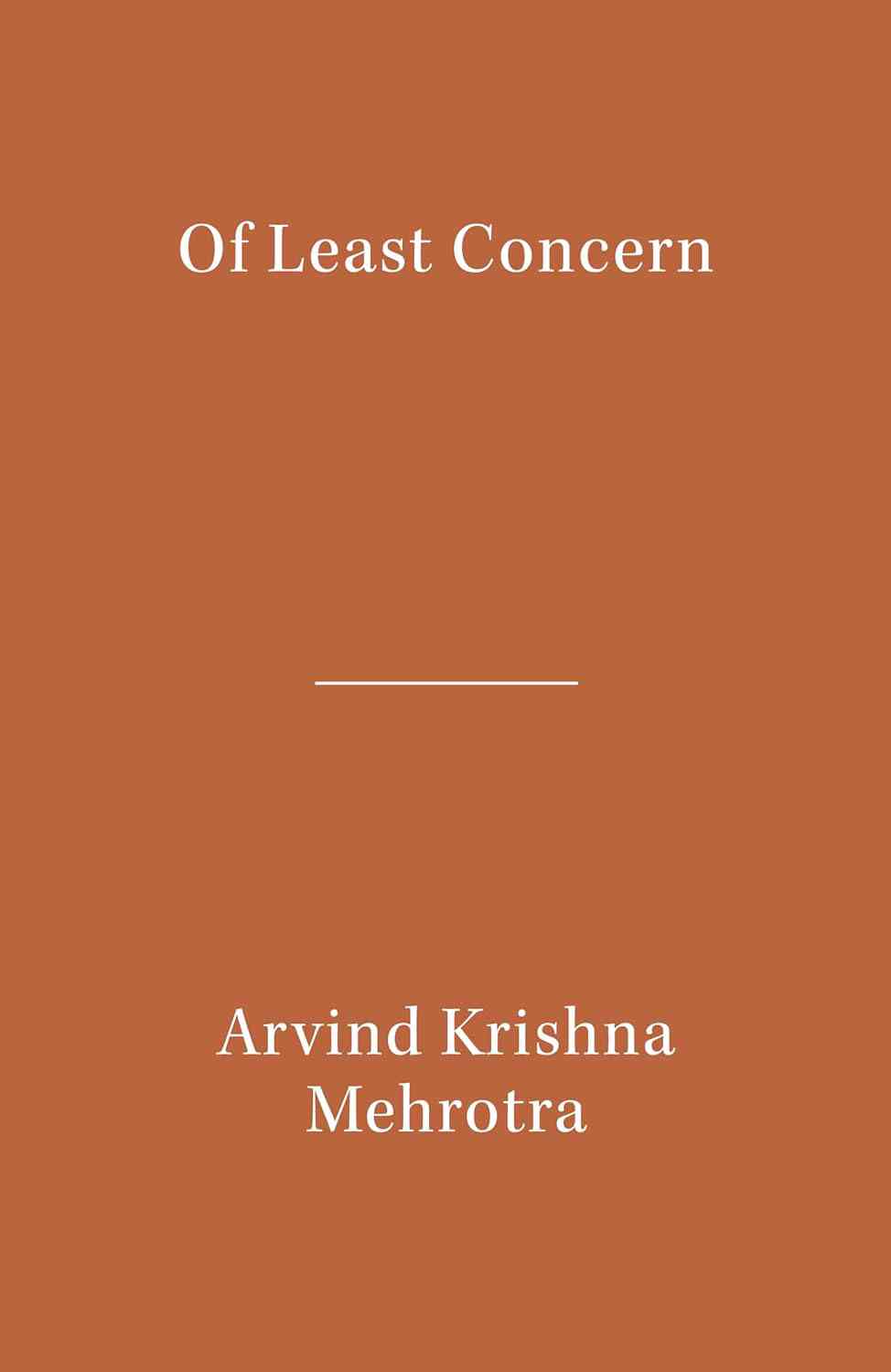
Of Least Concern, Arvind Krishna Mehrotra, Westland and Centre for the Creative and the Critical, Ashoka University.
