









Kuvempu’s novel Malegalalli Madumagalu (1967) is a classic for many reasons. It was the first of its kind in Kannada literature for the scope of the world that it portrayed and created. It has been described as one of the forerunners of Kannada literature for recording the voices, experiences and the lifeworld of the marginalised and the untouchables. Kuvempu captures in great detail the inherent cruelty of the feudal system and the dehumanisation of those who dehumanise others. It is raw, filled with a sustained sexuality, and the workings of an unthinking patriarchy. The most endearing characters are a couple belonging to the lowest of the low in the social hierarchy, along with a dog. The mundanity of this oppressive existence is part of the everyday rituals of living and dying. All of this is framed by the rich description of the Malnad region, filled with the sounds of the creatures and the multifarious presence of the rich, dense forest.
To translate such a text, one needs not only skill and patience, but also a dedication to Kuvempu’s work as well as an ardent desire for this book to be read by a larger English-speaking world. Vanamala Viswanatha’s translation of this novel (Bride in the Hills) is commendable for many reasons. While there has been significant attention paid to the mechanics of translating from Kannada to English, almost all of them have been clouded by the claim of the gap that seems unbridgeable in translating across these languages. Reading Viswanatha’s translation reminds us how it is possible to think beyond this problem of the gap.
Beyond the gap
An unnecessary preoccupation with the gap between languages does not lead to a fruitful translation. This issue arises primarily because of the reduction of language to meaning. Translation then becomes a search for the “same” meaning. However, language is always more than meaning.
There is a deeper issue about language that I want to begin with. What is a language’s relation to a story? Equivalently, where is the story to be found? In the language in which it is written? Or is it “outside” a particular language? Consider the translation of a simple word like “chair”. This word can be translated into many languages but all these words point to the object Chair. Translation is possible because the word that denotes the object is outside all those languages. This basic view of translation is very much present in the standard response to translating fiction, where the story or the location or events are seen like the chair: there is a story that can be captured in different languages. But this would imply that one can extract the story or location or events outside the linguistic world.
Thus, translatability reflects the belief that a story is outside the purview of particular languages. To understand this possibility, we have to begin with the process of reading. The translator is first and foremost a reader. But, at the same time, the translator is always more than a reader because the text has to be rewritten. Thus, to understand the nature of translation, it is necessary to begin by understanding the process of reading and writing. In the context of this article, I will focus on one important aspect of reading: as a process of imagining. The space of imagination that accompanies reading a story, for example, is different from reading an analytical or scientific text. When we read a story, we are actually not reading in terms of unpacking its meaning but in terms of experience and imagination. Language has one primary role to play in this: it is a medium to produce that imagination. Once the work of the imagination is done, language can be dropped off. To use a common analogy: language is the ladder to help you reach the imaginative world inside the reader and once you reach that place, the ladder can be removed.
Translation is the act of removing that ladder and replacing it with another ladder, replacing one language with another. In this view, a successful translation can be seen as one that is able to produce the experiences and imagination of the original novel. If this is the aim and consequence of reading, questions of equivalence and felicity are not as significant as it is made out to be by many translators.
A good translation is not about the felicity in one or more languages but rather the capacity to produce spaces of imagination from one language and reproduce/recreate it in another language. The movement from one language to another in the act of translation is always mediated and grounded in the imagination of the translator. A good translator of fiction reproduces imagination, not meanings, not words and structure. Does the translator have the capacity to enter and recreate the world in the imagination of the author? That is the real question. And I think this is really what Viswanatha succeeds so well in doing.
So, to first evaluate the success of a translation, we have to begin with the experiences of reading. We have to understand the relation between language and experience, and the meaning and role of language itself in telling a story. I have written about these points earlier and will not rehearse some of them here. Instead, I will use this as the framework to respond to this new translation of Kuvempu’s novel by Vanamala Viswanatha.
What is the experience of reading this novel? Kuvempu is not merely recounting a story or interlinked stories, nor is he celebrating the magnificent forests of Malnad. He produces an experience for us vicariously through his description. He uses language to incite our imagination, our memories, and our feelings and expectations – to produce a Malnad in our minds. It is not the physical region of Malnad. When we read the story, we are transported to a Malnad in our imagination. And, most often, we presume that this is the same as the physical region! This aspect of the where-ness of a story, where a story really resides, is important in the way we relate stories to regions.
How does Kuvempu use language to produce an imagination? And what happens to that language when it gets translated into English? Viswanatha’s translation is remarkable for it produces the sounds, the cadences, the feeling of Kuvempu’s novel even when read in English. This is possible only if the translator is paying close attention to the world of sounds and not merely to the written words and their meaning. Pay attention to the play of words rather than search for equivalence in another language. As I have always maintained, English and Kannada, like any two languages, share similar soundscapes. And the origin of language is sound. I am not surprised when readers have often told me that when they read my novels, they felt they were reading them in an Indian language, although they were written in English. The trick is to hold onto this common foundation of two languages and yet draw upon the uniqueness of each language.
Using Kannada words in an English text is the first step in producing this awareness of the commonality of sounds. When these words become a part of an English sentence, the sentence itself changes! The way the other words sound in that sentence changes. The relationship between these words and the Kannada words in a sentence produces a different experience of reading English. All the sounds of people, places, and idioms change the sounds of other English words. By paying attention to this phenomenon, the first possibility of producing new expressions in English is created. Viswanatha’s translation produces a sonorous world of Heggade, Appayya, Ayya, Gutthi, Anthakka, Holeya, Bettalli, Megarvalli and so on. When you use these words in a sentence, the words that follow are influenced by the sound of these words if you pay attention to it. If we produce English in resonance with the sounds of the world around us, from other languages, it will be a different English – first in the way it sounds and then in the imagination it produces in the reader.
With these preliminary remarks, I want to explore a couple of important points in this translation and enter into Kuvempu’s cosmos through the medium (ladder) of English.
Two translations
There is a major difference between the original Kannada novel and Viswanatha’s translation. The original text is in the past tense. Viswanatha makes an aesthetic decision to translate in the present tense. This has been an extremely effective decision. On the one hand, the use of the present tense adds a sense of movement and dynamism to the story. Moreover, given Kuvempu’s philosophical preoccupations in this novel, it complements it because of the idea of nature that seems so essential to this novel. Nature is always moving and dynamic, and in a sense the essential quality of nature is change and movement. One could ask why Kuvempu did not himself write in the present tense if this were to be the case.
One potential response to this question is from Prof KV Narayana, a renowned linguist and Kuvempu scholar. He points out that there is an interesting ambiguity in spoken Kannada which allows a text to be potentially read both in the present and past tenses. As he remarks, “The past tense in Kannada can also be used to indicate non-past time. For instance, the past tense could very well refer to action that is happening in the present in an on-going conversation in a scene. Hence, the reader has the liberty to choose whether s/he would like to read it as a scene being unfolded at the present time or as a happening in the past which is being reported.” He makes the important point that the way tense and aspect work in Kannada differs from that of English, and that may allow this transposition of the tenses. While this may be particularly true of spoken dialogues in a novel, the tenses in literary descriptions of nature, people, communities and such may be far more difficult to transpose, yet this channel of inquiry is an important one for future theoretical work on translating between Kannada and English, and perhaps for other Indian languages as well. Viswanatha has also described the difficulty in translating different types of pastness that are there in the original text such as immediate past, near past, far-off past and so on. This brief discussion is only to highlight the kind of difficult conceptual questions that lie at the foundation of this monumental translation!
Writing a novel in the present tense has its own limitations, for it does not allow a space for reflection that a novel written in the past tense can produce. However, Kuvempu has taken care of this problem by using his authorial voice spread through the book. So, independent of the tense, he is able to say what he wants as third-person reflections. I think it is reasonable to argue that it is because this authorial voice is already present in the original text that Viswanatha is able to carry off this shift into the present tense.
Ironically, the use of the present tense brings the novel closer to Kuvempu’s conceptual preoccupations. As I will discuss below, his approach is characterised by an experiential mode that draws upon the world of the senses in multiple ways. It is an experiential, sensorial novel. Even the theme of caste arises most powerfully in this novel as a sensorium. Experiences are captured most closely in first person, a description of what happens as it happens and not after it has happened. Writing about an experience in the past tense is not really about the experience but about the memory of that experience. So, paradoxically, in making a move to the present tense, Viswanatha actually comes closer to the spirit of the novel.
Practically speaking, this shift does something more. It allows her to translate the story not through some framework of linguistic equivalence but in terms of an imaginative equivalence. I will illustrate this by comparing – albeit very briefly – her translation with an earlier translation of the same novel (The Bride in the Rainy Mountains, KM Srinivasa Gowda and GK Srikanta Murthy, 2020). Through this comparison, I am not evaluating the translations or claiming one is “better” than the other. I am doing this to illuminate the process of translation from one language to another and to illustrate how a translation can be when mediated by the imagination of the reader/translator.
The first two paragraphs of the novel in the first translation are as follows:
Having crossed the large front door of his master, Simbhavi Bharamai Hegde’s house, Nayigutthi, the untouchable serf, paused on the last step of the front courtyard and stood staring at the sky. At this very moment, from the adjoining areca farm came the household servant Marati Manja carrying a bunch of bananas in one hand and banana leaves in the other, walking really slowly, despite his height. Seeing Gutthi, he spoke even more slowly than his walk, “Hey, Gutthi, why are you looking at the sky? Huh? Going somewhere? You seem to be all dressed up, huh.”
Though far stronger, Gutthi was very short compared to Manja. So, he could look up at the sky as well as Manja’s face at the same time as he said, “I am looking out for this blasted rain. Do you think it will start raining now?
Viswanatha’s translation of the first two paragraphs is as follows:
Gutthi, Simbavi Bharamai Heggade’s Holeya vassal, steps out of the main door of Heggade’s homestead with a central courtyard open to the sky and stands on the last step of the front yard, peering wide-eyed at the sky. Marathi Manja, the household servant, ambles up leisurely despite his six-foot frame, carrying a bunch of bananas in one hand and a bundle of banana leaves in the other, from the areca plantation adjacent to the house.
He stares at Gutthi and quips in a sing-song manner more sluggish than his languid gait, “What Gutthi, all dressed up, aan? Why are you standing here staring at the sky? Long way to go?”
Gutthi, shorter than him, yet much sturdier, mumbles, taking in the sky and Manja’s face in one glance, “Checking to see when this wretched rain will cease… uh… do you think it could pour suddenly?”
There are many points of difference in the first two paragraphs themselves – in a novel that is over 750 pages! The shift to the present tense changes the language too, as well as the kind of descriptions that are needed to describe the “same” event or the “same” happenings. The present tense of Viswanatha’s translation begins with Gutthi, who is the agent of the present tense. We follow him throughout the novel. And most naturally, her translation starts with him. In the first translation, Gutthi “crossed the large front door”, whereas in the second version he “steps out of the main door”. In the first version, his action is passive as it begins by saying that he had already crossed, whereas in the second version, his action is brought to the imagination of the reader. Thus, he “paused on the last step” becomes “stands on the last step”. Similarly, “stood staring” becomes “peering wide-eyed”. The next sentence begins with “At this very moment” in the first version which becomes unnecessary when written in the present sentence, where that becomes “ambles up leisurely” since the present tense already has within it “at this very moment”. The choice of the tense influences the words that can be used aesthetically in a sentence.
The last couple of lines in the first paragraph in the first version become the second paragraph in the second one. Interestingly, the order of the questions in the dialogue has changed. In the first, the question that is asked is about him staring at the sky and then the question about his being dressed up. In the second version, the first question is about being dressed up and then about staring at the sky. Are these differences inconsequential to our reading? Perhaps, if we only look at translation as a linguistic act but if we look at the novel as a text that produces particular forms of imagination, then definitely these have a major consequence on how we experience what we read. A present tense description focuses on the person looking at the sky and thus begins with the description of the person. The sky comes after the person in the order of experience. Whereas when written in the past tense, this temporal priority is not as important. So also the difference between “spoke” and “quips”.
The final paragraph in both these versions also has noteworthy changes. “… was very short” becomes “…shorter than him”. And “I am looking out for this blasted rain” becomes “Checking to see when this wretched rain will cease…” In the past tense, it is easier to use a term like “very short” than in the present tense. Looking out for the “blasted rain” is far more common in British writing. I think it is possible to argue that the expression “checking to see when this wretched rain will cease” is more Kannada than English in terms of its cadence and movement. It has cultural connotations where “checking” is used across a variety of everyday talk. “Blasted” versus “wretched” is also an interesting shift.
If the first few lines themself produce so many interesting contrasts, imagine comparing the full texts! Perhaps that can be a linguistic exercise that may be useful only to teach some skills of translation but my purpose here is to use this as an example of my argument about what is being translated and where translation really happens. In Viswanatha’s case, the use of dynamic, action-oriented words is catalysed by her decision to change the tense. This produces a different imaginative space in which the reader resides when she reads the book. My argument is that her translation is not as much concerned with meaning but with producing an experience of the events in the book. As readers, we are not spectators or witnesses to what is happening to Gutthi (as in the past tense) but we are walking with him (in the present tense). It changes how we respond to the story and how it can have an affective influence on us.
The first version is perhaps more “faithful” to the tense of the original, as well as to “proper” English. But is that what translation should be faithful to? The second version is perhaps more “faithful” to Kuvempu’s imagination and the goals of writing this novel. It is also more “faithful” to the sounds of language. That is, the sensorial is not only with respect to descriptions of nature and people in the novel but it is also about paying attention to how Kannada and English sound. It is manifested in many ways in these initial paragraphs: Heggade versus Hegde is one such. Heggade is more commonly used in Kannada speech. In the first two paragraphs, we can see another potent example. The first translation translates the sound made by Manja as “huh” whereas Viswanatha retains the word as aan, thereby producing this sound as part of the English text. For me, this is one of the most important qualities of translation and it is based on how we understand the nature of language. It is in this exchange of sounds that the first possibility of touch between the original and translated languages is possible. While these observations may in general be true, it does not mean that the present tense is always better than the past tense used in novels. That is obviously not the case. However, in this particular novel of Kuvempu, the role of the senses and experience is so deep and broad that such a change seems to be more “faithful” to the original spirit of the novel.
Interestingly, Devanoor Mahadeva, in the Afterword to Viswanatha’s translation, gives an anecdote from Kuvempu’s daughter’s book. When he was writing this novel, his daughter reminded him to have coffee. Kuvempu asked her to wait since he was “listening” to the sound of the wooden staff beating the cauldron, the signal for the bride Chinnamma to run away from her wedding place, as it takes place in the novel. Mahadeva writes that it “looks as though even the novelist was keenly listening to that sound” in the novel. The success of this translation is that Viswanatha is also keenly listening not just to the sounds in Kuvempu’s novel but also to the sounds of the English language as she translates.
There are other conceptual questions that are at play here, and I can only briefly allude to them now. The first is the idea of freedom in translation. How can we conceptualise this idea of freedom in the act of translation? Freedom is not a universal idea but one that is sensitive to contexts. We can be free as individuals but at the same time constrained by our bodies. Or by our language and prejudices. We may think we are free beings in a society but we are nevertheless under various social constraints. I raise this point because there is a fundamental tension between the belief about freedom in (creative) writing, in contrast to translating. But what exactly is the nature of this difference? Translation seems to be obviously limited in that it is always with reference to an original text. But yet there is a scope to go beyond these constraints, as in improvisation in Hindustani or Jazz music. A good translation is about these moments of improvisation; otherwise, like in music, it only becomes a rote repetition. In this sense, translation is always a creative act and the character of freedom in translation is a measure of its creativity.
Another important theme is to recognise the active role that translation plays in producing a text. I have earlier discussed in more detail about how translation functions as a method to produce new meanings and new languages, which directly links to the above point about the relation between creativity and translation. The task of creative writing is to produce a new language as much as it attempts to produce new expressions in a given language.
The sensorium of the novel
Viswanatha mentions some salient points of the novel, which are worth a reinterpretation. She points out that journey is the central trope in the novel. Gutthi’s journey anchors the story. As she notes, “all forms of sentient life from dog Huliya to Swami Vivekananda – are a part of this epic journey”. However, the story is not the journey but how the journey is made. There are many ways of describing a journey but I think it is useful to see the central journey of Gutthi through this long novel as mimicking the changes and transformations of the natural world around them. In other words, while journey is the central trope, the journey itself mimics the natural order. I would go to the extent of suggesting that the most important element of love that anchors Gutthi’s journey is itself a naturalised form of love, one that sustains between the creatures of the forest. Whether Kuvempu did this consciously or not does not really matter since the language of the text produces this correspondence, as I will show in some examples later.
These observations are not a surprise since Vishwanath points out that Kuvempu saw himself as a “poet of the forest”. She suggests that nature is all-pervasive in his novel and dubs his vision as “biocentric” vision. She also points out that “Nature is a determining force that shapes every character and situation in the novel”. The sonorous world of the novel includes that of non-human entities. These are important observations since they give us a framework to read the novel. Can these elements actually influence the way a story is told? Will it change the way we interpret and thus translate the novel?
Reading Kuvempu experientially and sonorously is to live in the forest of your imagination. You have to project your imagination into the shrubs and trees, amidst the fear of seeing animals and tigers as you read. This is not about the reader’s imagination but more a strategy of reading this text. I don’t know if Kuvempu intended it to be read this way but when I wrote my novel that is set in almost the same region as this novel, I did not want it to be read as a linguistic account of some events but rather as a place to be in, to live with. Reading becomes that act.
This means that the story of this novel is hidden inside this landscape. It is distributed among the shrubs and trees, and the dirtiness and ugliness of human societies. Many readers have argued that this is a novel about caste practices, as a seminal Holeya novel. (The protagonist is a Holeya, seen as an Untouchable.) This is important as far as the history of modern Kannada literature is concerned. But how is caste described in the novel? How does Kuvempu write about the sensibility of caste? Interestingly, he produces the sensibility by invoking an experiential domain of caste. He is not really commenting on caste atrocities in terms of their history or sociology, but instead produces a sensorium of caste. In fact, the most important contribution of Kuvempu towards the study of caste in this novel is to reproduce it at the level of sensorial experience and not in terms of social power relations alone. Caste as sensorium becomes the dominant motif through the novel, and, interestingly, it is closely related to the sensorium of Nature.
I think that it is because Kuvempu’s imagination is so much in the sensorial world, his attempt to use language to reproduce (not represent) this sensorial world makes him use the authorial voice. He realises – especially as a sensitive dominant caste writer – that presenting the sensorial world that is the foundation of caste practices does not let him comment on the immorality of these practices. It is this tension that might have forced him to use an authorial voice to comment on the social problems of caste.
Reading experientially also challenges the common practice of isolating stories and locations as if they are independent elements of a narrative. Commonly, we say that this is what the story of the novel is or that it is about particular locations. In so doing, we talk as if a story is set in a place, as if there is something called the story and another entity called the place. Stories are often seen to be about humans and the place is the locale where a story happens, one that produces the atmosphere. This prevalent view of understanding fiction reproduces the deep modernist view of nature and the non-human by placing them at a lower hierarchy than the lifeworld of humans. In my second novel, Water Days, I argued that Bangalore is an important character in it but some didn’t understand the difference between a locale and a character. Bangalore is a character because it does everything that a human does except speak in a human language. I went further to claim that the city has its own language, one that is not reducible to the human ones. Reading the novel as if Bangalore is a character is different from reading it as if Bangalore is a locale in which the events happen.
This framework of reading matters to translation because the meaning produced from this framework is different from that produced by seeing a novel as being about a set of human actions. Places act, they have an agency, they are part of the dynamics of human actions. Many stories might not be sensitive to this possibility or might view places as non-agential and thus focus on the human elements. But some others don’t. Some might imbue places with vitality of their own not through the claim that they have agency but through other mechanisms such as spirits and so on. Some might imbue nature and the built world as the basic framework upon which the story rests. In other words, the story, as said, would not have been possible if not for that environment. I believe that the Western Ghats plays a similar role in Kuvempu’s novel, as it did in my novel Following a Prayer. One way to understand this is through the framework of foreground and background. Places and environment are often seen as the background to a story that is the foreground, but how to read a novel that actually has it the other way, where the humans are the background although they seem to be at the foreground?
Nature and the natural
But what is it to write about the non-human world in a human language, with human sensibilities? Kuvempu, I would argue, is sensitive to this question. While some have pointed to the great details of nature writing in this novel, they should see it not only as a detailed description of nature but also as a struggle to capture the language of nature. The rustle of a branch is a linguistic description but that event has its own language, which can only be recovered in multiple translations. The world is communicating to us and all that we have to do is to train ourselves to listen to it. Language is the sense of hearing and not of seeing, although we have reduced literature to acts of seeing alone as in reading. Kuvempu hears the world as much as he hears people speaking. The language of nature in Kuvempu’s novel is a sensorium, filled with inputs from all the senses and not merely that of seeing and interpreting.
There is another clue as to why I think this framework is a meaningful one. Viswanatha points out that the narrative in the novel uses three registers: “dialogic, descriptive and reflective” – the spoken, idiomatic and stylistic, and a “high register” that has philosophical dimensions. If we see this text as recovering the languages of the non-human from which the perspective of the human should be seen, then this authorial voice becomes necessary. There are different ways of doing this: one, mutate and produce new languages to capture this world or two, use a god’s eye view or three, as in Kuvempu’s case, the nature-eye’s view to reflect on itself. I used the first option in Following a Prayer to find traces of these multiple voices, although it was very tempting to use the authorial voice.
Here is an argument why I think Kuvempu was attempting to do this when he wrote about the non-human: it is because of the way he writes about humans. His characters are quite troubling ones. His descriptions of the landlords as well as Gutthi are quite brutal and animistic but there is always an attempt to “nature-them” (in contrast to naturalising them). Nature’s qualities, when transposed to humans, produce a shift in values. Kuvempu’s evocation of nature is in terms of deep sensory qualities that include strong odours, sounds, sights of decay and so on. The people who inhabit this novel are also of the same kind but in their bodies, these sensorial qualities take on a repulsive aesthetic and social value. Thimmappa is described as follows: “decayed teeth, squint eyes, disgusting open-mouthed gape…odourous sweat, sickening spittle…”. His portion of the house is made of hay while his cousin – who in the act of getting cultured, moves away from these qualities – is replacing hay with tile. Unfortunately, Thimappa inherits other “wild” characteristics such as “his propensity for violence, cruelty and brutal behaviour”. Bathing is also used as a mark of distinction: Thimmappa has a bath only once a week, whereas his civilised cousin takes a bath every day, influenced by a brahmin. Thimappa’s father too is known to treat the women in his house as slaves and allow them to have a bath once a week. The front yard of his house was “filled with filth, stinking to high heaven” but it does not bother him.
Gutthi is part of this “natural” world. He too is like that but in his case, it is due to his poverty and the work he does. It is interesting that filth and its sensory manifestations occur across caste, and it is only the brahmins who are described as being clean because of their daily bathing and clean dress. The senior Heggade loves his pigsty and its smells are perfume for him. The way he treats his son is particularly brutal and mocking.
Right in the beginning is this description about Gutthi – “Like a rock in a mountain or a tree in a forest, he is an element of Nature”. This is interesting since Kuvempu locates Gutthi’s being an element of nature by comparison to rocks and trees. It is also an interesting insight into how Kuvempu sees Gutthi – steady and strong as a rock throughout the novel, and protective as a tree. Is it a slip or a deliberate use of these analogies? Throughout, Gutthi responds to nature as he does with other human beings. Right in the first chapter, he curses at the overflowing stream.
Gutthi is seen by the landed to be on par with animals. Anthakka’s daughter Kaveri sees him admiringly as she would a bird or a bull. Kuvempu cannot resist his authorial voice, adding that caste prescriptions make it impossible for them to have any relationships and this obstacle actually becomes a “dharmic protection” – a bit of a problematic conclusion. The function of the Holeya in this novel – representing nature, open to gaze but also to gaze back, relating to everybody because nobody is afraid of him – turns the most sombre elements into ordinary events. Such as in the story of Nagakka who is the object of lecherous interest by older men who want to have a live-in relation with her, but this description is triggered by Gutthi looking at them and then accompanying them across the dense forest.
Sexuality too is deeply nature-themed. Sex is not a cultural and social practice. It is raw desire. Its performance too is described as if they are all only basic animal instincts. Whether it is the old man Heggade’s desire for a(nother) wife or his son’s lust or even Gutthi’s approach to sexual desire, they are all at the primal level. It is as if the people living in that region cannot escape being like the world they are surrounded by. Nature too participates in this by allowing them affordances to do what they like, hidden from other eyes. Most of the men, especially the Gowdas, are shown as lustful after any woman.
Towards a metaphysics of translation
There are many registers to the use of nature and the natural in this novel. It is important to recognise that these terms are a potential problem for any translation. Nature, as is well-known, is one of the most polysemous words in English. It has multiple meanings and its reference is always unclear. In the original novel, there are different words such as prakriti, nisarga, and svabhava to refer to these terms. The translation into nature and the natural may seem to be restrictive and may perhaps remind us of the pernicious gap argument in translation. But when seen in the context of the production of imagination, we have to look at these terms in terms of the work they do in producing similar imaginations in their respective languages.
We should remember that the concept of nature has been socially produced over the ages. Although we may use the word over time as if it has a stable meaning, every epoch has produced its own meanings of nature. As I often like to say, there is nothing natural about nature and these are socially produced conventions. So too in Kuvempu. While it seems as if he is acting as an observer of his world and a witness to its events, his construction of nature is influential in the structure of the novel. Many have commented that there is a naturalness to the story – but what does this mean? Recounting as is? Without any intervention? But this is not fully true. Authorial voice is the voice of culture and wisdom. The recounting is the way things are, how events happen and so on. It is the raw material, whereas the aesthetics is the white brahmin dress and taking a bath. Nature has to be cleansed in order to become part of a cultured society but at the same time, his use of svabhava for nature/natural has the potential to equate the natural and social order. Kuvempu describes the Holeya colony in terms of its terrible smell, as “undivided family of animals” that includes humans along with pigs and cattle. But from whose perspective is this description? In the novel, while it may seem to be the point of view of a character such as the Heggade’s son, it is nevertheless not that of the Holeyas themselves or of their self-description of their sensory world. What would be their description of their living conditions? Is there really a natural gaze? Is that the same as a god’s eye view? This “obviousness” that is often mistaken for natural is found in this novel too. We can see why the authorial voice is important since there is an assumption that there is a universal idea of Nature and that can only be accomplished by the authorial voice. Kuvempu refers to the Holeyas being bound (as vassals) to the Heggade as natural; he calls it a “natural phenomenon”. It is clear from the context he is speaking but this ambiguity is an important sub-text in the narrative.
This distinction also enters into the description of two parallel stories of romance. Chinnamma and Mukunda’s romance is described as if it is preordained, invoking ideas of rebirth and memories of past life. This is definitely a reflection of their higher caste and the naturality of love becomes entwined with the social narratives of rebirth and karma. There is an idea of the naturality of rebirth and karma too, but the definition of nature gets changed in this case – it is about nature as sacred, and beyond the temporal. In contrast, Gutthi’s romance throughout is “natural” in that it is animalistic.
Equally important to note is that nature is not only about the locale, but it also provides the model for human action. This is possible in the semantic world of dharma, which can refer to both natural properties as well as right human action. And many times these worlds mix in the writing, which would have been more pronounced in Kannada since these resonances are present in that language. Two simple examples: “Gutthi sits there as if he has become the roar of the roiling stream”. And when referring to Sesanayaka and Thimmanayaka talking, Kuvempu writes – “The torrential rain barely penetrates the edges of their consciousness”. I especially like this entry of nature into human consciousness, as it shows the porous boundaries between the two. Such an interpolation between the natural and the social may actually be a tacit acknowledgement of the difficulty in dealing with these concepts in this novel, as exemplified in this remarkable translation by Viswanatha.
However, a final caveat of my own argument is this: In Chapter 45, Kuvempu talks about the majestic imperiousness of nature and asks why should this magnificent Nature ever be bothered by the happenings of humans? Devanoor Mahadeva, in his Afterword in Viswanatha’s book, too refers to this passage. Here, it might seem as if Kuvempu’s Nature has nothing in common with humans and there is no natural/social relationship that is possible. However, the different uses of Nature (and their various Kannada terms) tell a different story, which can be unpacked by deconstructing his idea of nature consistently through the text. But in the imagination of Kuvempu, if Nature is the supreme manifestation, then it actually shows the importance he gives to Gutthi in this novel. Gutthi is in the most natural state of all his characters. He is rejected by others but one with nature in various ways. Was Kuvempu, through this authorial declaration about Nature, actually saying something very important about the exalted status of Gutthi and the Holeyas?
I will end with a fascinating practical “problem” in the translation as pointed out to me by Viswanatha herself. I end with this because in these questions about natural and social, the word ‘human’ is consciously absent. This is because the human has always been a troubling concept as far as this binary is concerned since sometimes humans are seen as belonging to nature while at other times they are not. But the problem of the human is an unasked question in translation. One simple illustration of this is the difficulty in acknowledging human subjectivities in translation. As Viswanatha states, while she used the pronoun ‘he’ with reference to Gutthi, she used the pronoun ‘it’ through the text to refer to his faithful companion dog, Huliya. This was necessary to establish the different actions of Gutthi and Huliya who are inseparable in the narrative.
This was a conscious choice that also mirrored Kuvempu’s use of ‘it’ to refer to the dog. However, towards the end, in Chapter 56 where Huliya drowns, she has translated the reference to the dog as ‘he’, without her own knowledge! In other words, she had become so immersed in the imaginative world of Gutthi and Huliya that she began to see Huliya as a human, going against her conscious decision to use “it” to refer to him in the rest of the text. She described this act as a slip, an unconscious act based on some subconscious belief. But I do not see this as a “slip”. Her action actually points to the moment of translation, where she was a reader and writer simultaneously. Immersed in the imagination of the original text, she yet transcended it to produce her own words that went beyond the original. This is the consequence of translating the imagination, and not of words. It also illustrates the metaphysics of translation, the simultaneous act of being grounded (as in reference to an original) and yet being in a state of transcendence, of writing while reading, of imagining while sensing.
Also read:
‘Bride in the Hills’: Kannada writer Kuvempu’s novel depicts life under the ruthless regime of caste
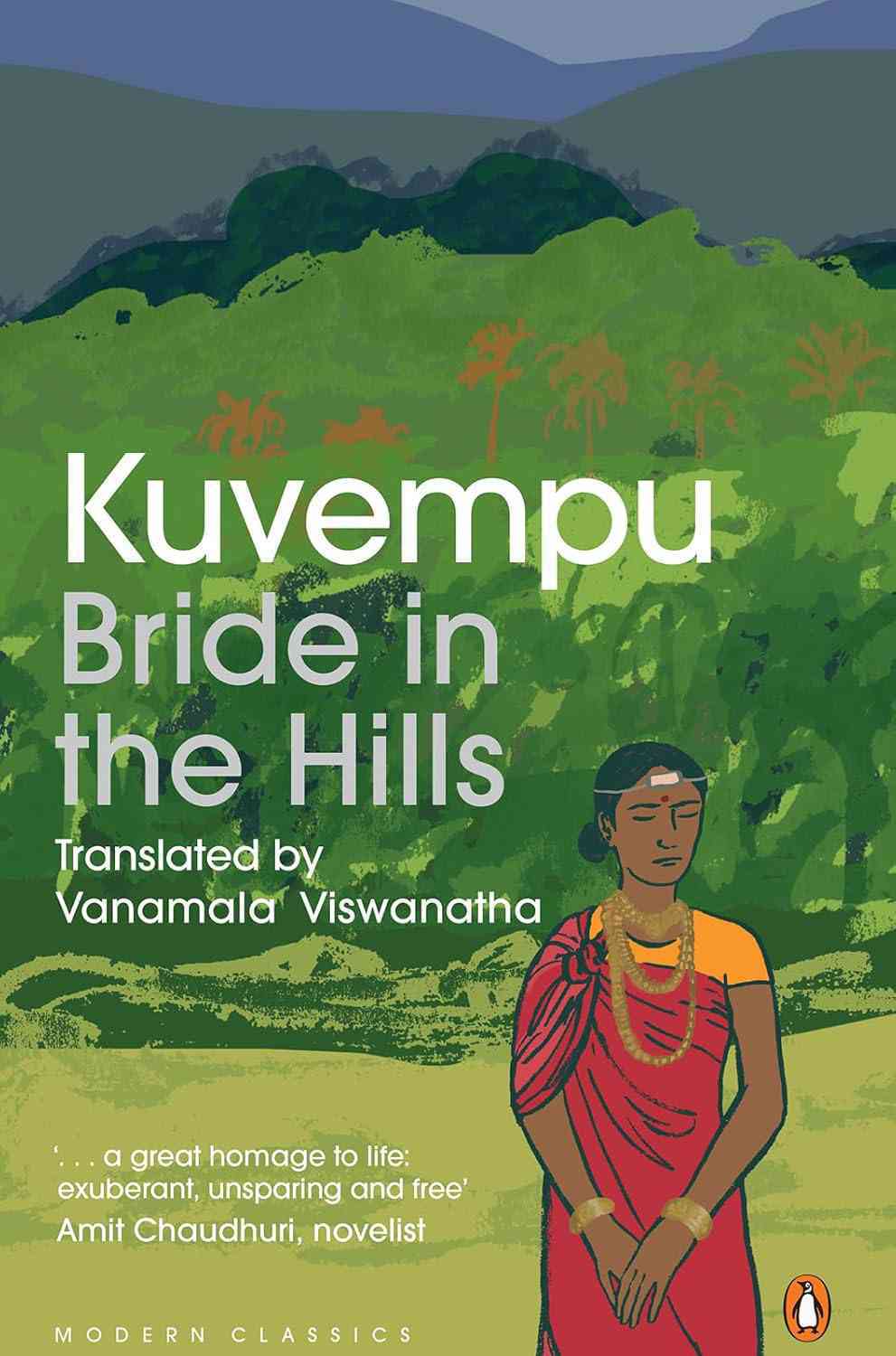
Bride in the Hills, Kuvempu, translated from the Kannada by Vanamala Viswanatha, Penguin India.
