



The big fort that surrounded the city of Thiruvazhumkodu was built in the time of the late king Maharaja Ravivarma Kulasekharan Priyadarsanan. The fort walls slanted downwards, measuring eight-feet thick at the base and six-feet thick at the top, and were as tall as two men stacked one above the other. There was a thatched roof on top. All along the length of the fort, at every hundred feet, great teak trees rose up into the air, with watchtowers built into them. Rope ladders swung down from their sides. Guardsmen dozed on the towers, spear and bow in hand. On the other side there were platforms with steps leading up to them for archers to perch on and take aim.
It was a bright morning. From a distance I could see smoke rising up in the air from the home kitchens inside the fort and dissolving into the sky above. The slow turn and fade of the smoke made it seem like the whole town was in a slumber. The tall fronds of the coconut trees raising their heads above the fort walls made the fort appear like a basket filled to the brim with grass. All the houses there were hidden in the green. They were all homes with thatched roofs. Only the king’s palace had a wooden roof and two storeys, and even that could only be seen when you went close.
I had my horse going at a fast trot as I approached the fort. However, the regular, unchanging face of the fort wall made me slow down. When we encounter specimens of vast stillness, like mountains, lakes or forts, we tend to rush past them. This has always struck me as a kind of folly. The fort rode along with me to my left, coming up into my sight like the wall of a grand homestead. Sometimes it looked like a wild elephant’s broad, unwashed clay-covered back. When I looked with my eyes half-closed, it almost seemed as if a very muddy river was running alongside me.
Foreigners marvel at the walls in our part of the country, built of just clay and water. The clay, brought from the ponds, is mixed with fresh sand, stamped and squelched, and allowed to rest for eight days. Then some limestone goes in and the whole thing is trod on, mixed, rolled into balls and piled up into layers to make the walls. Only the excess mud is polished off to make them smooth. These walls have been standing without a single crack for 400 or 500 years. Even the rainwater does not dissolve the clay. Such structures stand like new for centuries; it is enough to just renew the thatch on the roof every year.
Soil turns into stone. If left untouched, it locks into itself, hardening into rock with each passing year. The old fort at Eraniyasinganallur has turned into rock now. Time is flowing by. The kings are changing. The Pandya empire gave way to the sultans’, and now the sultans have also gone. But the fort continues to solidify silently.
When I reached the gates of the fort, the man in the watchtower recognised me. He seemed surprised to see me without my flag-bearers, attendants or guards. I saw him turn to the other warrior in the tower to ask if it was really I who had come. The fort lay open. Its wooden gates on both sides were splayed wide, their bases buried in the mud and soil underneath. It must have been thirty years since they were last closed.
The elephant-flanked Gajalakshmis on the gates had blackened with rain. The snake-like nagabandham and yali sculptures on their upper edges had taken on the appearance of stone. The crescent-shaped door handles and iron chains all looked like they were made of stone. The whole door was slowly turning to stone, I thought.
There had been no gates to begin with. It was only in the time of Maharaja Veeramarthandan that they were put up. But there had been no occasion to close them. Those who wished to attack Venad first laid siege to the fort up north, at Cheranmadevi. Sometimes there was war. The more usual course of action was to sign a treaty – for peace and tax. But whatever happened, it all happened there. There was no point in the armies crossing the mountain pass at Aralvaimozhi and trudging all the way across rivers and streams to reach Thiruvazhumkodu. There was nothing to be found here except grain, and even that would not last more than six months.
Bullock carts carrying grains and other produce into the fort swayed and lurched along the paths lined with laterite stones, their wheels rattling. A few lazy old men sat on stones under an ancient fig tree and stared indifferently. Two nairs in charge of the customs waited at the entrance of the customs house and announced the duties for each cart after examining its contents with their eyes and hands. They accepted the proffered copper coins and let the carts pass.
The levies and duties were simply decided on the spot after cursory examination of the goods. It was never too much. At the Manakkudi markets by the sea, the Arayars who ruled with the authority of the Pandya kings demanded four copper coins for a cart; here it was only two. Maharaja Aditya Varaguna believed that lower taxes filled the coffers better. There was some truth to it.
When taxation becomes a burden, people tend to hide their income and assets. Then the king has to appoint more officers to keep watch on them and extract the levies. This creates an elaborate network of tax officers, who slowly become powerful men in their own right.
Power makes them ambitious. They set their hearts on becoming karai-nairs and madampis in their own right, with feudal titles and lands of their own. They start stealing the tax monies. So the king would then have to appoint more officers to watch these men. He ends up spending ten coins to earn eight.
The burgeoning horde of tax officers tends to become kings of their little kingdoms. They raise men for a standing army. Then they make little skirmishes into others’ properties and lay claim to them. They rebel, they rouse. The king needs a stronger army if he wants to assert his dominance. He has to raise funds to pay them. But if these armies become powerful in their own right then they start thieving and pillaging as well.
“Crooks grow into crowned kings”: those are words of yore. When the Maharaja recited these words at me, I couldn’t help but smile; I realised the truth in them. Sometimes you can never tell that there is a government in Venad. So the people never realise they are paying taxes. Generally speaking, the people of Venad have no idea about the existence of a kingdom called Venad. It is only at the aaraattu, the sacred bathing festival at Thiruvattar, that the young ones learn from their elders that the man with the hunched back who goes at the front of the procession bearing a sword is the king.
As I rode on, I saw the guardsmen sitting under the trees in the shade with their spears on their laps, their mouths pursed, silently chewing the large wads of betel tucked into their cheeks. There was no breeze in the air, the flags hung limp. Everything seemed like it was half-dozing. Even the women carrying woven baskets filled with vegetables on their heads moved along in the morning light like fish in a stream. The Thiruvazhumkodu I knew had always been like that. As far as it was concerned, nothing ever mattered. It was an elephant. Its ears flapped, its bulk moved – very, very slowly. That was because it was encircled by a dense, green jungle.
I heard the ring of a conch signalling my arrival. Immediately, other conches sounded in response, announcing that the message had been received. Arumanthoor Chellakutti Pillai, the tax officer at the fort, came out from the customs house and made a formal bow. ‘How are you?’ I said with a smile as I entered the fort. There was a look of surprise in his eyes, but he knew not to ask any questions.
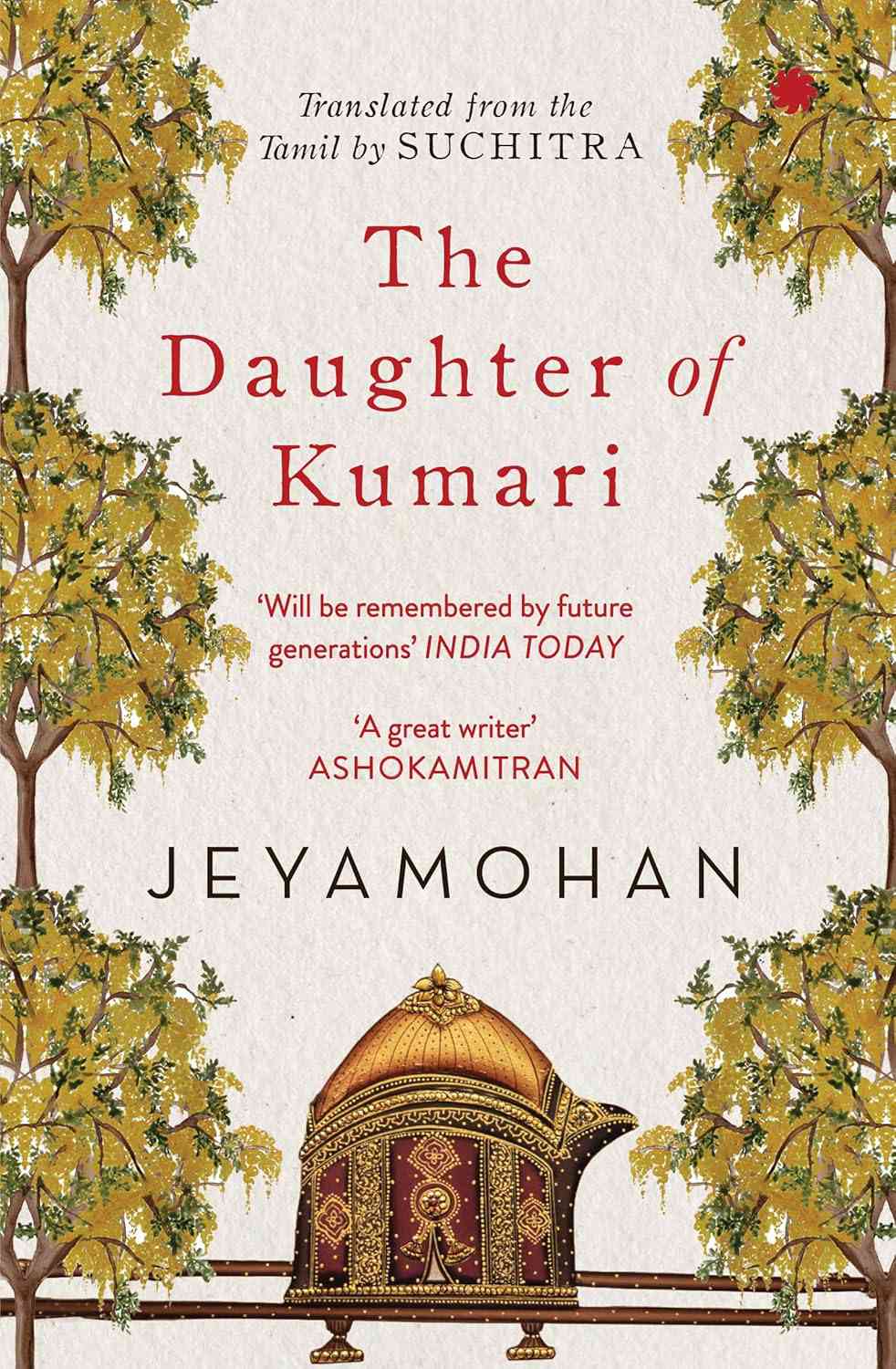
Excerpted with permission from The Daughter of Kumari, Jeyamohan, translated from the Tamil by Suchitra, Juggernaut.
