





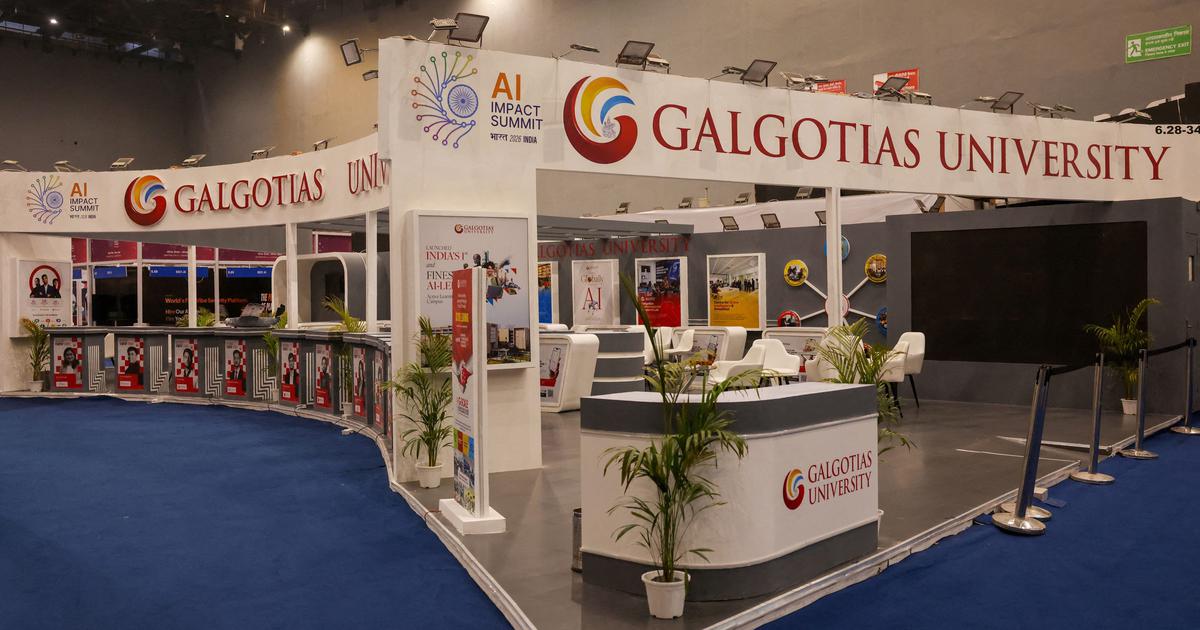
Galgotias University’s sloppy plagiarism of a Chinese robot dog has overshadowed the Modi government’s ambitious AI Impact Summit in New Delhi. The government asked the university to leave the summit because “misinformation can’t be encouraged”.
It could be tempting to treat the episode as just another faux pas by an errant university that has often been in the news for the wrong reasons. But the fiasco is the natural outcome of a growing trend in India’s private higher education.
For India’s private universities, “AI” is the new buzzword, alongside “world-class”. It can be printed on a hoarding, added to a course title or attached to a campus launch to make a university look like the great cradle of future Sam Altmans, Dario Amodeis and Aravind Srinivases.
The marketing of these institutions often includes a word salad of grand claims. Last year, Chandigarh University’s new campus in Unnao, Uttar Pradesh, was described as “India’s first Artificial Intelligence enabled multidisciplinary university”. Last week, Chitkara University unveiled a “LinkedIn Experience Zone” that would set a benchmark in “AI-powered career readiness” – whatever that means. Maharashtra has a Universal AI University, marketed as “India’s 1st AI University”.
This aggressive push is aimed at reassuring anxious parents that their child’s degree will not become obsolete before the ink dries. As The New York Times noted on Thursday, “across India, there is widespread anxiety about whether India’s students are able to compete for good jobs in an age of AI”.
There is a legitimate argument that every skilled person today needs basic AI literacy. But AI is also becoming a shortcut: a way to sell new age education without doing the hard yards of institution-building – good faculty, functional labs, research culture and a curriculum that is more than a pile of buzzwords.
We have seen this before with another obsession of private universities before AI came to the scene: global rankings.
The most sought-after ranking system in India today is the QS world university rankings. This index weighs indicators such as academic reputation, citations per faculty member, employer reputation, international research network, employment outcomes and sustainability.
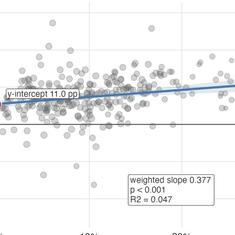
In March last year, British magazine Chemistry World reported that a research analysis had flagged 14 universities for unusual publishing patterns. The universities’ paper counts rose fast from 2019 to 2023, but the share of papers where their researchers were the first author fell sharply. At the same time, their international co-authorship rates rose far faster than the global average. Since the first author is usually the main contributor, this trend raised questions about how the output was being produced.
Which brings us back to Galgotias and its dog (which, I’m told, is called “Sheru” by university insiders). After global rankings, marketing AI is a new rage in private universities. Every second institution will open a “school of AI” and a “centre for advanced AI research”.
But will these institutions actually deliver on things that matter, such as employment outcomes? How many 17-year-olds and their parents can inspect lab capacity, faculty publication records or curriculum depth to judge quality education? Or will they be swept away by a robot dog, a LinkedIn logo, and a QS badge?
Also read:
- With Galgotias robot dog row, ‘AI-washing’ comes full circle for India
- Beyond the glitter of the AI summit: Jobs, livelihoods will become even more precarious
Here is a summary of last week’s top stories.
An extraordinary intervention. The Supreme Court ordered the appointment of judicial officers to help complete the special intensive revision of the electoral rolls in West Bengal. This came amid a tussle between the state government and the Election Commission.
Hearing petitions challenging the conduct of the exercise in the state, the bench said there was an “unfortunate blame game of allegations and counter-allegations” between the state government and the poll panel. It added that this “shows trust deficit between two constitutional functionaries”.
The court observed that the voter roll revision process was “stuck” and that most persons issued notices had submitted documents to support their claims for inclusion in the voter list. It requested the Calcutta High Court to allow serving and retired judicial officers to assist with the revision exercise.
Controversial project cleared. The National Green Tribunal disposed of challenges to the Great Nicobar Project. A six-member special bench said that it found no grounds to interfere as there are “adequate safeguards” in the environmental clearance.
The panel had been tasked by the tribunal to revisit the environmental clearance granted to the project. It noted that the project was of “strategic importance”.
Concerns have been raised about the impact of the Great Nicobar Project on the Shompen, a vulnerable tribal group, and the Nicobarese community. The project has also faced criticism for its potential impact on the island’s biodiversity, rainforests and endemic species.
The Great Nicobar project could wipe out species newly discovered on the island, experts told Vaishnavi Rathore
Arresting a royalty. Andrew Mountbatten-Windsor, the brother of the United Kingdom’s King Charles III, was briefly arrested on Thursday on suspicion of misconduct in public office. The police have been assessing allegations that he shared sensitive information with Jeffrey Epstein, the American financier and convicted child sex offender, while serving as the UK’s trade envoy.
The police had earlier said that they were reviewing allegations in the “Epstein files”, including a claim that a woman was trafficked to the UK by Epstein to have a sexual encounter with Mountbatten-Windsor.
“Freebies”. The Supreme Court said that state governments announcing welfare schemes ahead of elections could hurt the country’s long-term economic development. The bench was hearing a petition filed by the Tamil Nadu Power Distribution Company, which has proposed to provide free electricity to all consumers irrespective of their financial status.
The elections in Tamil Nadu are expected to be held in April or May. The bench asked whether it was in the public interest for the state to bear the costs without distinguishing between those who can afford to pay and those who are marginalised.
Tabassum Barnagarwala explainsthe cash handout burden and its underlying politics
Also on Scroll last week
- Umar Khalid’s five years of incarceration: ‘Do I even know the world anymore?’
- Anger and disbelief in Indore over attempt to delete thousands of Muslim voters
- Has the Supreme Court gone soft on hate speech?
- Kanhaiya Kumar interview: ‘Nothing changes by talking. Things will change through our actions’
- Why has the JNU sedition case gone nowhere in a decade?
- A spate of attacks in Tamil Nadu leaves migrant workers wary
- Harsh Mander: The communal, criminal injustice of the stories of Bilkis Bano and Maya Kodnani
- A bittersweet archive: The history of sohan halwa
- Review: ‘Assi’ reaches for shock treatment to talk about rape culture
- ‘Shatak’ review: The RSS gives itself a centenary gift
Follow the Scroll channel on WhatsApp for a curated selection of the news that matters throughout the day, and a round-up of major developments in India and around the world every evening. What you won’t get: spam.
And, if you haven’t already, sign up for our Daily Brief newsletter.
