










Set in the city of Ayodhya in Uttar Pradesh, Nishi Chawla’s novel, Silent Walls, Speaking Stones, is a courageous tightrope walk across the quivering lines of mythology, history, faith, religion, and identity that go back more than 5000 years, and the similarly zigzagging, tottering strands of present-day politics. Here, Ayodhya is not just a sacred city but the pivot of power, driven by the rhetoric of dominance and cultural revival through forceful restoration efforts. Within this volatile socio-political landscape, the city is also seen as wrestling with the challenges of urbanisation: underdevelopment and poor healthcare, education and infrastructure.
The novel, spanning more than 400 pages, is a lucid exploration of how easily balances can tip in a city, both past and present. It examines how swiftly empathy, which underpins core human values, can be lost, addresses the persistent challenge of memory slipping into forgetfulness, and emphasises that peace is not merely the absence of conflict but the ability to manage conflict peacefully. Additionally, the novel highlights how humanity, which recognises the value of both the individual and the community, is often eroded in an unfeeling and repetitive manner. All of these factors, alone and together, pull in different directions, throwing the city into disarray and discontent.
Chawla’s own immigrant experience lends a nuanced perspective to India’s cultural and political history and brings the boundaries and bonds within Ayodhya into sharp, analytical focus. The fact that she’s also an academic, writer, poet, playwright, and filmmaker brings the strengths of each discipline into play.
A fateful birth
This book begins by charting the lonely struggles of Saanvi Trivedi, born on December 6, 1992, the day the Babri Masjid was razed, to a Hindu father and Muslim mother, who live separately to assuage societal displeasure and ostracism. She says, “I was born in Rama’s city and raised with Allah’s name on my tongue.” The novel then progresses against the backdrop of Ayodhya’s unrest, with its political, religious, and ideological divisions smouldering, and uncovers how family dynamics, religious identities and political affiliations collide.
As societal divisions deepen since Saanvi’s birth, she embarks on a lifelong journey to find her identity and place in this world. This quest for an anchor leads her to explore the lives of her parents, her paternal and maternal grandparents, and to gain insights from the diverse people around her who come from different faiths. Her exploration of their lives is both intimate and intense, and she repeatedly circles back to their daily lives, obsessively trying to understand their motivations and compulsions. However, to her disappointment, she discovers that each remains isolated from the other, creating a disjointed perspective that does not give her a sense of wholeness.
Saanvi’s father, Ramesh Trivedi, is an erudite, soft-spoken college lecturer who has become a passionate supporter of the Hindu Party, cautiously at first and then sure-footedly, much to her dismay and deep disappointment. Though he talks of inclusive politics, equal representation, social justice, and education for all, he has aligned himself with the movement to build a Ram temple on the disputed site in Ayodhya, which, according to Saanvi, is bigoted. Meanwhile, her mother, Yasmin Khan, a Muslim woman, continues to live alone in her modest home in the Muslim neighbourhood even after marriage. She copes with the political and personal conflicts in her life through silence, stoicism and writing poetry. Although Saanvi loves her parents deeply, she struggles to see a future for herself that agrees with either of their paths.
Saanvi’s paternal grandfather, Shyam Trivedi, is a prominent lawyer who leads the team that secured the Supreme Court verdict paving the way for the construction of the Ram Mandir on the site of the mosque. He provides her with a safe home where she can grow up. While Saanvi admires his cultured, sophisticated, and liberal outlook, as well as his kindness and generosity towards her and others, she struggles to understand his passion for Hindu revivalism, which she perceives as insular. His wife, her grandmother, Sumitra Trivedi, is devoted to her gods and the relics of her ancestry, finding her fulfilment within the walls of the ornate Trivedi mansion. To Saanvi, this life also feels limiting.
Adil Khan, Saanvi’s maternal grandfather, is largely absent from her life, just as he is from the lives of his wife and daughter, following the tragic murder of his son Aarif during communal riots. While Saanvi closely observes his transformation from a school teacher to an activist, with an unwavering commitment to seeking justice for his community, she feels that his pursuits, like her father’s and her paternal grandfather’s, lack inclusivity. She views his austereness towards the family as both unfair and unkind. On the other hand, her maternal grandmother, Amina Khan, has lost her voice and sense of purpose after her son’s death. As Saanvi attempts to uncover her grandmother’s hidden personality, she finds herself seeking strength in the silence that surrounds her.
Despite each person’s keen understanding of loss and grief, Saanvi relies on her own intellect, sharpened during her time at a boarding school in the Himalayas and her years in Oxford. These institutions are not escape routes but help her turn inward, enabling her to forge a new self and shape her vision of the world and her city.
She realises that although each person who has influenced her life is significant in their own way –some driven by passion, others by intention, and still others by love – their impact on her would have been much stronger if they had united as a force for the common good.
The city as the self
Saanvi also finds numerous disturbing contradictions, paradoxes, and dualities within her city, much like those in her family. She grapples with complex issues that lack easy resolutions. Is Ayodhya merely a geographical location, or does the notion of it being a spiritual sanctuary overshadow its politically charged reality? Are the deities of various religions in harmony, or are they in conflict? Should history serve as a lesson from past mistakes or be wielded as a weapon to reclaim lost glories? Does the city express the voice of the majority, or do the perspectives of marginalised groups matter as well? Can the private struggles of individuals who love and marry outside their religion ever gain public recognition and empathy? Will their love withstand societal rejection? Is it possible to live a non-partisan life in this city, or must one take a side? Are personal experiences truly private, or is everything inherently political? Will the “us” versus “them” divide ever end? Can the quiet, unspoken suffering of women be acknowledged by the men in their lives or their families, or will it be dismissed as another agitation in their tumultuous society?
Years later, after completing her master’s degree and sitting far away from Ayodhya in London with Ezra, her spouse, who is of Christian-Jewish parentage, she realises something momentous about her parents. She understands they have “taught her the most important lesson of all: that religion, race, nationality – all of these things are merely labels, systems of belief that humans have created to organise their lives.” That their love “was not a private affair; it was a statement about the boundaries that people often draw between themselves.”
Saanvi understands something else, too, with her advantage of distance from Ayodhya: when caught in a pincer, where choosing one option over another can lead to destruction – as history has often demonstrated – the solution lies in accepting that multiple truths can coexist, even if they are in conflict.
The lines of her discovery are haunting. She talks of walls speaking not in words, but in textures. And of stones on one side smelling of turmeric and on the other of attar, yet hovering in currents, separately and stubbornly themselves. Between them, she says, is a thin seam that runs, carrying neither turmeric nor attar but only silence. A silence that knows the weight of drums and the rhythm of azaan, yet refuses to declare which it remembers more fondly. This is where, one guesses, the title of the novel has sprung from.
Saanvi’s ultimate realisation is that her inheritance is not defined by loss. Instead, she is expected to “carry the weight of both worlds, not as a burden, but as a testament.” It means “she is meant to be a child of two worlds, standing in Ayodhya, whole, bridging the gap between the old and the new.”
For now, sadly, she can only feel whole and complete outside of Ayodhya. However, perhaps one day the city will call her back when she feels complete and healed, freed of her city’s congested histories and sacred geographies. Chawla leaves her readers with the hope that a time will come when Ayodhya’s past, present, and future will converge. There will be a continuum – an unchanging presence, much like the Sarayu River, which has flowed through the city since time immemorial, quietly, calmly, and unassumingly.
The novel’s final insight is that discovering profound truths often requires a leap beyond simple logic. It emphasises the importance of imagination and introspection over just intellectual understanding. This idea reflects William Blake's perspective in The Marriage of Heaven and Hell, where he asserts, “Truth can never be told so as to be understood and not be believed.”
Chitra Gopalakrishnan is a journalist and social development communications expert.
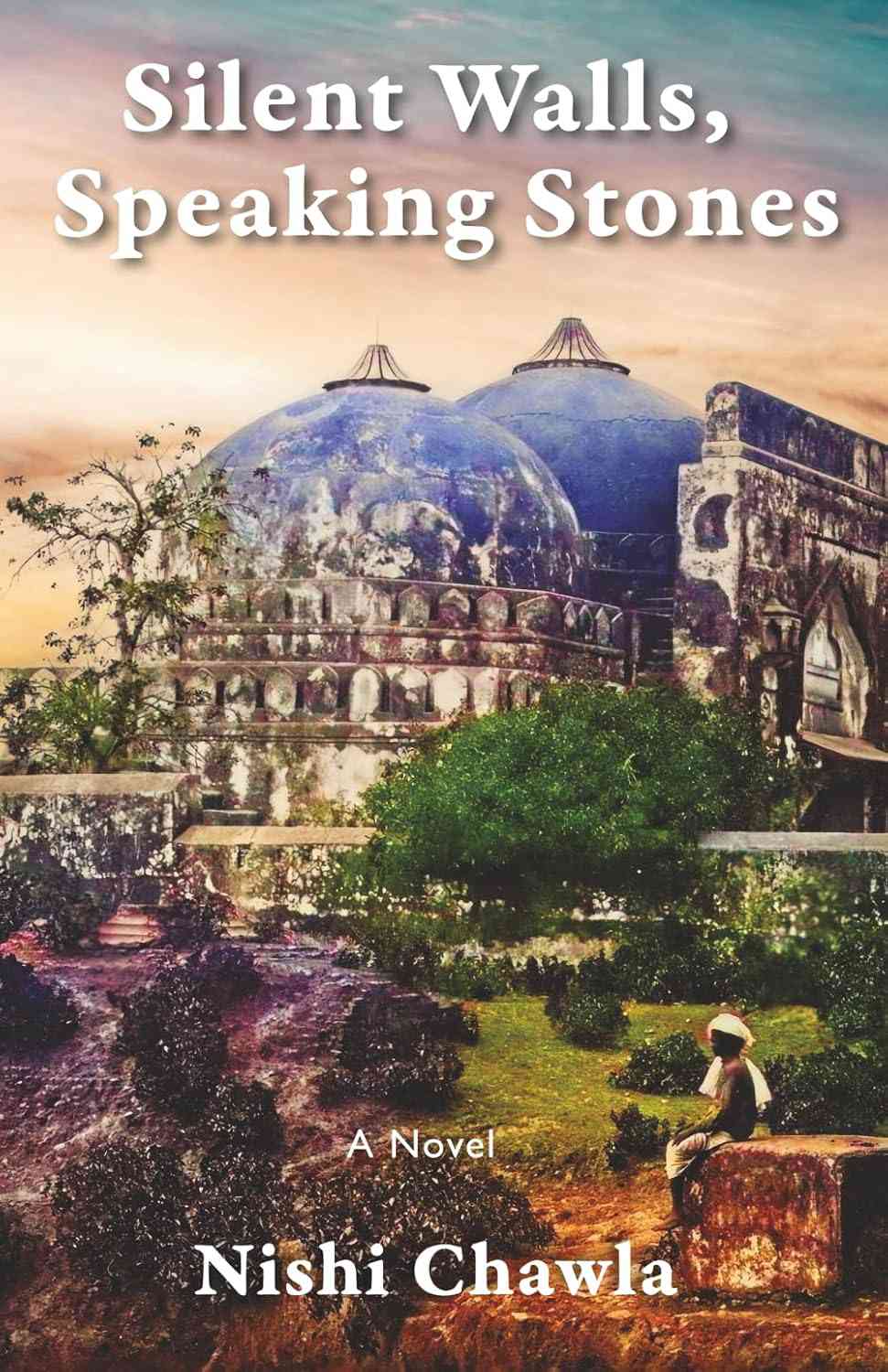
Silent Walls, Speaking Stones, Nisha Chawla, Pierian Springs Press.
