



Ananya Vajpeyi’s Place: Intimate Encounters with Cities offers a presentness to the history of cities. In the introductory essay, Vajpeyi describes feeling a “shadow of the past falling across the daylight of the present.” Yet the essays also move in the opposite direction, showing how the present continually reanimates the past.
Through pieces written over 25 years, Vajpeyi walks her reader through 13 different cities across the globe. The anthology is divided, in no particular order, primarily between the author’s time as a student in the US, across different cities in India, and her research escapades across Europe. Each essay revisits the architectural history of a city, recounts the author’s first encounters with it (in some cases, repeatedly), and reflects on the psychic impressions those encounters left behind on the author.
For instance, when comparing Humayun’s Tomb in Delhi, San Giorgio’s Church in Venice, and Cihangir Mosque in Istanbul – structures built roughly around the same time – Vajpeyi reflects on how each appears through the lens of the different renovations they had undergone. Like the memories of a loved and lost person, these buildings too, were a “reminder – and a remainder – thereof in the present.” There is a sense that the wholeness of such encounters – with buildings, streets, animals, books, and people – does not disappear once the moment passes, but lingers as a sensory residue in memory.
On loss
While the past continues to bleed into the present, Vajpeyi’s essays continue to be an exploration of the possibilities that stayed unlived. She questions the very logic of loss, its procedure, and its aftermath. Her travels across Delhi, Istanbul, and Venice, described in the essay “Istanbul Interregnum,” then become a way to understand the anatomy of such loss. Many of these reflections unfold through repeated questions – especially the persistent “How?” that punctuates Vajpeyi’s reflections.
At times, these philosophical questions seem to drift away from the city itself, yet they ultimately draw the reader into the affective texture of inhabiting a body in urban space, by virtue of which the language of loss emerges. Elsewhere, the meditation on loss turns toward cities themselves. How they are lost due to reasons such as “natural” calamities, genocides, and so on. More profoundly, Vajpeyi suggests that a city can also be lost when one loses the personal compass through which it was once navigated. After being orphaned at the age of 46, she describes feeling suddenly anchorless. It is almost as if when we lose those who guide us, we lose a vocabulary of encountering newness, and yet, continue to look for it. In a similar vein, we are asked by the author struggling to look underneath this encounter, whether it is easier to penetrate another’s happiness or their pain? On the subject of pain, she offers us a tentative answer: that one cannot understand the other’s pain, especially when it is difficult to occupy our own pain with any sense of authority.
On politics and publics
The anthology’s engagement with politics complicates this earlier claim about the limits of understanding another’s pain. Which is to say that as much as Vajpeyi acknowledges this inability to understand, really understand the pain of others, she continues to try, and in her own words, “fails” to do so. Like the author herself, the idea of pain in these essays is constantly in motion. Vajpeyi repeatedly invokes ongoing violence in Gaza, the humiliation of minorities in India, and earlier historical catastrophes such as the Second World War and Partition. Her preoccupation with political violence, then, is not only to elaborate on her personal reflection, but also that of a historian’s intervention in keeping alive this dialogue. She offers a Postscript: After Gaza in her essay titled “Lost City”, wherein she discusses the genocide and offers a comparative reading of the Mahabharata to reflect how Israel’s violence over the Palestinians also contains the seeds of its own destruction. At times, however, Vajpeyi turns to intimate or domestic metaphors to render distant political violence emotionally legible. While these analogies invite empathy, they can also blur the structural asymmetries that shape such conflicts.
The anthology continually makes efforts to both recount as well as seek moments of intimacy. For Vajpeyi, the “cartographic coordinates have become enmeshed with personal memories,” reminding her readers that one rarely escapes the chiasm between the flesh and the world. Each conversation, then, exceeds the moment of its occurrence, carrying with it the memories and circumstances that shape it as well as those it calls back into view.
One such instance occurs when Vajpeyi recounts meeting Giorgio Agamben in Venice, where their conversation moves between discussing totalitarian governments and developments while contrasting it with Agamben’s memories of his last visit to India. The conversation also recalls, for Vajpeyi, her father’s meeting decades earlier with Samuel Beckett, during which they discussed the politics of writing in a foreign language. Rather than drawing a direct comparison between the two encounters, Vajpeyi evokes an affective resonance between them, imagining what her father might have felt nearly 45 years earlier.
Much of the prose unfolds in a similarly reflective fashion, with the author moving back and forth between recent experiences and earlier memories. However, in these encounters – with both people and places – there is a persistent effort to make the familiar strange and to know the world afresh. Even in moments of estrangement, the essays persist in inviting intimate encounters. To end, I recall Vajpeyi’s metaphor of Samudra Mahal. While it is the name of a sea-facing building owned by the author’s family friend, which they often frequented, she tells us that it served as a reminder for her family to desire that which remains at a distance, acknowledging both its connection as well as its disconnection.
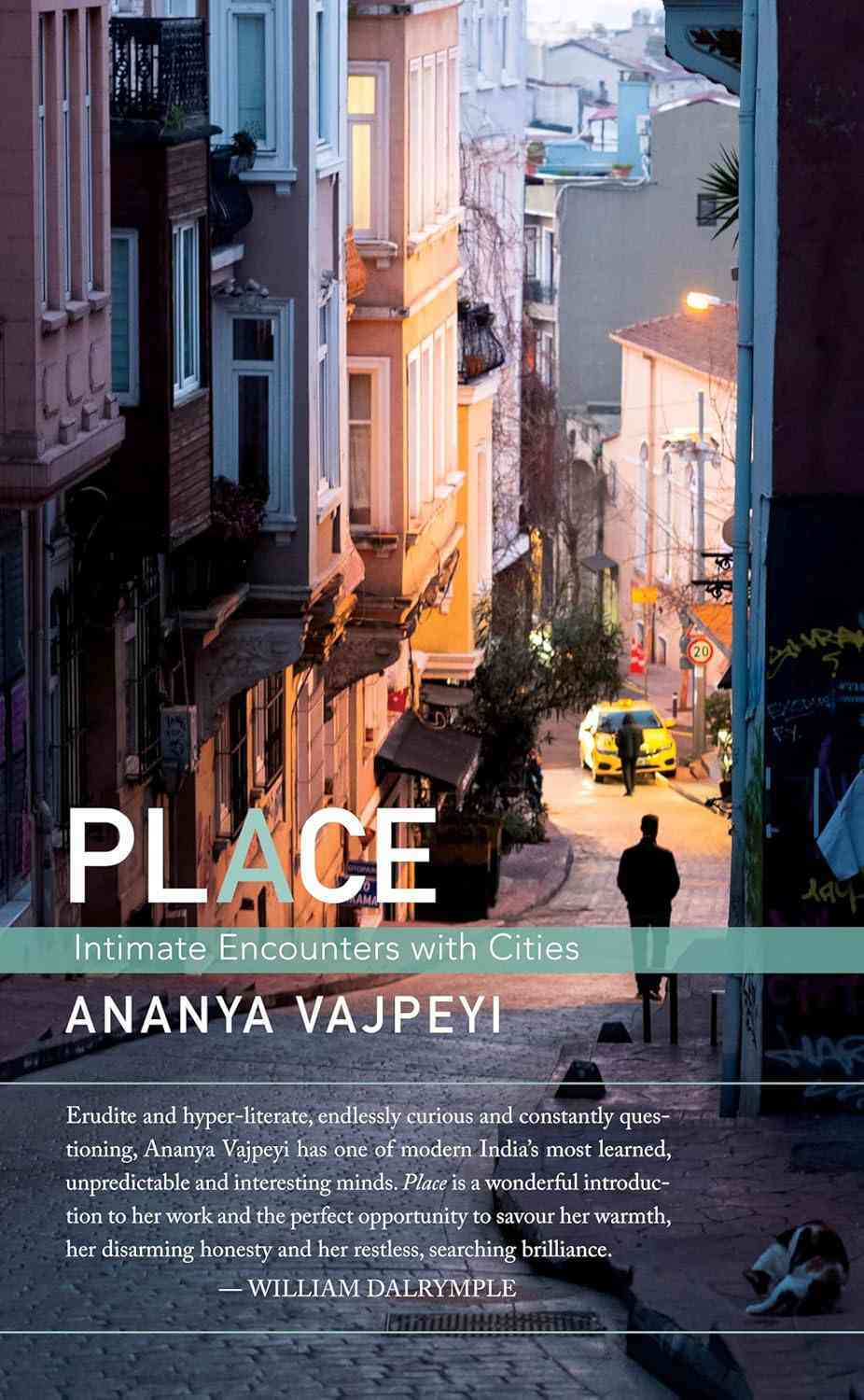
Place: Intimate Encounters with Cities, Ananya Vajpeyi, Women Unlimited Ink.
