







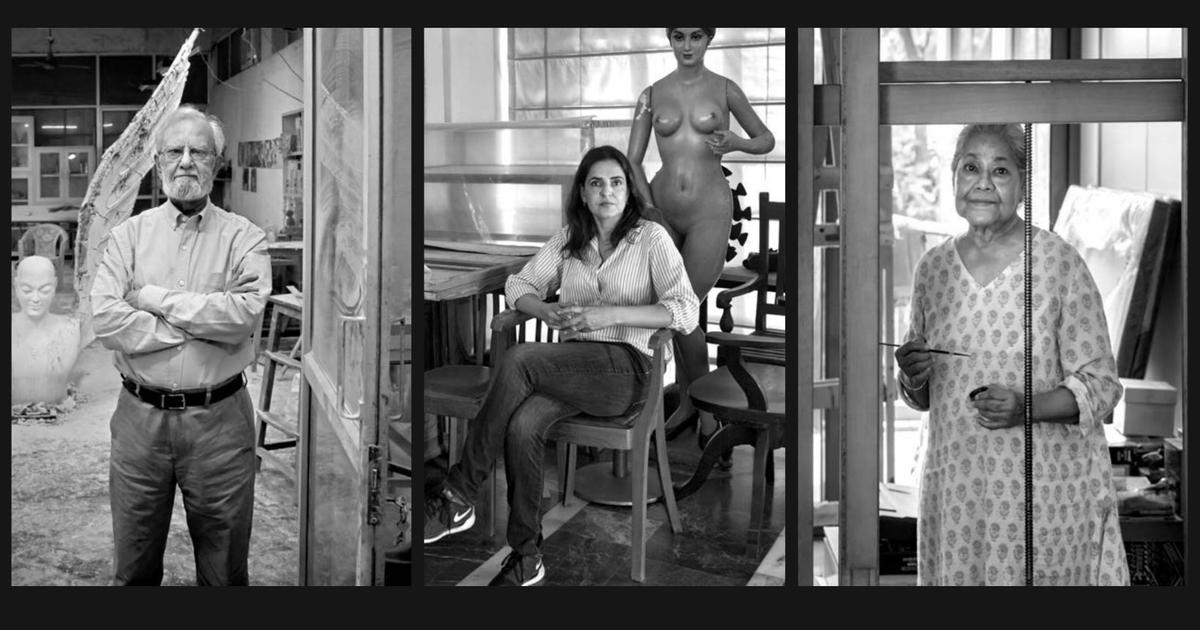
Gulammohammed Sheikh: The studio is your home that you discover again and again because everything that you do exists there
Gulammohammed Sheikh has just finished reading Arundhati Roy’s Mother Mary Comes To Me. “It was a riveting read,” he says. You might mistake the house he shares with his wife Nilima Sheikh as belonging to a professor – books spill out of shelves in his two-room library, from cupboards in every room of the house, over ledges and tables and sometimes even on the floor – and you wouldn’t be wrong. For Gulam sa’ab has taught art history; is a published poet; and is currently engaged with editing essays written over the years, for publication. There are books on art, of course, but also literature, biographies, autobiographies, fiction – in English, Hindi and Gujarati. He keeps giving them away too, “to the Faculty of Fine Arts” at the university where he taught. “ I even give them cupboards for their storage,” but between books received and books bought, managing them is still a chore.
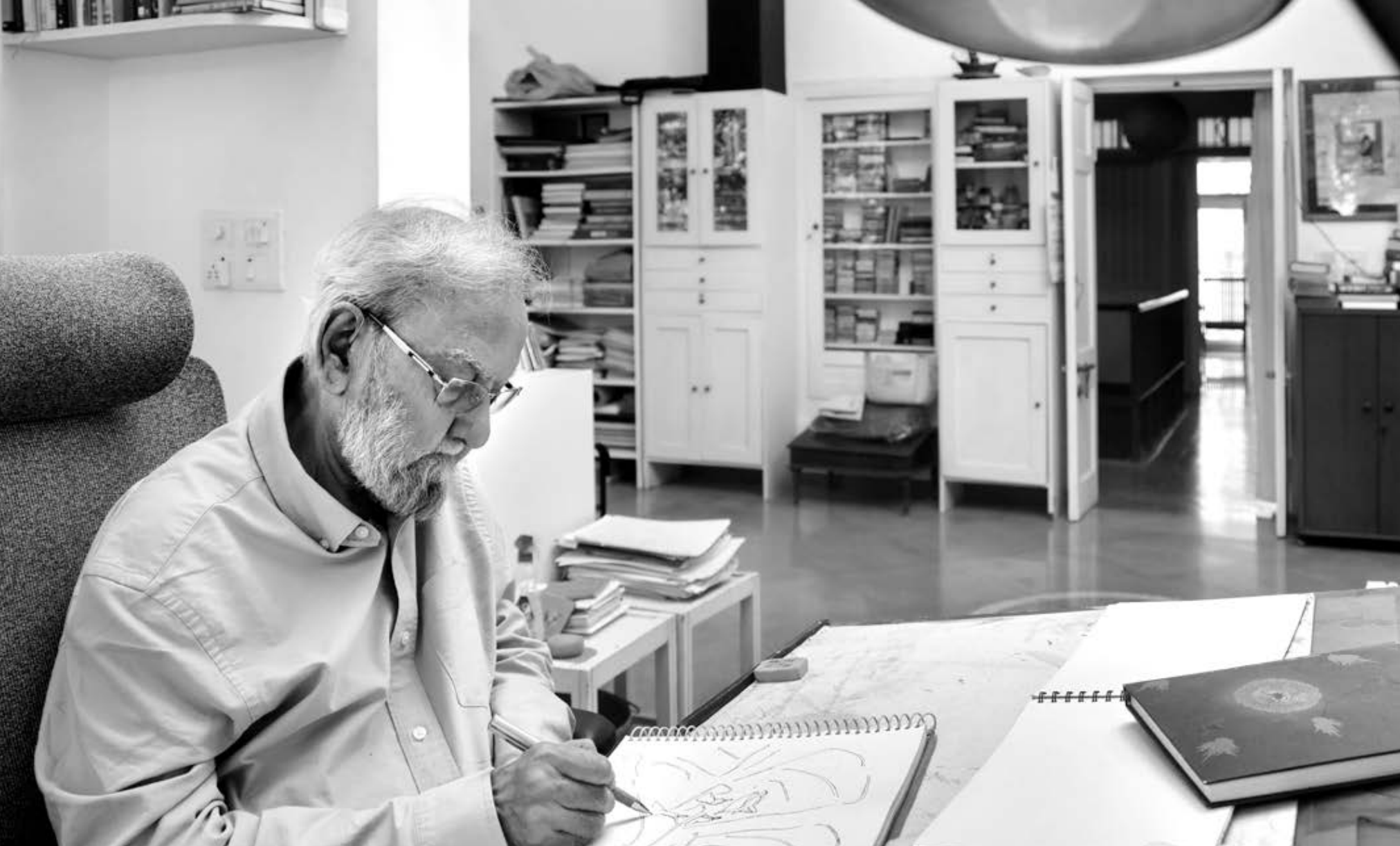
Books apart, his painting and his studio constitute his world. “ In one sense, the studio is a home within the home. Whenever I return from outside, I don’t think I’ve arrived home till I enter the studio.” This, his sanctum, is where he can be found most times, whether painting, drawing, surrounded by his sketchbooks, or writing. “ I have two walls to paint on and a third wall that is kept to see films using a movie projector.”
A third love – music – begins with the artist couple exercising in the morning and follows him to the studio where he listens to classical Indian vocals, folk, bhakti, Sufi, and sometimes Western, with Kumar Gandharva and Siddheshwari Devi among his favourites.
In the studio, amidst his brushes and pens, paints and inks, Gulam sa’ab works with a few assistants – he calls them “facilitators” – who help with digital arranging and sourcing, while the artist himself prepares the drawings while supervising everything and, if the result is not satisfactory, painting still, himself. “I use the hands of my assistants to save me time,” he says of the arrangement. That’s one for the books.
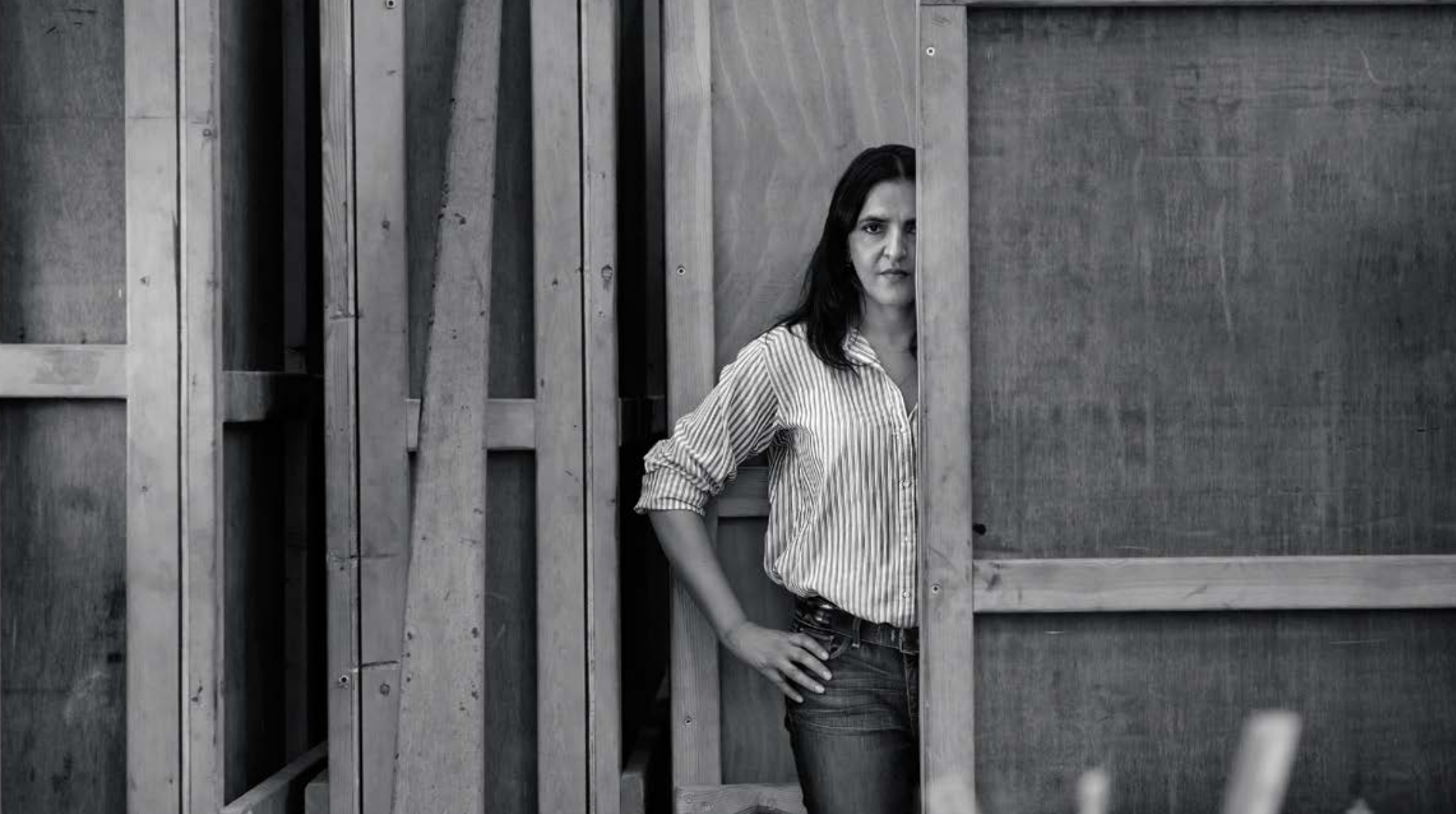
Bharti Kher: I created my own language and now I speak it
Among the most prominent contemporary artists who has continuously reinvented the lexicon of her practice, Bharti Kher has been extensively exhibited – and admired – around the world. Combining feminism with creative autonomy, she chose to respond in first person to questions regarding her studio, what the space means to her, and her relationship with it.
“The studio is a place of wonder that holds all its secrets until it is safe for them to emerge. The usurpers and the pure, the adulterated, cross-pollinated and shadows are all welcome. The studio is my centre. It is a safe and welcoming space but also engages with caution and warning and some degree of danger. I’m also captive to it.
“It’s a place where all images, things, bodies and skins are marked with the blush of poetry and art. I use the word blush to describe the innocence of first sight, the genesis of invention and the wonders of abstraction in both thought and image. Through drawing and painting and making, I follow in the footsteps and through the eyes of the greats before me; I try to channel some poets of the world, writers, alchemists and weirdos – basically, the creators of magic. And to learn the magic of the studio you have to teach your hands to activate material; to learn to see through drawing space and tapping into things unseen. Understanding form and formlessness teaches you to see the things that you don’t know and negation becomes a powerful tool that describes presence.
“I sometimes see the studio like a metaphor for my body. She is made up of different organs that function independently but also as a whole. The kidneys filter; the gut communicates instinct; the heart reciprocates in rhythm; the lungs breathe a dance of holding and letting go. They all meet holistically and serve the synchronicity of nature. The works I make are like the organs of a body: the furniture works, the bindi works, the women and cast goddesses, the saree portraits or the animals/hybrids. But it doesn’t work to break them down this way. The whole practice is both a physiology and a psychology: a mixed-up, unpredictable, vulnerable, failing-very-often, sulky or difficult mistress. But she is also a warrior who shields her children, sharpening her sword, trying again and again, learning from her mistakes along the way.”
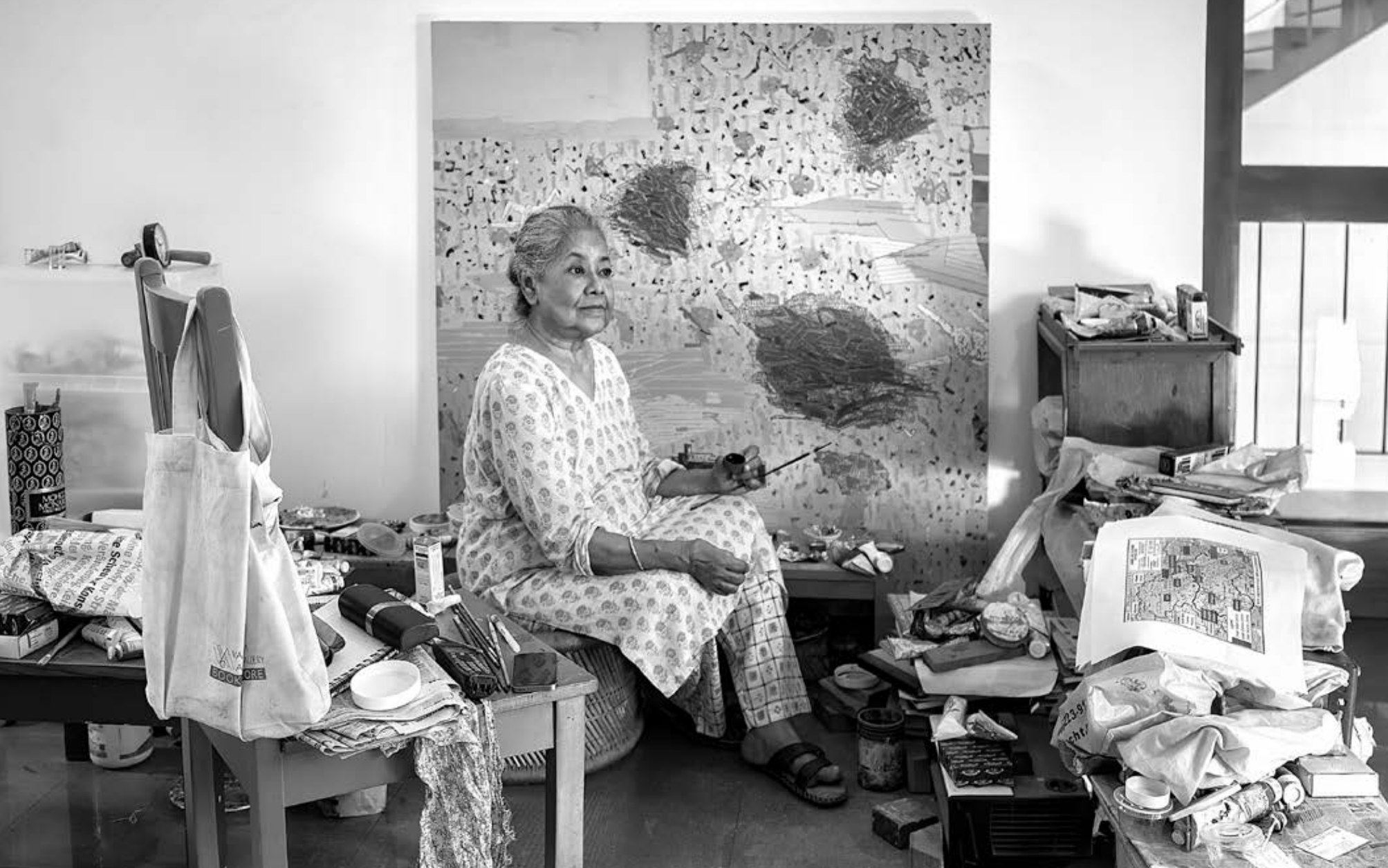
Arpita Singh: The studio is just another space in the house
Arpita Singh paints in a park-facing, light-filled room that she has sectioned off with a row of book-filled shelves, separating it from the rest of the apartment’s living areas in Nizamuddin East. Not many know that she is a voracious reader – “everything from William Dalrymple to Namita Devidayal” – and isn’t easily scared by their voluminousness, just as large paintings don’t put her off, even though arthritis sometimes makes it difficult for her to squeeze the paint from paint tubes that have hardened. Sometimes, she’ll call her husband on his phone in his studio across the wall to ask him to help her. At other times, their driver will be summoned for help. “He scolds me that I haven’t yet finished a painting even though it’s been so many days.”
In this, her new studio in a new apartment in the same neighbourhood to which the artist couple shifted a year earlier, Arpita’s work has changed, taken up almost entirely by words. The figure has been obliterated, replaced by letters. When she couldn’t find her earlier sketches, she started making new drawings. These consisted almost completely of words, snatches of lines or phrases that she liked and wrote down in a diary: “if only you knew”; “road to nowhere”; “become something else”…
A highly regarded artist, she combines the anxieties of a woman’s interior world with humankind’s existential threats, quite literally the guns and roses of everything from patriarchy to threats of terrorism and violence. Her drawings are dense, appearing like redacted sections of a proofreader’s text. The paintings, contrarily, are saturated with colour. Emotionally, though, they fit together like pieces of a jigsaw puzzle in a nervous world continuously mired by fear of the other.
For someone whose work reflects the apprehensive, Arpita feels freest in her studio, a place where she lets her guard down so her viewers can put theirs up. In this, the autumn of her career, she paints to keep darkness and loneliness in abeyance. “When I work, I feel free,” she says. “My paintings involve procedure, and procedure keeps me occupied.” The studio, then, is her place of solace.
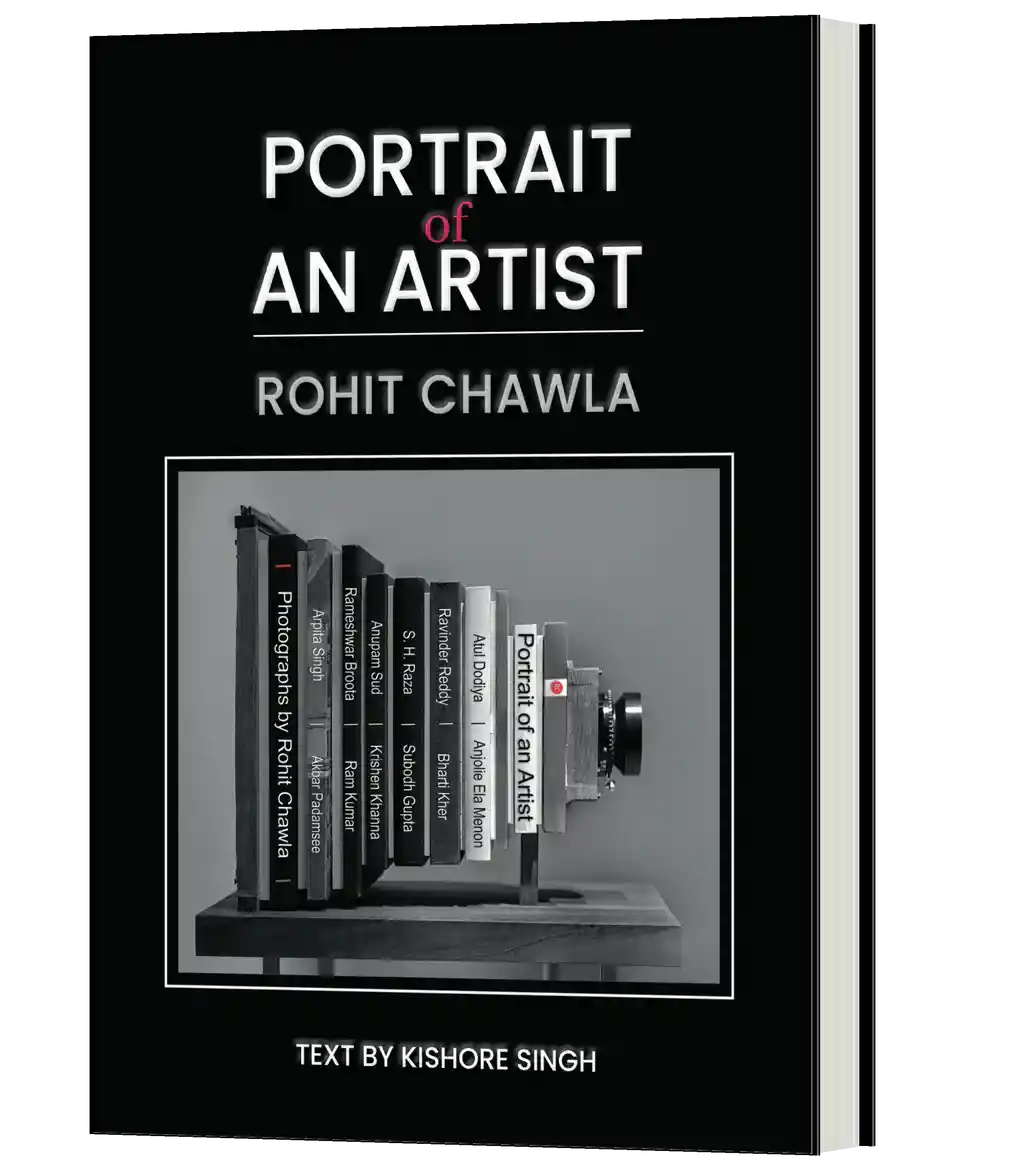
Excerpted with permission from Portrait of An Artist, photographs by Rohit Chawla, text by Kishore Singh, Mapin Publishing in association with the Kiran Nadar Museum of Art.
