





Of course, just like most little kids, long before all this I went to mosque and studied prayer and recitation. Why? Because my father went to mosque and studied prayer and recitation, because my grandfather went to mosque and studied prayer and recitation, because my great-grandfather went to mosque and studied prayer and recitation. And I guess it kept going like that, stretching back from the father of my great-grandfather, to the grandfather of my great-grandfather, the great-grandfather of my great-grandfather, all the way back to Prophet Adam, from where there is no farther back to go. Apparently, all of them went to mosque and studied prayer recitation.
If I may be honest, I preferred going to watch the cock-fights behind the market, or going to the sports field to watch the pigeon races. That was way more exciting than sitting cross-legged in a prayer room, pronouncing letters I never used to recite, words whose meaning I didn’t know. It was better to watch the horse dancers spin into trance at a party. Or argue over who’d won at cards. Or swim in the little stream that ran through the rice fields. Or watch the singers in an orkes band at a wedding. Or, in a big gang of kids, swarm a restaurant parking lot and wash the car windshields and force the drivers to give us some money for it. Or frisk a produce truck and steal a few juicy pieces of fruit.
But then I discovered grownups don’t really like to see kids happy. So they start sending them to the mosque in the late afternoons. The army families sent their kids to the mosque. The village headman sent his kids to the mosque. The chicken porridge seller sent his kid to the mosque. The metalsmith sent his kid to the mosque. Even the town drunk sent his kid to the mosque. Every afternoon until night fell.
Really it wasn’t all that bad, though. Kids always find a way to have fun. Long after I was grown, I’d still remember those times. We’d wear sarongs, more often slung over our shoulders than wrapped around our waist, and peci prayer hats a few sizes too big that slid around on our heads. I was happy because lots of my friends were there, and sometimes snacks were served. I’d see that bastard Asep and throw punches with Turman, and we’d all take turns singing into the mosque microphone. Its speaker would amplify our voices until they resounded over the whole settlement, before the pancake maker who had just had a baby would come hurrying over to twist our ears. Or before the village military liaison would come rip out the cord.
At that time, was I a pious child? Maybe, if you’re basing it solely on the fact that I went to mosque every day. With the other children, I stood in the lines behind the grownups and prayed. When it was time to say “amen”, we would compete to see who could say it the loudest and drag it out the longest, to make the limewash on the mosque ceiling come crumbling down and the cobwebs swing and sway from the beams. If I got the chance, I’d tug a friend’s sarong so it fell off, or if he was standing in the line in front of me I could headbutt his ass, so he’d go crashing into the old folks in front of him, and so on, line after line, until half the congregation had collapsed on top of each other in a heap. If that happened, the kiai would be furious and interrupt the prayer. He’d come at us, ready to smack our butts with the huge wide palm of his hand, not caring who’d started the whole commotion, but my friends and I were always on the alert so we could go scrambling out of the mosque in all directions and escape. “You dumb kids!” someone would swear – and that was fun too, we felt like the biggest rascals in the world. It wasn’t anything complicated, but it really riled the old folks up. We’d be doubled over with laughter in the mosque yard, but still ready to run in case an adult was still aiming to grab us and yank on our ears.
One time, when we didn’t dare go back to the mosque, we gathered on the side of the road. Kurnia, that stinky snot-nose, complained that his stomach was churning, but he didn’t want to go back and use the mosque washroom, afraid the kiai would ambush him, and he didn’t want to go home and face his mother, because she’d yell that he hadn’t gone to worship. We told him to go poop in a banana grove, so Kurnia found a plastic bag in a trash heap and disappeared into the shadows. It wasn’t long before he re-emerged, the nasty snot-nose, the plastic bag filled with shit in his hand and a foul idea in his head.
He stood at the roadside with the bag dangling from his left hand. In the distance, the headlights of a city mini-bus could be seen slowly approaching. Kurnia waved his arm, signalling he wanted a ride. He was taller and stockier than most of the other kids, so he probably looked like an adult from far away and the bus slowed down and came to a stop right in front of him, thinking it had found a passenger. But instead of climbing aboard as the ticket-taker was expecting, Kurnia hurled the plastic bag inside. Sato Reang doesn’t know whether the bag landed on an empty seat or a passenger’s lap, but in all honesty, he hopes the contents splattered everywhere, because he’s happy to imagine the world filled with all kinds of hilarious misfortune – it’s ok to laugh at stuff like that.
Realising what was in the bag, curses erupted from the driver, the ticket-taker, and all the passengers: “You pig!”
“You dog!”
“You devil!”
“You’re dead meat, dammit!”
The ticket-taker almost caught Kurnia, but this friend of ours was oh-so-nimble; he’d already leapt over the roadside ditch, and was racing back into the banana grove. The ticket-taker was fixing to give chase, but then he caught sight of all us other kids still gathered nearby, and it was like his eyes were shooting laser beams. Realising the danger, especially since a few of the passengers were also starting to climb out, we followed suit and shot off, jumping over the little ditch after Kurnia, and vanished.
As we ran farther and farther, the calls and curses of the ticket-taker and the passengers faded into the distance. Gasping for breath, we found Kurnia behind the tofu factory. Now we were the ones cursing him, smacking his head from all sides.
“I swear on the devil’s pubic hair, you’re such an idiot!!”
Turman added, because he was the first to realise, “And you didn’t even wipe! You foul stinky dog!”
Kurnia just grinned wide, so wide. He said he’d wiped with a banana leaf. What an animal. Disgusting! Nasty! So dumb! Kurnia didn’t care. He just kept smirking and smiling and scratching his butt. And after all, he wasn’t the only one who sometimes had to poop in the grove and wipe with a banana leaf, so we soon forgot about it and thought up other ways to have fun that night, without having to go back to the mosque and without having to hurry home, because at such an hour once we’d gone inside it would be hard to get out again.
So back then, was Sato Reang a pious child? After considering everything I did in my childhood, the answer is, maybe not. At least not until I turned seven.

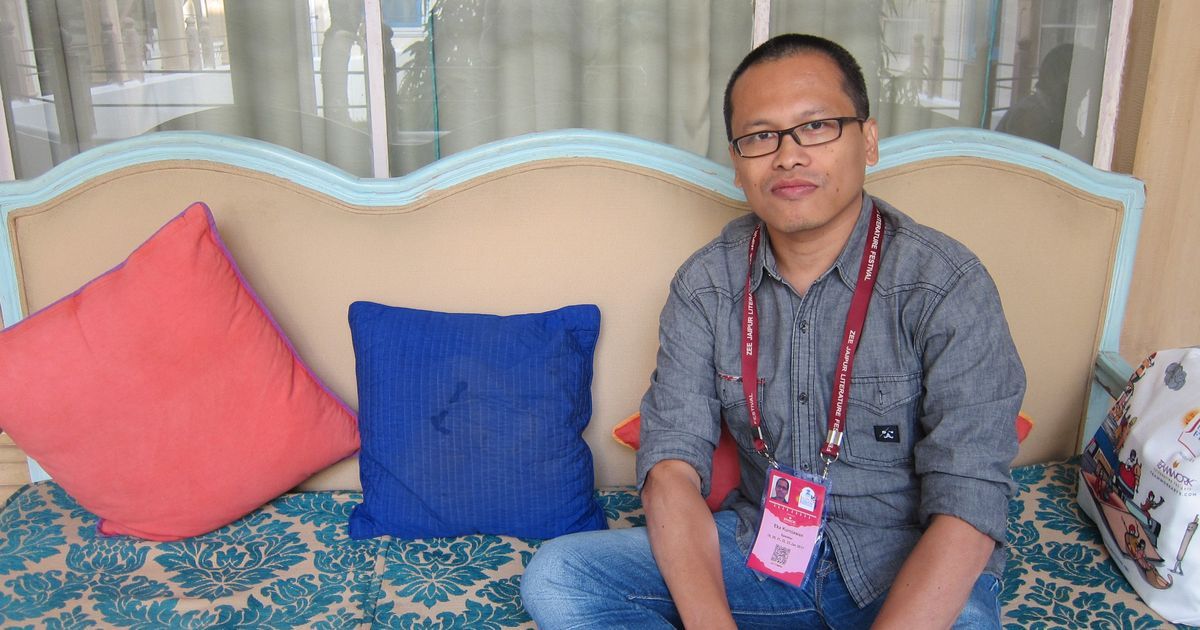
Excerpted with permission from The Dog Meows, The Cat Barks, Eka Kurniawan, translated from the Indonesian by Annie Tucker, Speaking Tiger Books.
