





From my position, curled up in my bed, I watched with a growing sense of sadness as the sun slowly rose over the river and cast its brilliant, warm glow. This had always been such a perfect spot to view the dawn of each new day, and the sight had never failed to fill me with optimism. Today, though, all I could think was that this would be my last sunrise in this home. Rising out of bed for the final time was an equally odd sensation. I had grown up in this room and slumbered every night of my life in this bed. What would happen to it now? Would the room be closed up, left to gather dust? Perhaps one of the servants would claim it. For a fleeting moment, I kidded myself that my father was far more sentimental than I credited him for and my room would be left untouched to return to as I wished. I knew this was not true. This was not part of his grand plan. Not now that he had finally claimed his prize.
As I began to reluctantly dress myself, I listened to the birds that carefully built their nests in the eaves outside my window each year. I swear their songs were more melancholic today. In the distance, I could hear the fish beginning to leap in and out of the river, their best insect-catching tricks on display. Usually, this would make me smile. This was my alarm call, telling me to get to my boat. Half the day is over, come on! But my pretty little boat would stay in its moorings now. I wished I had treasured my time alone on my boat more, as I realised now that I may never have that time again. I hoped that, at the very least, my father could find a use for my boat when he was out fishing and the boat wouldn’t rot away in the river, forgotten.
And what of my regular customers? Perhaps the next time they would hear of me would be when word had spread that I was the new queen of Hastinapur. What a strange thought that was! Would they have treated me kindlier all these years if they could have known that this would be my future?
My finest sari was ready for me, cleaned and pressed to perfection. Once I was fully dressed, I made my way out of the room, rehearsing in my mind how to say a quiet farewell to the servants. The first one I encountered, though, a maid sweeping just outside my room, avoided eye contact and instead dropped into a deep curtsy. Was this my life now? Just yesterday, I would have bidden her a cheerful good morning, and she would have replied with a smile. We might even have exchanged some pleasantries.
Tarran, the head servant, was waiting for me as I reached the kitchen. This man had been with the family since before I was born and had cared for my father and me with deep loyalty. He was kind and patient and was perhaps the only person who could talk my father out of his fits of rage when he lost his pachisi game. Tarran, at least, seemed to be behaving normally.
“I wish you well, my new queen,” he said with the warmest smile. “Thank you, Tarran, and thank you for everything you have done, and everything you are yet to do for my father.” I wanted to say so much more but found myself tongue-tied. I hoped Tarran realised that I had the best of intentions but was just too overwhelmed.
My appetite was not up to much that morning. The cooks had prepared a large feast for my breakfast to help prepare me for my long journey ahead to my new kingdom. (My new kingdom!) Instead, I asked for the only thing I could bear, a kamrakh, freshly picked from our garden. Even the mild, sour taste of the fruit that I usually enjoyed so much brought me no pleasure. I made myself finish it, though, and when I had done so, I wrapped a few of its seeds in a small piece of fabric. I hoped that one day soon, I would plant them in the grounds of my new palace. In many years’ time, I would eat the fruit that it bore so that the taste would lift my heart with a little hope.
My possessions had already been packed into several small sacks. It was strange to see one’s whole life compressed into such little space. I’d thought I owned a lot more. I imagined that when I lived in a palace, surrounded by riches, my modest belongings would seem quite meagre and pointless in comparison. Perhaps I shouldn’t burden the horses and just leave them here.
I was so absorbed in my farewells that I hadn’t noticed the arrival of the chariot. The knock at the door startled me, and I watched as the servant hurried to answer it. The loud and clear voice announcing his presence was unmistakable. It was Devavrata.
“I have come to collect the queen,” he said. “Please tell her to take her time, though. I do not wish to interrupt her farewells.” Tears pricked the corners of my eyes, and I blinked hard to keep them in. Why was I sad? There was nothing for me here. Not really. I knew why I was sad, though. I was sad because of what had happened – what this great man, Devavrata, had felt he had to give up for his father’s happiness. I could not change what had been done, but the guilt would live with me until my dying day.
I got to my feet from my seat at the table and turned to take a last look at the house, breathing in its familiar smells. I spun around slowly, taking in all the little details that I had seen every day, but never really noticed. There was that dent in the wall where I had once dropped my father’s tools after slipping on some spilt mango juice. On the table in front of me was a chipped bowl, broken when he had flung it on the floor in a rage, about what, I could no longer remember. How long would it be before I forgot this place too?
As I stepped towards the door, I realised that I hadn’t even thought of my farewell to my father. I knew where he would be. In the backyard, in his fishing clothes, preparing for his day. No doubt, he’d have a piece of rope in each hand as he skilfully tied the knots. I had never thought of it, but my father may have been the finest fisherman in all of Bharat. I didn’t believe anyone knew more about the fish and the waters than he did.
As I walked towards him, there were a thousand things I could have said. While he had his faults, and he was an impatient man, he had been a good father and had only ever wanted what was best for me. In some ways, he was not that different from Devavrata. He loved one person so much that nothing else could stand in the way. The big difference, though, was that he had been doing this for me, a nobody with nothing to sacrifice, whereas Devavrata had given up everything. A whole kingdom would suffer as a result.
There was no point going over it again. What was done was done. Without a word, I embraced my father and whispered “goodbye”. In return, he muttered something so softly that I could barely make out the words. I think I heard the words “daughter” and “love”, but I could not be sure.
When I reached the front of the house, Devavrata was waiting in the chariot, my few sacks arranged at his feet. As soon as he saw me, he stepped down and offered me his hand to help me up. Despite my nerves and misgivings, I could not help but laugh. His stance was almost identical to that of his father when he used to help me into my boat. Seeing my reaction, he too broke into a broad grin.
“I am so pleased that you are at ease with me,” he said. For the first time, I noticed how hypnotic his deep voice sounded. There was a nobility and confidence about him that could not fail to put one at ease, even if I had not reacted to the coincidence of him holding out his hand to help me. I nodded but averted my gaze. Even though the tension had been broken, I still didn’t feel ready to speak with him. I was just too much in awe of this demigod, whose presence seemed to fill the space around us. Part of me was also worried that if I did say anything, I would embarrass myself. I would not be able to stop apologising for what had happened at my father’s house. Again, Devavrata seemed to sense exactly what I was thinking and feeling and did not push for a response. Instead, with the gentlest flick of the leather reins, he spurred the horses. I watched my home receding into the distance, surrounded by a halo of sand and dust kicked up by the chariot.
My mind went blank as we moved on. I had so much to say that I was unable to make sense of it, my thoughts collapsing into one another to create a void. However much I wanted to snap out of it, I was simply unable to do so. I was feeling hugely self-conscious, standing beside this great man – a man who had given up everything for his father and me.
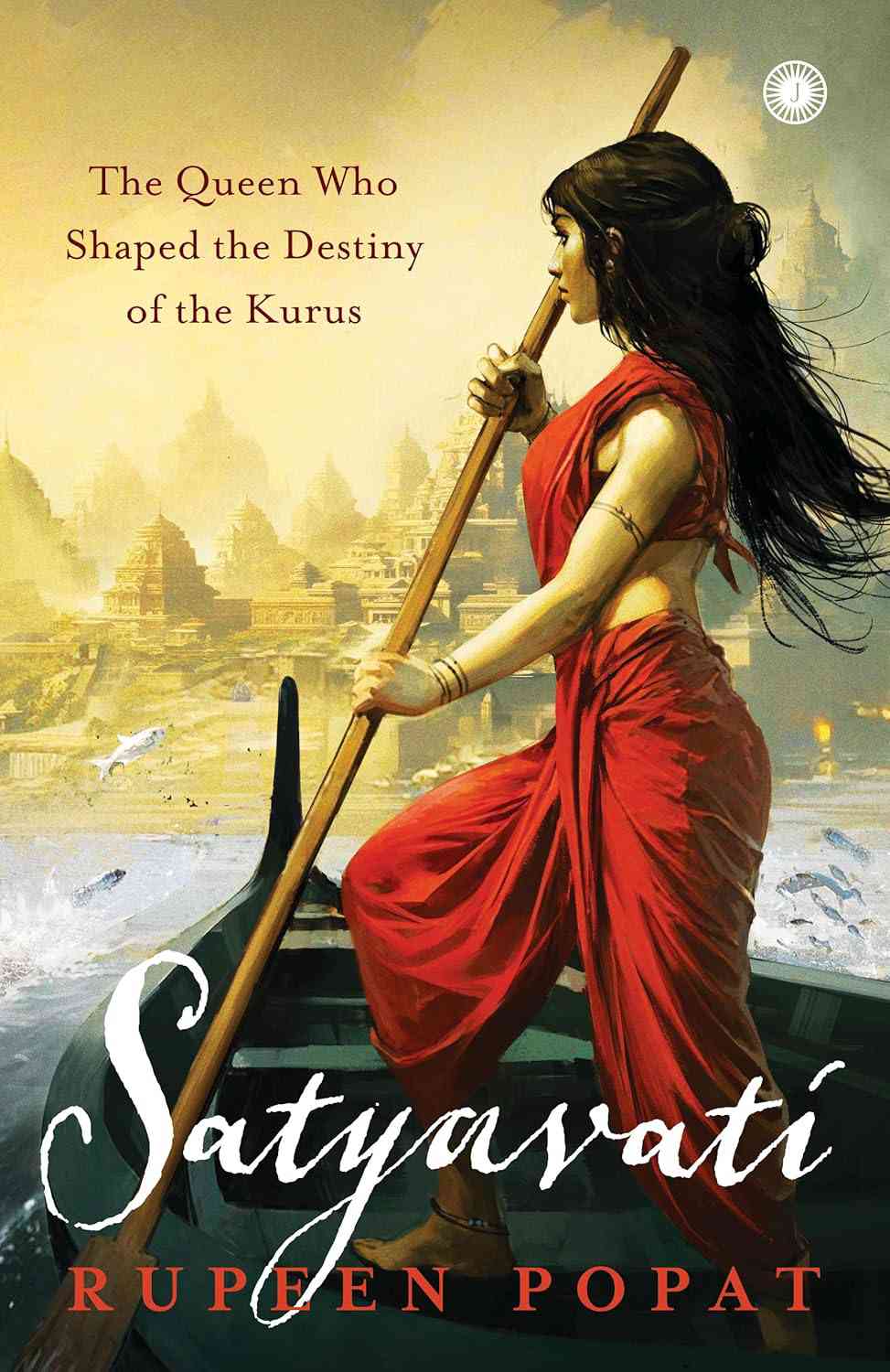
Excerpted with permission from Satyavati: The Queen Who Shaped the Destiny of the Kurus, Rupeen Popat, Jaico Publishing House.
