





Bearing Witness to the Age is the first substantial collection from Behçet Necatigil, one of the most distinctive and influential figures of 20th-century Turkish poetry. Translated by Neil P Doherty and Gökçenur Ç, the collection – published, interestingly, in India – introduces English-speaking readers to a poet whose work articulates a grounded vision of Turkish modernism – shaped less by manifestos and more by the fragile dignity of ordinary life.
Unlike Anglo-American modernism, Turkish modernism did not emerge under a unified name or program. It existed as a constellation of overlapping poetic currents such as Edebiyat-ı Cedide (The New Literature), Milli Edebiyat (National Literature), the Garip movement, Sosyalist Gerçekçilik (Socialist Realism), and İkinci Yeni (Second New). Only retrospectively, from the 1980s onward, did critics describe this period as “modernism.” Among these currents, the Second New proved especially influential for its imagistic density and formal experimentation.
Following a poet
Necatigil’s relationship to the Second New was ambivalent. He neither claimed membership nor was fully embraced as one of its poets. Yet critics observe a marked stylistic shift in his mid- and later work under the movement’s formal influence. Bearing Witness to the Age, spanning nearly three decades – from Evler (Houses, 1953) to the posthumously published Söyleriz (We Say, 1982) – is organised chronologically, allowing readers to follow his evolution. What emerges is a poetic voice increasingly condensed and elliptical, yet anchored in emotional and ethical concerns.
Necatigil is often called the “poet of homes,” reflecting his sustained engagement with domestic spaces and the lives they contain. Homes are not idealised refuges but sites of tension where interior and exterior worlds meet. Streets, schools, cinema houses, and shop fronts recur as charged urban spaces where memory and identity erode. In one poem, we see how the city quietly consumes the self over time, when the speaker observes:
“Whenever I wander the streets
Schools cinemas shop fronts
Each use up
The old me’s in me.”
This attentiveness to ordinary life defines Necatigil’s style. He documents the everyday with seriousness usually reserved for political or historical events. Domestic imagery often carries fear rather than comfort: “No flowers of the prophet— / It was always flowers of fear / That graced our pots.” Hope, when present, is modest and collective rather than utopian: “Hope in tomorrow is all we ever asked / Children, homes and bread…” Yet even this restrained hope is shadowed by doubt, culminating in a question echoed across his work: “But happiness, is this all there is?”
Though rooted in the domestic, Necatigil’s poetry is never insulated from history. His later poems show a stark awareness of modern civilisation’s destructive capacities. In a striking passage, he writes:
“Now Pan has abandoned the deserted meadows
For the cities where millions dwell…
While in the city’s belly and in its remote corners
The needy, hungry and sick crawl…
He stokes this civilisation into furyWith atomic bombs and ballistic missiles.”
Pan’s displacement into the modern city allows Necatigil to confront technological violence and collective moral exhaustion. The poem concludes with a profound ethical question: “If we cannot live with dignity in this world / What have all the past centuries left to us?” Progress is interrogated not by monuments or conquests but by its capacity to protect human dignity.
The poetic idiom
Formally, Necatigil’s later poetry reflects Second New influence through fragmentation and visual experimentation. Ellipses, dashes, parentheses, blank spaces, and abrupt line breaks interrupt linear reading, requiring active participation. Necatigil leaves much unsaid, trusting images to carry meaning and viewing each poem as a self-contained entity. Meaning emerges through restraint and resonance rather than declaration.
This poetic idiom presents formidable translation challenges. Necatigil’s language is dense with puns, colloquialisms, and sound play – features deeply rooted in Turkish. Yet these tools expand the expressive limits of everyday speech, creating a compact idiom uniquely his own. The achievement of Bearing Witness to the Age lies in the translators’ ethical approach. Neil P Doherty and Gökçenur Ç, himself a poet, preserve formal tension and semantic openness, pushing conventional English usage when necessary, while maintaining clarity. Thus, translation becomes another act of witness here in its own right, carrying forward the moral attentiveness of the originals across linguistic and cultural boundaries.
Necatigil’s understanding of the poet’s role is articulated with quiet urgency in his own words:
And for whom do the poets always write?
If at the edge of bridges ruined
Someone howls in a terrified abyss
And for those I am here do the poets always write.
These lines form a fitting conclusion to both the collection and Necatigil’s poetic project. The poet writes not for movements or institutions, but for those at the margins – for voices on the verge of disappearance. Poetry, in his vision, becomes an act of presence rather than proclamation.
For readers unfamiliar with Turkish poetry, Bearing Witness to the Age offers not only access to a major poet but also a deeper understanding of Turkish modernism itself – grounded in restraint, attentiveness, and ethical responsibility. Through careful translation and selection, this book ensures that Necatigil’s witness – to homes and streets, fear and hope, dignity and doubt – continues to speak across languages and generations.
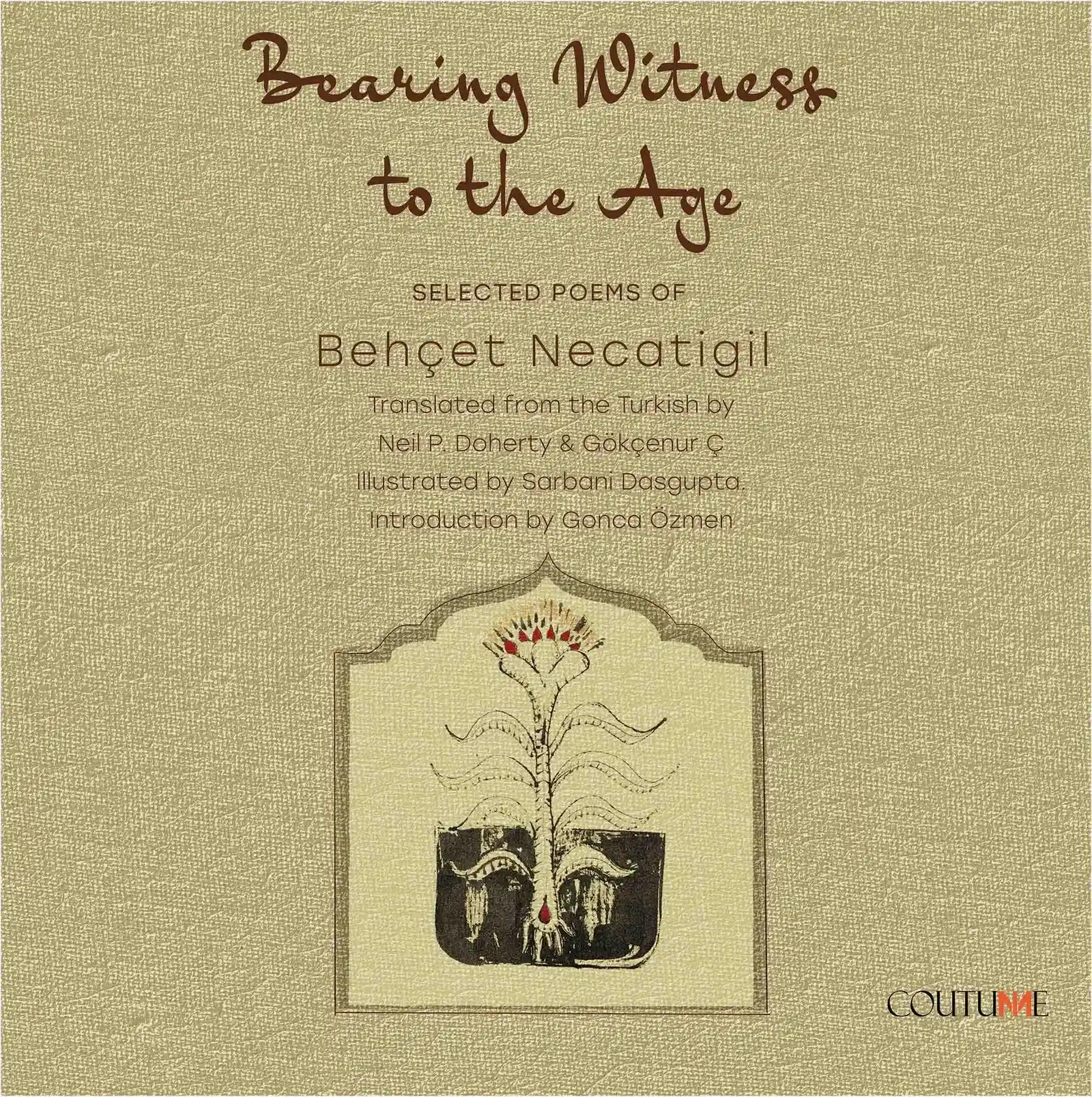
Bearing Witness to the Age: Selected Poems of Behçet Necatigil, translated from the Turkish by Gökçenur Ç and Neil P Doherty, Antonym Collections.
