





As the world witnesses the war and conflicts in the name of unkind stringencies of national borders and ethno-religious identities, a professor of literature, Jonathan Gil Harris, reimagines the past of cultural confluence in his gripping memoir about his mother, The Girl from Fergana: Secrets of My Mother’s Chinese Tea Chest. Acknowledging personal loss and historical trauma, the memoir brings together two different stories – one about the travails of a Jewish girl, Stella, and another about the cosmopolitan past of the Silk Road. However, Harris brilliantly coalesces these two stories into a compelling narrative that bolsters the idea of the cross-cultural existence of different peoples. And thus, the memoir appears as a beacon light in these dark times of wars fought on the pretext of religio-cultural clashes.
An ancient past and a tense present
Fleshing out the inner world of the book, a sepia-tinted image of the “tea chest” on the cover page alongside a lucid subtitle, Secrets of My Mother’s Tea Chest reflects the profound importance of this “piece of furniture” for the author. For Harris, his mother’s Chinese tea chest, which was shipped to her in Palestine by his uncle Joe, smouldered “an inchoate longing” for a long time to know what was hidden inside it. Turning out to be a chronicle of his mother’s past, this Chinese tea chest, a kind of palimpsest embedded with Stella’s memories, becomes an impetus for Harris to embark on writing this memoir. With his impressive acumen as a researcher, Harris uncovers many intriguing stories hidden in “photos, documents, notebooks, paintings and countless letters written in a variety of languages” that he found in it. And this tea chest also preserved some of Stella’s everlasting memories of her stay in the Fergana Valley.
An epitome of the harmonious cross-cultural exchange of the past, the undivided Fergana Valley, where Stella lived for five years, was situated at the crossroads of the Silk Road. One of the animating energies of the memoir is how Harris, with his great finesse, brings to the fore the ancient history of the Silk Roads with a convivial Jewish presence, while, at the same time, juxtaposing it with a relatively recent past when Stella, as a Jew, had to bear the brunt of her religious identity. The book plays out a riveting interplay between Stella’s account of sufferings precipitated by widening religio-cultural rifts and the ancient past of harmonious cultural connections.
Stella, one of the thousand Polish Jewish deportees, arrived in Fergana in December 1941, escaping Nazi atrocities. After her parents’ death in Fergana, Stella found solace in her friendship with Kamrakhan, an Uzbek girl from a working-class Jewish family. Harris astonishingly traces the routes of cross-cultural exchange between Jews and Mongols, for instance, in the last syllable of Kamrakhan’s name. And he argues that people whose names end with Khan may have been the direct descendants of Genghis Khan, the “conqueror of the Asian steppe”. Harris digs up many such illuminating historical facts, drawing close cultural affinities across different geographies and ethnicities. But, sadly, Fergana Valley, which once housed the people of diverse ethnicities and embodied the idea of cultural confluence from the days of yore, was later arbitrarily divided among three nations – Uzbekistan, Tajikistan and Kyrgyzstan – with “no place then, for Jews”. And that compelled Stella not only to leave Fergana but also her friend Kamrakhan, whom she never met again.
Harris dives deep into ancient history to obsessively unearth the instances of cultural confluence among ethnically diverse peoples. And sometimes the memoir takes a protean leap, appearing as a well-researched tome of history. When probing such facts of cross-cultural connections, he writes:
“The Fergana Valley was the starting point for Babur, whose first Indian capital, Agra, lay 1,500 kilometres to the south. But it was also the end point of Stella’s parents, both of whom would be buried here, 5,000 kilometres from their birthplaces in the place which is now Ukraine. In our modern imaginative topographies, India and Ukraine have little to do with each other. Yet for many centuries, they have been connected via the Fergana Valley on the Silk Roads – not least by the Jewish merchants who ranged across the breadth of a largely borderless Eurasia.”
Teasing out many of the conveniently thwarted historical facts, The Girl from Fergana becomes more relevant amidst the ongoing war between Iran and Israel. Iran, which is ostensibly the biggest enemy of Israel, a nation created for Jews, ironically, “provided a haven to over 100,000 Polish refugees, a significant number of whom were Jews”. Tehran, where Israel recently bombed a girls’ school killing more than 170 girls, was once home to many Jewish orphans displaced from Poland.
The personal and the universal
Iran was one of Stella’s locations but she had yet to face many imminent dislocations. Harris microscopically captures the faultlines of these displacements and the unvoiced angst of the displaced that widens the scope of his memoir. While rummaging through the personal segments of his mother’s account, he brings into his gamut the peoples across ethnicities to meditate upon their “unspeakable traumatic loss”. And Palestinians are one of them. Thus, the memoir is a compassionate mélange of the personal and the universal. This is not only the story of Stella’s search for home; it also resonates with the story of all those who fell prey to the cruel demarcations of geographies and cultures. Flagging up the fraught questions of arbitrary borders and national identities, Harris leaves us compelled to ponder them.
One of the more delicious parts of the book is Harris’s enlightening explorations of cross-cultural relations among the diverse languages and their evolution. One of his wry yet sharp observations about the history of languages is that “languages often develop less like a tree and more like potato tubers. Unlike branches, which stem from just one trunk, potatoes can form underground connections, through their tubers, with other potatoes”. And with his scintillating understanding of languages, Harris remarkably tracks down such “underground connections” among disparate languages, bringing out intriguing commonality among them with a complex relationship. And here are some interesting examples of it; the word “non” meaning bread, which is spoken in Uzbekistan and Kyrgyzstan, has its link with Jewish and Persian history and “non” became in “nan” in Urdu; another word “minaret”, an Anglicised version of the Arabic “manara” meaning “tower” and it is a cognate of the Hebrew “menorah”, the nine candled candelabrum lit by Jews during Hannukah; “opa” is another such word with which Kamrakhan always addressed Stella and it means “elder sister”, the same as the Urdu word “apa.”
Discarding the idea of one culture, one nation, Harris celebrates an affable yet complex relationship among the varied cultures and languages. The memoir is not just an impassioned contour of Harris’s mother’s life; it is a celebration of the cultural confluence of the past and a caveat for our present and future.
Mohammad Farhan is an Assistant Professor of English at the Center for Distance and Online Education, Jamia Millia Islamia, New Delhi.
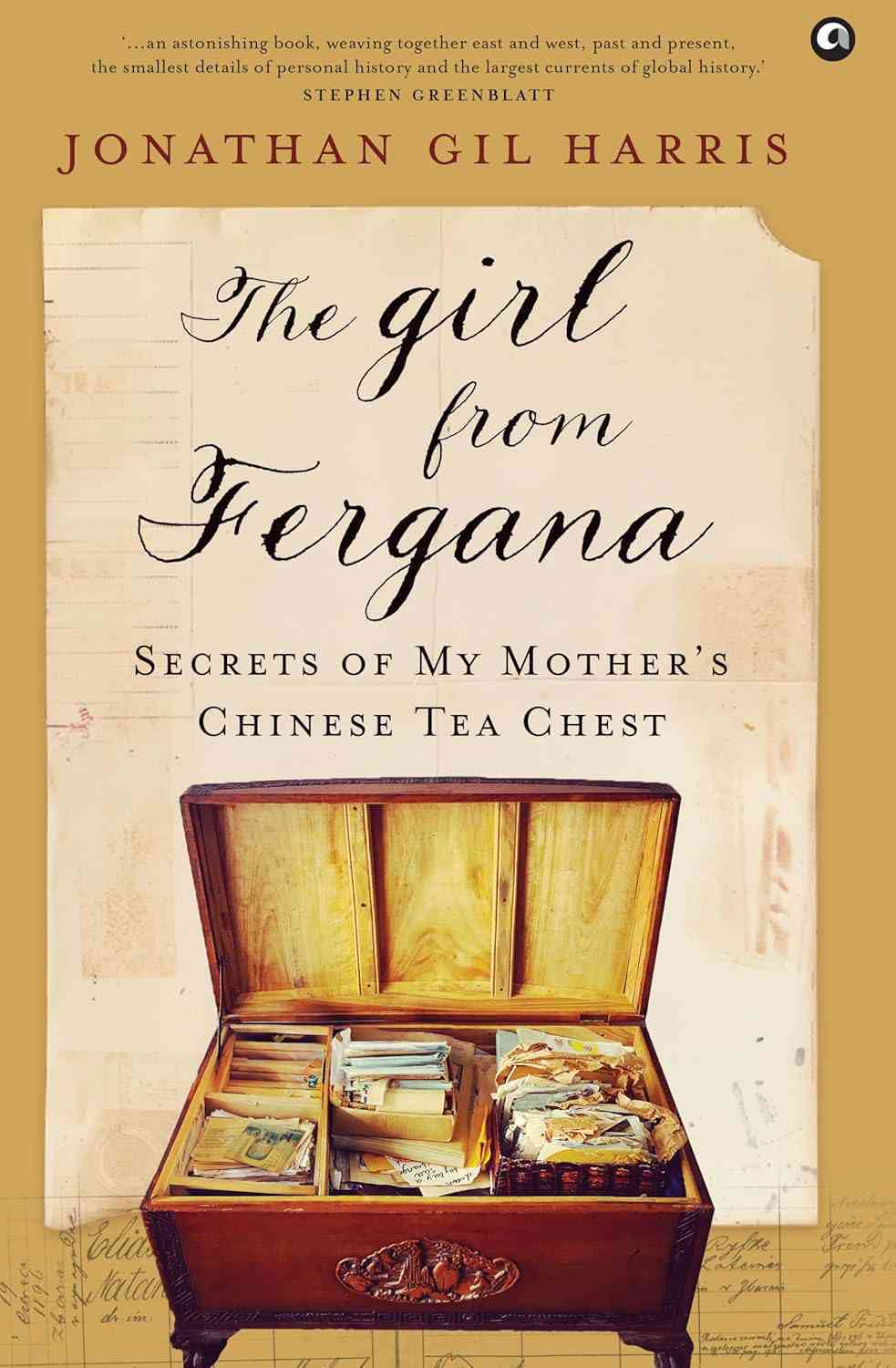
The Girl from Fergana: Secrets of My Mother’s Chinese Tea Chest, Jonathan Gil Harris, Aleph Book Company.
