




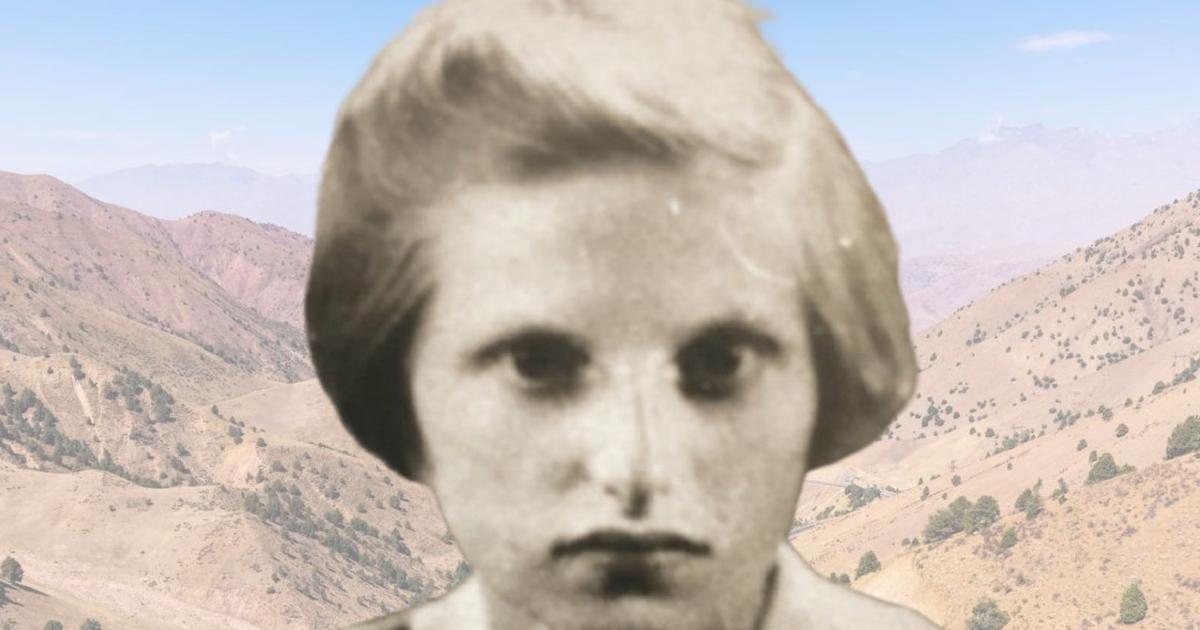
Stella talked to me several times of Osh. She did so as someone who had never visited the city, even though it is just one hour by bus southwest of Uzgen, the town where she lived in the Fergana Valley. She would speak the city’s name in a whisper, prolonging the “sh” and then pausing for a beat. The effect was to make “Osh” sound like a dangerous hex.
Osh is the largest city in the Kyrgyz portion of the Fergana Valley. Because of its relatively advanced medical facilities, it was where her mother Lola Freud – now desperately unwell – had gone for tests in December of 1943. She had required special permission from the Soviet authorities, as was then customary, to set foot outside the Uzgen district. Lola didn’t inform her daughters about the precise reason for her trip. But Stella realised that it had to be for something serious, as Lola was gone for a week.
When Lola returned, she looked like a shadow of herself. She smiled wanly at Stella, murmuring feebly that she was fine. But she also told her that she was feeling very tired and needed some rest. All Stella knew was that her mother’s health was worsening, and that the visit to Osh was in some way connected to her condition.
The very name of the city of Osh began to acquire a malign power in Stella’s mind, as if it was a spirit possessed of a power to harm those who stepped in the city. “Osh” would later metamorphose for Stella into a full-blown angel of death, responsible for taking her mother away from her.
Lola must have seen little of Osh during her week there. Given her condition, she probably went straight from her bus to the hospital. But it would have been impossible for her not to notice from her bus window a large, four-peaked stone promontory in the city centre, soaring 200 metres above it. Lola couldn’t have known that this stony mass had once been a major landmark on the Silk Roads: it was almost certainly the Lithinos Pyrgos, or “Stone Tower”, that the Greek-Roman geographer Ptolemy described in 120 CE as the mid-point on the overland caravan route to China. The locals call the promontory by two names. The Kyrgyz refer to it as Sulaiman-Too, or Sulaiman Mountain; for the Tajiks, it is Takht-e Sulaiman, the Throne of Sulaiman.
Sulaiman is, of course, the Arabic and Persian name of the tenth-century BCE King of the Israelites, Solomon, son of King David. In addition to building the First Temple in Jerusalem, Solomon supposedly wrote the Hebrew Bible’s Book of Proverbs and the beautiful Song of Songs. He is revered equally by Jews and Muslims: Jews cherish Solomon as Shlomo, a model of justice as well as wisdom, while Muslims ascribe to Sulaiman unusual supernatural powers – in particular, magical control over the wind, demons, and djinns.
My mother never knew the name of the stone promontory in the Fergana Valley that had been named for an Israelite king. But she would have been fascinated to learn that his name has had considerable power throughout the territories connecting Osh to the Gangetic plains. For Solomon-Sulaiman’s cross-faith djinns have long haunted the Fergana Valley–India route of the Silk Roads, particularly since the time of the Mughal Empire.
The Fergana Valley and the Indian subcontinent have been culturally and commercially connected for over two millennia. From the third century BCE to the third century CE, the Kushan Empire – a syncretic, Sanskrit-speaking, Yuezhi-Zoroastrian-Buddhist-Shaivite Hindu successor to the Indo-Greek Bactrian kingdoms that had emerged in Central Asia after Alexander the Great’s conquest – extended from just south of the Fergana Valley all the way to Bihar in northern India. Indeed, the name “Fergana” may itself have a Sanskrit origin dating back to the Kushan Empire: in ancient Sogdian records, it was sometimes written as “Pargana”, Sanskrit for “small region”.
Local legend claims that Solomon visited the Fergana Valley and died in Osh; his grave is said to be at the summit of Sulaiman-Too. The legend probably dates to the arrival of Islam in the Fergana Valley, though Jews – there is a long-standing community in Osh – may also have contributed to it. But the name of Solomon had travelled further south through the former Kushan Empire territories: it is associated with several summits between the valley and India. The Sulaiman Mountain range extends from the Khyber Pass on Pakistan’s border with Afghanistan to the town of Jacobabad in Sindh. One of its highest peaks is known, like the Osh hill, as Takht-e Sulaiman; it is revered by Pashtuns as the resting place of their founder. Kashmiris likewise claim that Solomon visited their region. A local legend maintains that Solomon erected a stone temple on a hill overlooking Srinagar, Kashmir’s capital; the hill, which the Mughal chronicler Abul Fazl called Koh-e Sulaiman (Solomon’s hill), is also known as Takht-e Sulaiman.
Osh’s promontory, then, was not just the midway point in the trading route between Europe and China. It was also part of a constellation of mountainous landmarks for merchants, soldiers, and pilgrims travelling between Central Asia and the Indian subcontinent.
Sulaiman-Too was the launching point for one of the most consequential invasions of India. At the tender age of eleven, a young Chagatai prince named Zahir-ud-Din became ruler of Fergana upon his father’s death in 1494; Uzgen was one of his possessions. He spent his teens and his twenties embroiled in endless battles and mutinies, during which he was three times installed and three times deposed as ruler of Samarqand. By 1510, Zahir-ud-Din was terribly worn out. So, like Lola, he went to Osh.
Legend tells us he climbed to the peak of its stone promontory, prayed to Sulaiman for relief and inspiration, and received a divine message. It directed him to invade Afghanistan, cross the Indus, and conquer India. Although he was a Chagatai Turk, the imperial dynasty Zahir ud-Din founded in India was named after his mother’s Mongolian ancestors – the Mughals. He is known to us now as Babur, the first Mughal emperor of Hindustan.
In his memoir, the Baburnama, Babur talks about building a hajra or retreat on Sulaiman-Too at the site of his revelation. It still exists; although renovated in recent years, the Hajra Sulaimani boasts the distinctive tilework and hexagram patterns that distinguish generations of Mughal architecture from the Fergana Valley, through Afghanistan and Pakistan, to northern India. Babur remarks in the Baburnama on the hajra’s ‘porch’ and its excellent view, “the whole of the town and the suburbs being at its foot.” The hajra serves as a signpost advertising the Fergana Valley–India route taken by Babur – and the Israelite king’s presence along it, into the Gangetic plains.
Ayodhya is located at what were once the crossroads of Silk Roads tributary routes running west to east and north to south. Its lively markets were for centuries the stopping point for travellers, pilgrims, and traders from across the world. The city was home to people of many faiths: the visiting Chinese monk Faxian described Ayodhya as a Buddhist centre in the fifth century; a hundred years later, his compatriot Xuanzang was impressed by its Deva temples; and in 1226, following Ayodhya’s annexation by the Delhi Sultanate, it became the Muslim-ruled capital of the province of Awadh, a Persianized version of Ayodhya.
In 1500, the Hindu poet Kalyana Malla wrote a story called Sulaiman Charitra (The Story of Solomon). He did so at the request of the son of Ahmad Khan, the king of Ayodhya. Remarkably, this story about an Israelite king, produced for a Muslim ruler, is in Sanskrit: in the story’s prologue, Prince Lad Khan commands Malla to employ the “language of the gods” – Sanskrit, the language of most Hindu scriptures – to tell the life story of “the wise and learned Sulaiman”. Malla’s tale is written in what Sanskrit calls the shringara rasa or erotic flavour; Malla uses it particularly to narrate the affair between Solomon’s parents, David (whom Malla calls by his Muslim name, Dawood) and Bathsheba.
The Sulaiman Charitra’s main love affair, however, is not between a man and a woman. It is between different cultures and faiths.
Malla says that Sulaiman – Solomon’s name in Muslim tradition – is “in heroism[…]like an Arjuna” (the archer who is the close companion of Krishna in the Hindu epic Mahabharata), “in beauty another Kamadeva” (the Hindu god of love), and “learned in the eight branches of yoga.” Malla’s Sulaiman, therefore, is Islamicized by name and Hinduised by nature. As if to emphasise this syncretic union of cultures, Malla renders the name of David’s lover Bathsheba as Saptasuta –Sanskrit for “seventh daughter”. It is a striking touch: the names Malla gave the lovers, Dawood and Saptasuta, signal a bond between Muslim and Hindu.
Yet hidden in Saptasuta’s name is proof of Malla’s knowledge of a third religious tradition. He clearly had some awareness of Hebrew: her Sanskrit name is a literal translation of the Hebrew “Bathsheba” which derives from “bat”, meaning daughter, and “sheba”, seven. The sources of the Sulaiman Charitra, then, are Muslim, Hindu, and Jewish. Ayodhya’s crossroads location, with merchants passing through it from Afghanistan in the north and Sindh in the west, meant Jewish as well as Muslim and Hindu traders must have frequented its bazaar and traded stories with Malla there.
We often hear of the Ganga-Jamuni tehzeeb, the pluralist Hindu-Muslim ethos that sprang up in India’s Gangetic plains from Delhi to Bengal alongside the banks of the intersecting Yamuna and Ganges rivers. The Sulaiman Charitra makes clear that this Hindu–Muslim confluence also included Jewish tributaries, suggesting the extent of north India’s connection to the pluralism of Osh and the Silk Roads. But that confluence has been forgotten. And Solomon-Sulaiman has become powerless to stop the violent division of Indian communities that once shared stories of the Israelite king.

Excerpted with permission from The Girl from Fergana: Secrets of My Mother’s Chinese Tea Chest, Jonathan Gil Harris, Aleph Book Company.
