



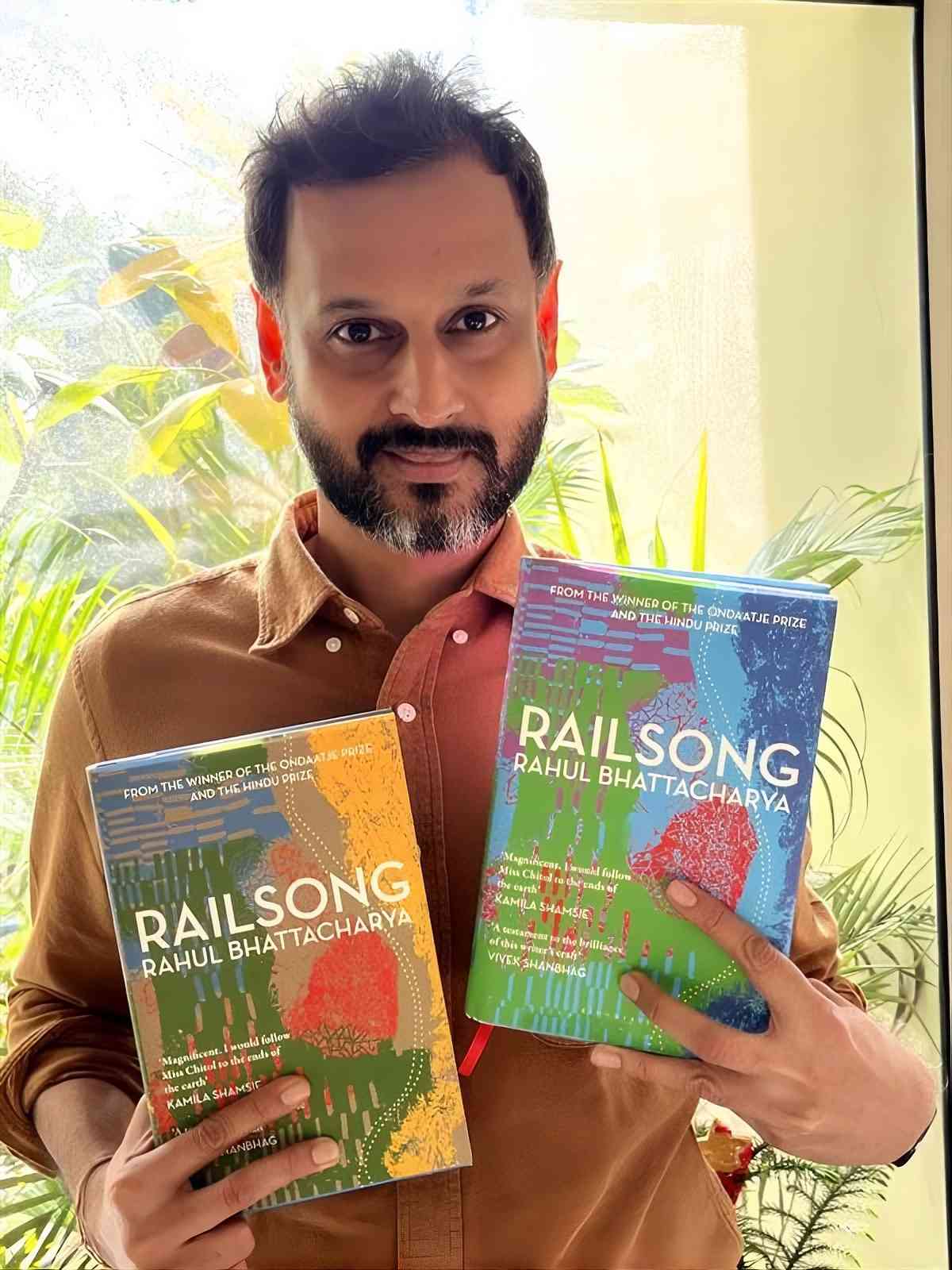
In Rahul Bhattacharya’s latest novel, Railsong, in a new independent India charged with national vigour, Charu, the motherless daughter of a railway worker, pines for freedom from the oppressive domesticity of her childhood and flees to Bombay, the promised land of opportunities. Unfazed by the everyday discriminations around her, she becomes an unlikely hero: a railway woman and census enumerator who witnesses, first-hand, the vast possibilities of her nation. Sweeping yet intensely personal, Railsong is stunning in its scope and craft – it is easily among one of the best novels to have been published in recent years.
A review on Scroll noted that “Railsong is a love song that defines a lyricist’s career, even changes it for the better. Bhattacharya is at his composed, elegant best as he belts out his gentle ode to the India that was and the India that can be…”
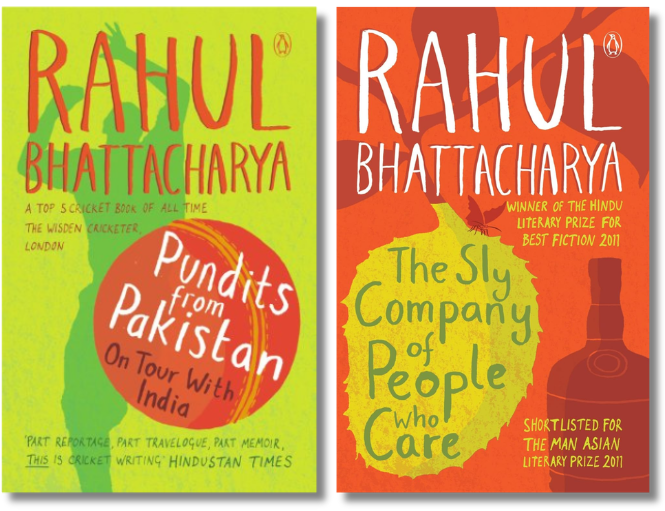
Railsong, Bhattacharya’s second novel, comes 14 years after his debut novel, The Sly Company of People Who Care, which won the Royal Society of Literature Ondaatje Prize in the UK and the Hindu Literary Prize in India and was shortlisted for the Man Asian Literary Prize, the Commonwealth Book Prize and the Economist Crossword Book Award, and was a Kirkus fiction Book of the Year in the US.
His first book, Pundits from Pakistan, a cricket tour book, was published in 2005. It won the Crossword Popular Book Award in India and was shortlisted for the Cricket Society Award, UK.
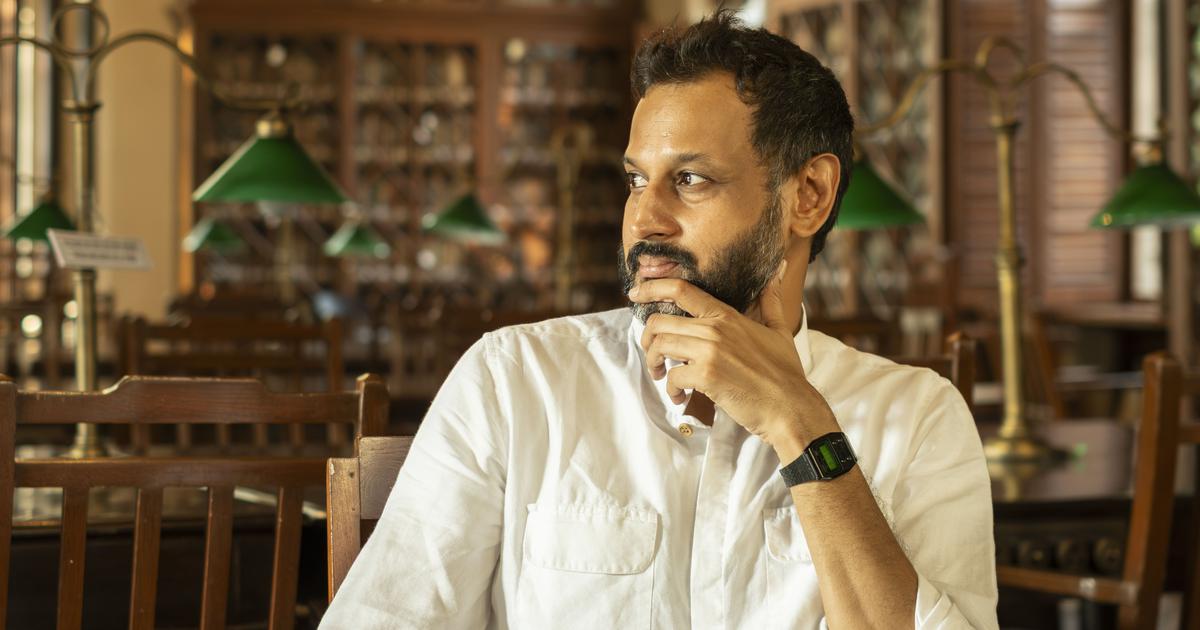
A writer, sports journalist, and editor, Bhattacharya spoke with Scroll on a winter morning in Kolkata about writing breaks, researching the Indian Railways, and how his characters are shaped by the “cumulative effect of a thousand little things.” Excerpts from the conversation:
You published Pundits from Pakistan and Sly Company in 2005 and 2011, respectively, and then Railsong came 14 years later. What were you busy with in the intervening years?
In retrospect, the earlier six-year gap seems very honourable!
It took me a while to get started on Railsong, and then the complexity of the project grew on me. I had a lot to learn and bring together. I don’t mean only the knowledge or the research. I mean also the insight into the emotional texture of the novel. So much of it was outside my lived experience, even those parts that might seem as though they are not. For instance, I wrote a Bengali family. But as a half-Bengali whose Bengali side has been outside Bengal for generations, I didn’t really have the Bangla language until I began attending free Sunday classes with children in a Kali Mandir library during this period, taking exams and so on, until I could read the literature. I wrote a railway family, but I’m not from one myself. Charu, my protagonist, is a woman, and I am not.
But also, as you know, life happens. I became a father of two daughters, a work-from-home father. I had a job editing The Cricket Monthly in order to support the novel I was writing. I had some journalism on the side.
As a writer who does not spend a lot of time in the spotlight, were you nervous about how your new novel would be received? Did you ever battle the anxieties of fading from the reader’s memory?
It’s greatly liberating to live a quiet life and do your thing. Anonymity is useful for writers.
I was 25 when Pundits from Pakistan and 31 when The Sly Company of People Who Care was published. They were well received but that perhaps made me a little self-conscious. I needed to go away and work out what I wanted to do next.
You’re right about how people remember or forget. As I have been travelling with Railsong, people tell me what they thought about Pundits or Sly Company, or that they are interested in reading them. I now believe that writing a new book is the best thing you can do for your previous books.
Your primary interest is sports, cricket in particular. Was writing a sports novel ever on the mind? Or did it feel too predictable?
No, it wasn’t. Cricket was one of my first loves, and it got me into writing, and then writing, in a sense, took me out of cricket. With Pundits from Pakistan, I did what I wanted at the time, literarily, with cricket, and much of that is down to the wonderful structure of a cricket tour. It gives a writer locations, movement from place to place, a set of characters with their fluctuating fortunes and their interpersonal dynamics, and the built-in conflict of a sporting contest. Writing that book allowed me to consider the possibilities of writing books that weren’t like it.
There simply can’t be a small Indian Railways novel. You must have realised how mind-bogglingly vast the canvas is before you even wrote the first scene.
Yes! And one of the reasons it took me a while to begin. My idea was to take something as vast and complex as the railways and the census, which reflect the gargantuan scale of India, not to mention the government of India, and place a mere individual in their centre, and see how the relationship played out.
That process took me deep into the Indian Railways. I find the idea of the railways is almost seeded into our ancestral memories. We don’t forget the train journeys we took growing up. These are intimate memories, but which still evoke the scope and size of the railways that spread out like neural networks across our country.
There’s no doubt that the railways are a unifier, but as we see, they also disrupted lives in tribal lands, for example. And we see this unifier–disruptor conflict play out again and again. How did you keep your balance without tipping over to either side?
That’s a really interesting question because railway tracks are – or used to be – called the “permanent way”. They embed themselves into the earth. They disfigure the land. The railways cut through fields, villages, and forests. They need vast expanses of land for the stations, workshops, and tracks. One has to mow down and dig out a great deal for rail lines to exist. That said, the railway is still undoubtedly one of the most sustainable forms of transport we have. It carries a huge number of people for a relatively low energy cost, certainly compared to flying and automobile travel as well.
Now, what are the costs of that? When the Chittaranjan workshop was set up at Independence, there was a Santhali resistance against the takeover of their land. Of course, their bows and arrows could not match the might of the state. Chittaranjan is on the Chhota Nagpur plateau, as is the fictional railway township in Railsong. That region has borne a lot – adivasi populations displaced by mines, from where the railways carry away material. Who does the forest belong to? Mahasweta Devi’s great novel, Aranyer Adhikar, which can be translated to Rights of the Forest as well as Rights to the Forest, addresses this question. That spirit kind of informs the consciousness, or the conscience, of Railsong.
While reading, I realised that you were more interested in chargemen, gangmen, etc and not really in the officers. This is a novel of observation. When did you begin to notice the “nobodies” of Indian Railways?
This is a question we have to ask ourselves: Is anybody really a nobody? This, I’d say, is a project of the novel. To excavate the “somebodiness” of everybody.
Every “nobody” that I can think of has a full life, a great number of complications in their professional and personal worlds, and, even if we cannot always imagine it, a vivid inner life. The idea that we can privilege so-called important lives over unimportant ones is such a small and limiting one. In the world of subcontinental English fiction, it is possibly a function of the shared class of the writers and the readers.
I am guided by my instincts in this. Sly Company, too, was a novel about “nobodies” – the descendants of the enslaved and the indentured emerging from the experiences of their ancestors. Both Sly Company and Railsong explore encounters between common lives – by common, I don’t mean uninteresting but uncelebrated, unlike, say, the cricketers in Pundits – and the frictions and connections in that.
The elites are a very small proportion of the railways. The officer classes make up a tiny percentage of railway workers, one or two per cent. The Indian Railways, one of the biggest employers in the world, largely consists of Group C and D workers – clerical workers and technicians, labourers and cleaners – whose lives are deeply instructive about the country. Charu is a Group C employee.
Charu Chitol feels so real that at times it felt like I was reading a biography. How did you find her?
Bit by bit. I built her from the ground up, from the age of three when the reader meets her first, till well into her thirties. Expanding her consciousness as she grows up, building a relationship with the world around her, was meaningful. How might she respond to the petty tyrannies that govern a girl’s and a woman’s life, for instance. A character starts living from the cumulative effect of a thousand little things.
There’s a sleight of hand involved in presenting Charu to the reader. The third-person narrative is sometimes a close third person, while sometimes I observe her as the omniscient author. On occasion, I look at her through another character’s eyes. In small segments, the first-person voice is Charu’s own. This agility on the page took some doing but I hoped to create a credible character, a character that a reader could inhabit.
I really had to get a sense of her work life. It is, after all, a novel about a working woman. Her work is central to Charu and to the design of the novel. I met a lot of railway people for that.
So, were you primarily looking for female employees in the Indian Railways?
That always helped but you can imagine, given our structure of social and filial constraints, how challenging it would be for women to take on, say, inspection work. That requires rough, solo, often unplanned, urgent, travel to the back of beyond, looking into cases that can turn into investigative missions.
I have also felt that engaging with politics in a story directly is easier than having it unfold in the background. Its passive presence somehow feels more difficult to tackle. More ominous, even. This is how you deal with the demolition of the Babri Masjid. Can you tell us why you did not put it in the centre of the narrative as you approached the 1990s?
The job of the novelist, I believe, is not to tell the reader what happened, or even how it happened or why it happened. The novelist can take a look at historic events from different vantage points – that histories are not usually constructed from – for what it felt like. With the Rath Yatra and the Babri Masjid, I don’t have to rehash what the news headlines said. I can take it into the domestic space or the workplace.
The late 1980s were a febrile time. When bricks were being donated to build the Ram temple at the site of the masjid, Charu could see this donation as an act of potential violence dressed up as piety. How might she speak up about this in her in-laws’ home, where she still feels an outsider? It is not dissimilar to how families are divided on Modi or Trump.
I was also thinking about the process of writing a novel like Railsong. Shruti Debi, who is your agent, also happens to be your wife. Do you prefer receiving feedback in stages or only at the end? I could see merit in getting an agent’s input after every chapter but I also could not see how you could stop till you finished writing it…
I should add that Shruti is also a brilliant editor. Not just me, but all her authors rely on her for that. She has a very busy professional life, and with two young children, our personal lives are very busy too. I certainly can’t presume to have her time whenever I want.
For the novels, I did not show her anything at all till I had an entire draft. My process for this novel was unlike either of my previous books. I wrote the entire thing in sequence, probably because I wrote the first draft by hand. Of course, I didn’t show her the handwritten draft – my handwriting is occasionally illegible to even me. I typed it up, edited it, and sent it.
She knew I was working on a novel and I imagine she knew it had something to do with the railways, because I was always researching, but she did not know anything more. Not even about Charu’s existence.
Have you started working on another novel or are you going to take a short break?
I hope it’s a short break! I do need some time to scratch my way into the next book.