



A late-spring twilight in a boarding school in Ooty still lives with me. It was one of those large rooms in a building that had redone Harry Potter’s Hogwarts with 21st-century technology – stone floors, arched windows, discreet wiring, glowing screens. There was hushed magic in the room with about a hundred teenagers gathered in eager silence. They were Potterheads in a curious way: anxious about motivation, mental health and reading and thinking habits, but everything was dwarfed by an obsession with a large looming cloud. That was the unnameable magic of the already-present future, the force that you didn’t want to name but had to.
Artificial Intelligence. Will my learning matter anymore? Will my skills matter? Will I?
I, too, was grappling with a question that, at that time, seemed unrelated to this looming anxiety. Can creative writing be taught? As a writer who has taught for two decades at universities worldwide, this is in fact a question I have heard often – on campus, at book events, literature festivals, conferences, even at parties – Can any art be taught? Can it be learned? In a classroom?
That afternoon in Hogwarts Hall, it didn’t quite strike me that this was a basic question about human potential that was deeply entwined with the anxiety about AI. But it made me wonder about the peculiar nature of human potential that fused the individual and the collective in strange ways. Will my learning matter? Art and artifice shape each other, and hence, in the end, remain inseparable.
I tried to explain to teenagers that all art has a dimension that is more like science – call it the technical part if you will. And another dimension, the harder-to-define one, that is closer to our idea of art. The science part includes aspects that can be organised as a collective system, which can be reproduced with training. Then there is the wilder and idiosyncratic personal element, which is unpredictable even to the artist. The controls of this element are invisible. The artificial, too, has art in it, just the way art flirts with the artificial.
This is why some art forms, such as filmmaking, have more elements that invoke the technicality of science. This takes nothing away from their more idiosyncratic artistic dimension, which is as crucial to filmmaking as to any other art form. It’s just that there are more ground rules and more distinct patterns. Art forms with more visible scientific patterns have more teachable components. That is perhaps why it is difficult to make films without formal training, even though the ubiquity of phone cameras has now popularised video-making far beyond the reach of specialised film-making cameras.
Daylight and darkness. Learn the ropes you must, but nobody can teach you how to jump. The pit of art is always dark and unfathomable. That’s what I told them in the waning twilight across the hall perched atop the Eastern Ghats.
And that is how this question became one with the great anxiety hanging like a sleeping bat in Hogwarts Hall. Indeed, it is perhaps the Great Anxiety of our time. What is going to happen to the arts now that AI is here? Will human artists continue to play significant roles, or will writing, painting, music, films be increasingly done by artificial intelligence? What about readers, viewers, consumers? Are we going to be happy with books, films, music, paintings produced by machine intelligence? Will we miss the way human breath leaves its mist on soul and form?
It has been easy for AI to pick up the scientific, learnable patterns and technical foundations of all art forms. But for the wild, unpredictable, idiosyncratic element, one thing feels essential – a subjective consciousness. AI has shown remarkable intelligence, already exceeding human potential in many domains, without requiring any sense of a unique self and the feelings that come with it. It has also proved itself quite capable of simulating these feelings without actually possessing consciousness. This cannot but bring the relationship between the human, the personal and the artistic into new configurations, inserting the artificial seamlessly in between. And yet the human remains essential. How? And how can we ensure that this stays this way?
Art celebrates the particular and the unique; therein lies its unique humanity. A story set in India, or even in a boarding school in Ooty, is not just about a particular culture, social class or caste. It is all that, but it is also about one person, a specific family or families, a particular day or a fading afternoon, a single moment, one shade of a mood, one smile or teardrop, a single pang of fear – something that is unique, something that happens only once. Art offers the intimacy of the private in the larger structure of the social. It highlights the magical relation of that particular with the universal.
A personal consciousness that offers something different and unusual, sometimes shockingly so, is the identifying mark of art. If and when AI owns this personal consciousness, or simulates ownership to perfection, the human signature will wither. If that happens, will the last vestige of unique humanity become a ghost from the past?
While definitive answers are still not here, it is already clear that the relationship between animate consciousness and creativity is being cast into increasingly new landscapes. Different and often-unexpected components of art are being better handled by AI, while others continue to befuddle machine intelligence. It is making us wonder if the personal actually requires a truly individual consciousness behind it. Most importantly, AI is forcing us to rethink our current understanding of creativity, which, in any case, has been with us for a little more than two hundred years, since the European Enlightenment and the Romantic traditions of art and literature in the late-eighteenth and early-nineteenth century. Digital and interactive forms of art, such as through interactive video games that let players shape the narrative, initiated this reconceptualisation of the aesthetic a while ago, and AI will take this a whole lot further, possibly creating works that shift and evolve in real time depending on who is watching, reading or listening.
The deeply disturbing dimension of this question was articulated by the early AI legend, Douglas Hofstader. In a conversation with Wired on November 1, 1995, Hofstadter feared that AI would demonstrate that the most complex human qualities that we cherish most deeply – such as the music of Chopin and Bach – are simple to mechanise. “If such minds of infinite subtlety and complexity and emotional depth could be trivialised by a small chip, it would destroy my sense of what humanity is about.” Unfolding studies suggest that this has, in some ways, already come to pass. But that doesn’t mean that human agency will become irrelevant in domains of creative and imaginative labour. Nor is this the first time that new technology has brought about change in the trajectory of art. The invention of photography in the 19th century appeared ready to put painting out of business, but what it ended up doing instead was to limit the reach of realist painting and open up possibilities for impressionism and post-impressionism. Not long before that, the popularisation of printing created the new form of the novel and made private reading a widespread phenomenon.
But AI is much more than a single technology. It is what is called a general-purpose technology, such as the steam engine or electricity, but ultimately, far more significant due to its capacity for autonomous learning and evolution. Hence, its impact will be wider and more far-reaching, on both quantitative and qualitative scales. And yet, there is no need to imagine a future where the human will be obsolete. But large and unexpected reconfigurations of human roles in imaginative labour will be inevitable.
One cannot think of education and employment without asking some fundamental questions. How d human beings become who they are? How does learning – both inside and outside the classroom – shape them? In what ways do work and labour give shape to a life? These are questions that have long preoccupied me, not only as a teacher and educationist, but as a writer of coming-of-age stories and narratives of education, which can be both liberating and oppressive. What is it that makes us truly human? Are we unique individuals? Or can anything we do – any job we perform, any bond we form – be done just as well by someone else? Are we merely interchangeable parts, no matter how special we believe ourselves to be?
It was perhaps natural that I would get drawn to the enigma of artificial intelligence. And this became inevitable as I faced the breathless anxiety of young people across the country, heavy with questions: “What should I learn? What should I study? Will there be jobs for me? Will I matter in the future?” Teenagers, on the cusp of their first uncertain steps into the real world, voiced their own version of Hofstader’s unease: Not just could humanity be made obsolete by a small chip, but would it?
This book, in part, is a response to all those students grappling with fears of irrelevance in a fast-changing world. But it also tries to speak to the key figures in their lives – parents, educators and the employers who will one day work with them. It is my attempt not only as a design thinker of language but also as a teacher drawn again and again to the paradoxes of education: its power to liberate and its tendency to confine.
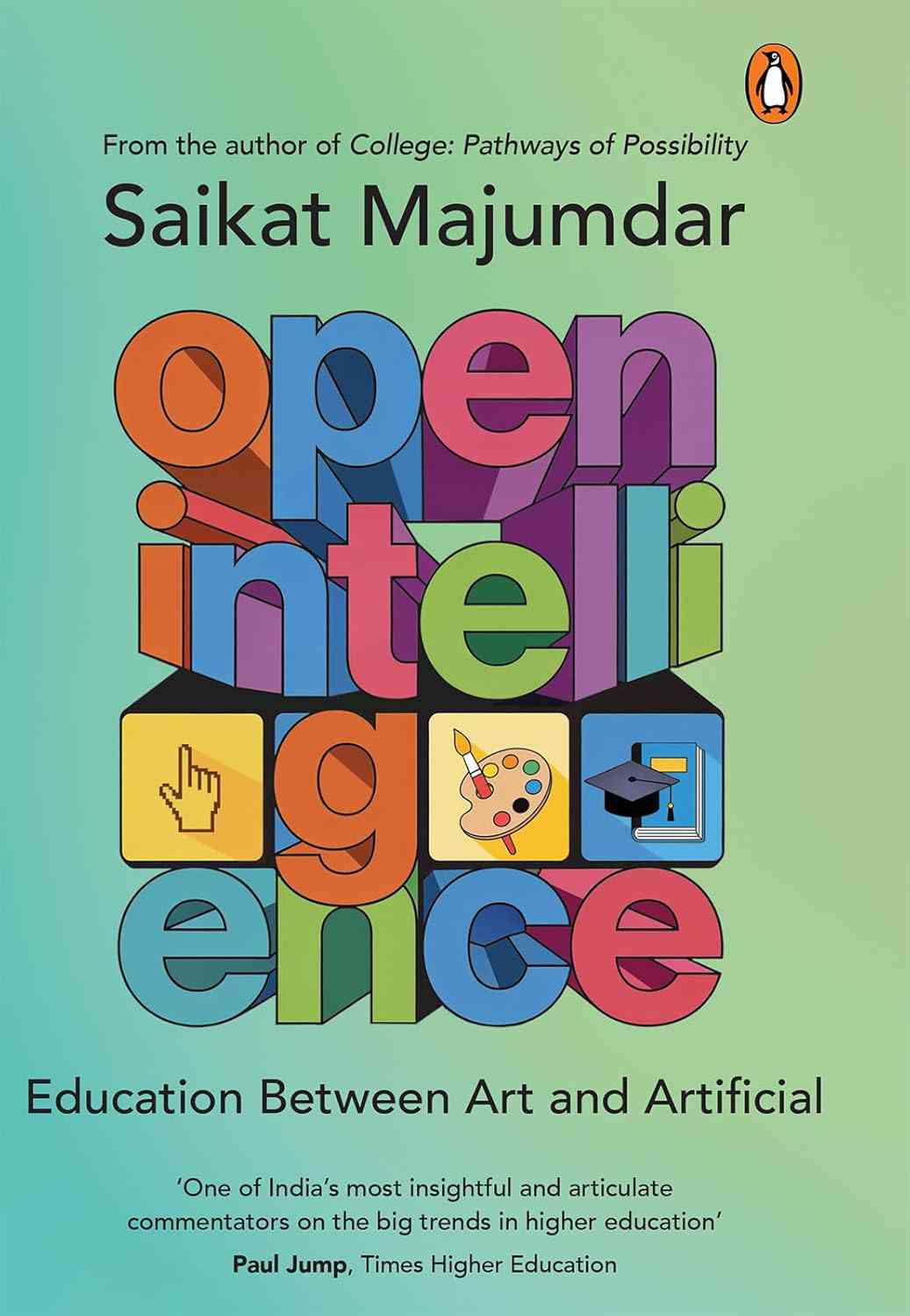
Excerpted with permission from Open Intelligence: Education between Art and Artificial, Saikat Majumdar, Penguin Random House India.
