






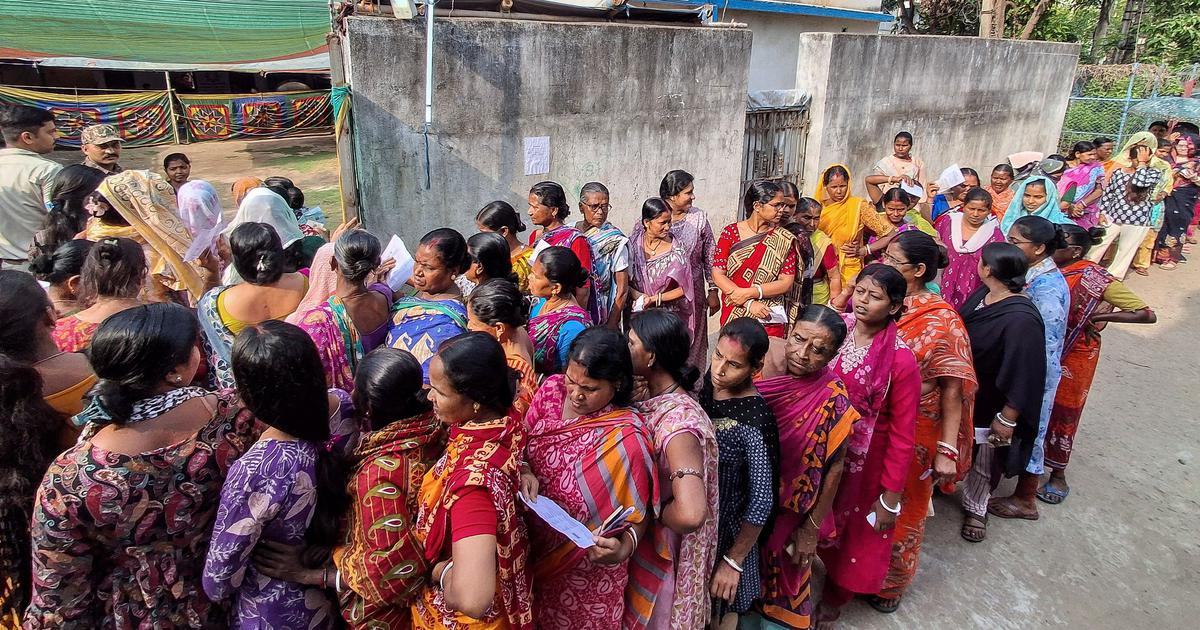
“So you made it to the voter list!” exclaimed a middle-aged resident of my locality in Kolkata.
He was addressing the man standing next to me in the crowd that had gathered to vote in the polling station in the government school in our neighbourhood.
“I thought you were from another country,” this person added, before the two of them shared a laugh. Their interaction would have amused me more had I not been busy looking for my parents. I was done with voting and had been trying to locate them – we did not have our phones with us.
Thanks to the Election Commission’s chaotic special intensive revision of voter rolls in West Bengal, my polling station was different from that of my parents. Though we live in the same house and stepped out together to cast our votes, we had to go to different places to do so. This was not the case the last time we voted in 2024.
But then ours was hardly the only family to get caught up in this mess. In the voting queue, I heard similar stories from several others. Election Commission officials described this as booth rationalisation. On the ground, it appeared to be anything but rational.
This was among the many bizarre things about these elections in West Bengal, some of which Scroll has covered in a previous edition of this newsletter as well.
Living through these absurdities as they played out felt even stranger than I had thought. I saw fellow citizens forced to accept them as they kept piling up. Eventually, they came to be perceived as common sense, our new normal.
Take the Election Commission directive banning riding pillion on motorbikes, for example. Word about it spread quickly soon after it was announced. Even before the restrictions had come into effect, people stopped using bike taxis, particularly after sunset.
Several bike taxi drivers in Kolkata told me that their incomes had taken a hit because of this. Remarkably, some of them argued that such an intervention was needed. “Politicians and their lackeys take out bike rallies and harass common people during elections,” a bike taxi driver complained while taking me home one evening. “It is a nuisance.”
The unprecedented deployment of paramilitary forces, too, elicited similar reactions. Voters acknowledged how unusual it was to have so many uniformed men carrying guns, especially in the busier parts of Kolkata that rarely see political violence.
However, many of them were also convinced that this sort of security presence was necessary. “They are here to ensure nothing untoward takes place,” was a standard justification that I would hear.
Nothing emblematised this line of reasoning better than the attitude of a large section of people towards the widespread disenfranchisement caused by the special intensive revision of the electoral rolls. Supporters of the Bharatiya Janata Party insisted that the purge was necessary even if it led to the wrongful exclusion of some names.
Scroll has reported how the SIR in particular, and citizenship politics in general, even hurts communities that are seen as BJP voters in Bengal. But that has not necessarily diminished support for the SIR among these voters, many of whom appreciate the Hindutva party for taking up the issue of “illegal immigration”.
Oddly, though, even those whose names had been deleted were not very worked up. They seemed to have made their peace with the fact that they would not be able to exercise their right to vote by convincing themselves that the disenfranchisement was temporary.
“Everything will be alright after the elections,” Asadul Hoque, a 30-year-old e-rickshaw driver in Malda whose name had also been deleted from the rolls, told me confidently. Unlike many other Bengali Muslims, he was not losing sleep over concerns that Assam-like detention centres and foreigners’ tribunals would spring up in his state.
Perhaps those fears might be exaggerated. However, it is irrefutably true that the voting rights of lakhs of people were snatched away while their fellow citizens chose to participate in the elections. When I asked deleted voters if they were bothered by this apathy, they simply shrugged.
“It is a closed chapter,” Imtiaz Akhtar, a lawyer practising in the Calcutta High Court, said in a matter-of-fact manner. His parents were voters in 2002. Yet, his name was removed from the electoral rolls. His maternal grandfather, the late Mohammed Amin, was a freedom fighter who served as a minister when the communists ruled West Bengal.
Akhtar joked about showing his grandfather’s memoirs to the retired judges heading the appellate tribunals for deleted voters. It was a relief to discover that Bengalis like him still have a sense of humour about what happened in these elections. So what if the joke is on us?
Follow Scroll’s coverage of the 2026 West Bengal elections here.
Here is a summary of last week’s top stories.
Kejriwal vs High Court judge. Aam Aadmi Party chief Arvind Kejriwal said that he would not appear in person or through a lawyer before a Delhi High Court bench of Justice Swarana Kanta Sharma. The judge is hearing the Central Bureau of Investigation’s challenge to him and several others being discharged in the liquor policy case.
The former Delhi chief minister’s comments came a week after Sharma on April 20 rejected his plea that she recuse herself from hearing the case. During the hearings, Kejriwal had raised concerns about her “perceived ideological proximity”, referring to Sharma attending events of an organisation linked to the Rashtriya Swayamsevak Sangh.
Kejriwal had also contended that the judge’s children had been empanelled as counsels by the Union government and had been allocated cases by Solicitor General Tushar Mehta, who is representing the CBI in the liquor policy case.
Party leader Manish Sisodia said that he will also not participate in the trial.
Hate speech laws. The Supreme Court refused to pass additional directions to curb acts of hate speech, saying that existing laws are sufficient to deal with the problem. The order said that the court can only draw attention to the need for reform.
The bench said that the power to create new categories of criminal offences lies within the legislative domain. It also noted that the existing framework of the criminal law, including provisions of the Indian Penal Code and linked legislations, “adequately addresses” acts that promote enmity, outrage religious sentiments or disturb public order.
Has the Supreme Court gone soft on hate speech, examines Ratna Singh.
Press freedom under attack. India’s rank in the 2026 World Press Freedom Index fell to 157 of 180 countries in the 2026 World Press Freedom Index, media watchdog Reporters Sans Frontières said. In 2025, the country was ranked 151st.
It remains in the “very serious” category, said the non-government organisation that has been publishing the World Press Freedom Index since 2002. “In India, judicial harassment of independent media is intensifying, driven by the growing use of criminal statutes – defamation and national security laws among them – directly targeting journalists,” said the organisation.
Among its neighbours, India ranks below Nepal (87), the Maldives (108), Sri Lanka (134), Bhutan (150), Bangladesh (152) and Pakistan (153).
Also on Scroll last week
- How a law to empower Adivasis is being used to target Christians in Chhattisgarh
- How the Iran war has plunged India’s diamond industry even deeper into crisis
- Central forces look on in viral Bengal violence video. Men doing the hitting are from the BJP
- How the hard ‘na’ insists on Marathi’s caste hierarchy
- In ‘new UP’, the real message behind setting up a Noida police cell for industrial disputes
- Anand Teltumbde: Not more MPs, Indian democracy needs citizens to have a greater say in governance
- Delhi’s draft EV policy gives car subsidies to the rich, puts more vehicles on the roads
- Manganiyar women are stepping onto a stage long closed to them by men
- Review: Even the luminous Sai Pallavi can’t rescue dull and gimmicky ‘Ek Din’
- Why Marathi films are all the rage again – and why this wave could last
Follow the Scroll channel on WhatsApp for a curated selection of the news that matters throughout the day, and a round-up of major developments in India and around the world every evening. What you won’t get: spam.
And, if you haven’t already, sign up for our Daily Brief newsletter.
