







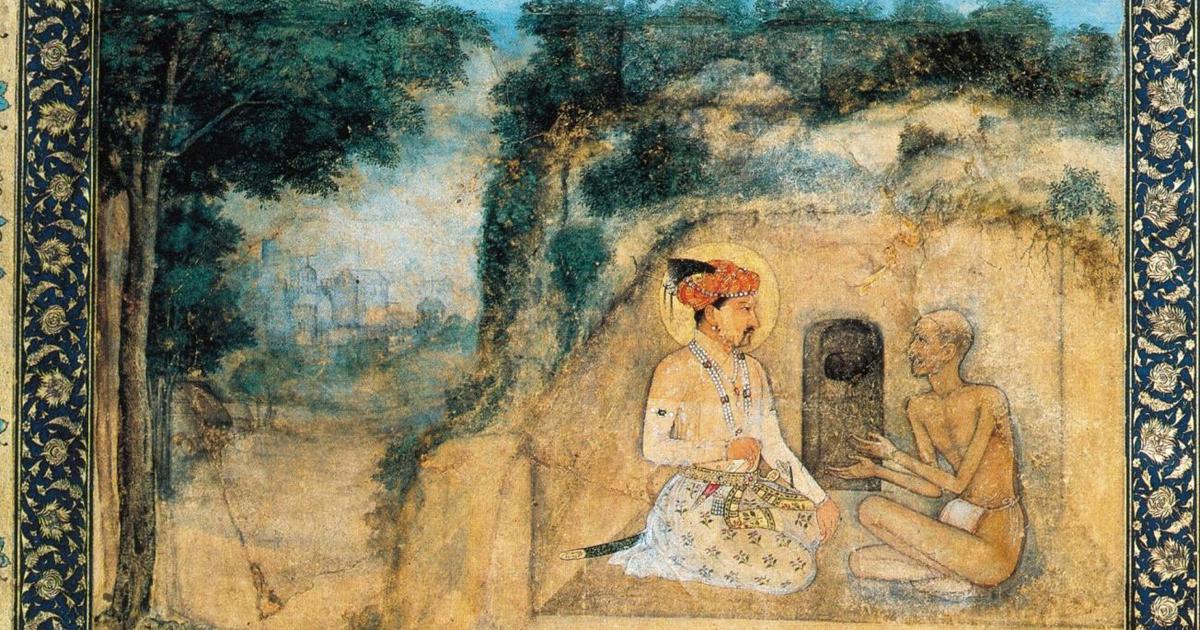
In the winter of 1617, the fourth Mughal emperor did something unusual. Jahangir dismounted from his royal procession, walked to a narrow cave near Ujjain, and squeezed his body through an entrance so small that even a thin person would have struggled to enter it.
Inside lived a man whose real name was Chitrup, though history knows him as Jadrup Gosain. He was a Vedantic ascetic who had renounced the world at 22 and spent 38 years in austerity, eating five mouthfuls of food daily, bathing twice a day, and meditating on the identity of the individual self with ultimate reality.
Jahangir, by contrast, was a man of excess and contradiction. He drank heavily, struggled with guilt over the rebellion of his son Khusrau, and yet he yearned for detachment with an intensity that bordered on obsession.
Over two years, he would return to Jadrup’s cell repeatedly, not for political advice or military intelligence, but to talk about philosophy. These were not casual conversations. Jahangir was attempting something intellectually audacious: to prove that Vedanta and Sufism were essentially the same, expressed in different languages.
Vedanta is the philosophical school of Hinduism that teaches the identity of the individual self (atman) with ultimate reality (brahman) as revealed in the Upanishads. Sufism is the mystical branch of Islam focused on seeking direct, personal experience of and closeness to God
Jahangir’s own memoir, the Tuzuk i Jahangiri, records his core claim with characteristic directness. He wrote that Jadrup “had studied well the science of the Vedanta, which is the science of Sufism”.
Structural parallel
This was not a lazy equation. The emperor was pointing to a genuine structural parallel between two radical monist traditions. Classical Advaita Vedanta, codified by the philosopher Shankara in the eighth century, holds that only brahman, a formless, attributeless ultimate reality, is real. The world of separate objects, persons, and events is maya, or illusion.
The individual self, known as atman, is identical with brahman, and liberation comes from realising this identity, not from ritual or prayer.
Sufi wahdat al-wujud, or the unity of existence, articulated by Ibn al-Arabi in the twelfth century and immensely influential in Mughal India, holds that only god truly exists. All apparent multiplicity is a veil over underlying divine unity; the human self is not separate from god, but a manifestation of divine attributes, and spiritual realisation involves transcending the illusion of separation.
Jahangir saw the shared core: the world is not what it seems, the self is not separate from ultimate reality, and spiritual practice aims at dismantling the illusion of duality.
What makes this engagement particularly striking is the contrast in style between father and son. Akbar, Jahangir’s father, had famously invited the Brahmin scholar Debi to his court. Debi was summoned to the jharokha and engaged in formal philosophical debates in the Ibadat Khana, the house of worship that Akbar had built for interfaith dialogue.
These were public, courtly, and structured events, part of Akbar’s grand policy of Sulh-e-Kul, or universal peace, which sought to harmonise the empire’s diverse religious communities. Akbar is also said to have established a philosophical “school” (silsila) known as Din e Ilahi, which however was not a separate religion.
In the 16th century, Gujarat first came into contact with Christianity when the Portuguese won Daman and Diu in 1534 and 1559 AD, respectively. In 1596 AD, Mughal emperor Akbar issued a Farman (order) granting permission to the Jesuit Society to build a Catholic church at… pic.twitter.com/YLs8hNgybl
— Gujarat History (@GujaratHistory) December 25, 2025
Jahangir explicitly claimed to have followed the same policy. But where Akbar summoned holy men to his court, Jahangir chose to go to them. He did not call Jadrup to Agra or Lahore. He travelled to Ujjain, dismounted from his horse, and crawled into his cave. This act of physical humility was a philosophical statement in itself. The seeker must go to the teacher, not the other way around.
Contradicting the orthodoxy
The Tuzuk records only fragments of their conversations, but those fragments reveal the philosophical stakes. Jahangir asked Jadrup about the nature of the self after death. The ascetic’s Advaita response would have been clear: there is no individual self to survive or perish.
The atman was never born and never dies; only the body and ego are temporary. Liberation means recognising that you were always already brahman without knowing it.
This directly contradicts Islamic orthodoxy, which holds that the individual soul is created by Allah, judged after death, and sent to paradise or hell eternally. Jahangir does not record his own response to this teaching, but the very act of repeated visitation suggests he took it seriously.
Another strand of their conversation likely concerned maya, the Vedantic doctrine that the world of multiplicity is illusory. For a Mughal emperor whose identity was entirely constructed around power, territory, and succession, this was not abstract speculation. If the empire was maya, then his wars, his drinking, his guilt over the rebellion of his son Khusrau, all of it was no more real than a dream.
That is a terrifying thought for a ruler, but it is also a liberating one. It may explain the palpable sense of joy Jahangir repeatedly reports after meeting Jadrup.
But we must be careful not to romanticise this endeavour. Jahangir’s engagement with Vedanta was real, but it was also a translation, a domestication of Hindu philosophy into categories that Islam could digest.
Consider what he rejected. The emperor explicitly refused the doctrine of avataravada, or divine incarnation. For a Vaishnava Hindu, Vishnu’s descents as Rama and Krishna are central. For a Muslim, God taking human form is shirk, or polytheism, of the highest order.
Jahangir also showed no interest in bhakti, the devotional traditions where emotional surrender to a personal deity replaces philosophical abstraction. His Vedanta was the dry, intellectual Advaita of Shankara, not the tearful devotion of Mirabai. Finally, he never abandoned his own Islamic identity.
The Tuzuk remains framed by Islamic piety, with praise of Allah, invocations of prophetic blessings, and adherence to the Islamic calendar and ritual. Jahangir was not becoming a Hindu. He was attempting to logically demonstrate that, properly understood, Vedanta was already Islamic. This is intellectual engagement of a subtle kind, one where the emperor sought confirmation of his own philosophical instincts through dialogue with a tradition he genuinely respected.
Limited knowledge
The historian Shireen Moosvi has done more than anyone to recover the true story of Jadrup, or Chitrup, from the footnotes of imperial memoir. Her 2000-2001 reconstruction of his biography in the Proceedings of the Indian History Congress identified his Advaita lineage and traced his patronage by Akbar and the noble Mirza Aziz Koka.
She showed that Jadrup was not a random ascetic stumbled upon by accident but a recognised spiritual authority whose reputation had crossed religious boundaries for decades. He was not a prop for the emperor’s spiritual autobiography. He was a teacher who consented to teach, a philosopher who argued back, and a renunciant who chose engagement.
When Jahangir wrote that his meetings with Jadrup produced joy, he was describing something real. But the joy was his. What Jadrup thought of the emperor, whether he saw a sincere seeker or a powerful visitor, remains lost. That silence is the limit of our knowledge. And like the entrance to the cave near Ujjain, it is narrow, difficult to pass through, but contains something worth finding.
In an age when the Mughals are being systematically reduced to caricatures of Muslim tyranny, the image of Jahangir crawling into a cave to learn Vedanta from a Hindu ascetic is a necessary antidote. It reminds us that the 500-year legacy of Mughal rule is not one of simple religious domination but of complex, contradictory, and at times a profoundly sincere intellectual exchange. To erase that is not just bad history. It is a betrayal of the subcontinent’s own pluralist inheritance.
Syed Ali Nadeem Rezavi teaches medieval Indian history at Aligarh Muslim University, where he is a senior professor. He is the general secretary of the Indian History Congress.
