










Magic is lay intransigence in the face of priestcraft. A little tradition of ghosts and hobgoblins, yakshis and yakshas, has always survived beside the great faiths, tugging them back into line from time to time. The appearance of the yogini has been linked with tantric practices about the middle of the first millennium, around the time the gods were beginning to petrify in every sense, practices aimed at allowing the devotee to experience godhead in her own way, ways that transgress the norms of orthodox piety. To this day, tantrism is commonly perceived as a debased version of higher forms of worship, and yet for the 5th-century BCE scholar Panini (he of the first grammar), tantra is the loom on which a person weaves himself or herself. Two thousand years later, the poet-saint Kabir, a weaver, speaks to the hearts of ordinary persons hungry for unmediated access to God. Poem after poem upends fixed notions of the Indian personality as a construct eternally embedded in family and tradition. Take your fate in your own hands, Kabir urges, mocking patriarchs and godmen of every stripe. It is an old and inward voice, another of those recusant folkways a jobbing priest would gladly expunge.
The yogini, the tantric, join with the poet in flouting orthodoxy, their rites conducted in obscure crannies of the sacred. But the rebel takes a risk. Many of the surviving yogini statues come to us vandalised. The lopped-off arms and legs and heads were once attributed to invading idol-breakers, but it is now thought the vandals might have been nearer neighbours on the rampage. In their deliberate defiance of Brahminic lore, do-it-yourself amateurs would have invited the wrath of the high-born. The revenge of clerics is as sudden as their memory is long.
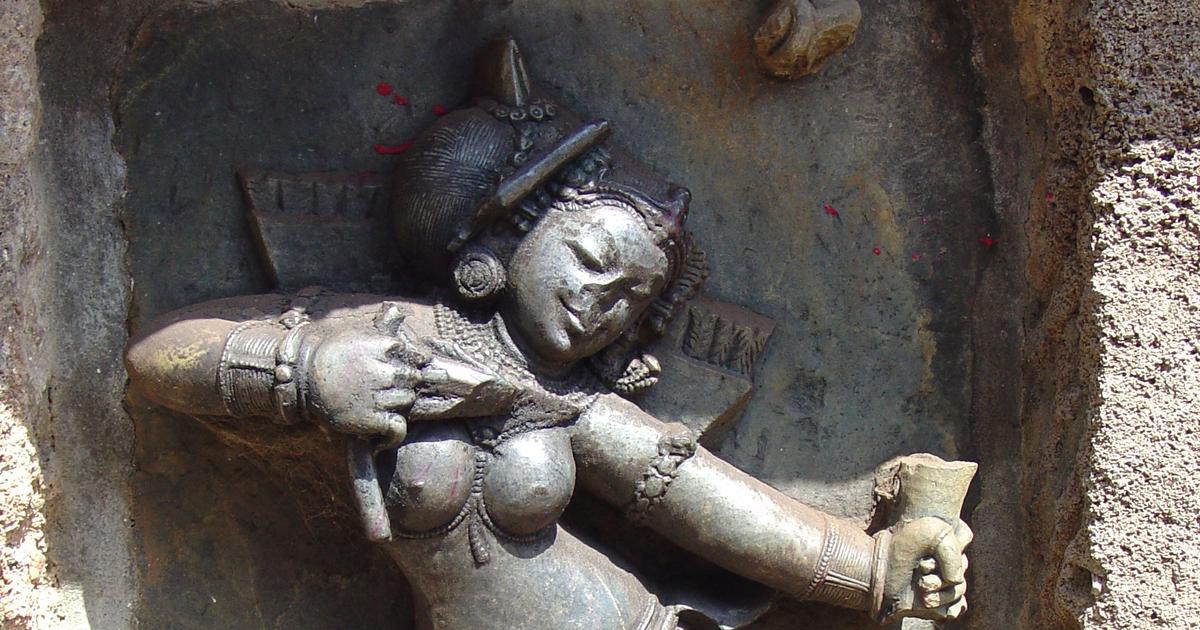
Yet the spirit violently checked in one place can survive to evolve in another. Take the plastic form of the yogini. Late in her formal evolution, when the sex is hidden and only the breasts mark her as female, she comes to acquire a beauty and selfhood distinctly human. Unlike apsaras, unlike the identical angels of European painting (witness the terrifying blonde clones of the Wilton Diptych), yoginis are plainly individuals. And unlike the aloof and generic gods of the Hindu pantheon, they are singular, credible women: in their individuality lies their power. A certain uniqueness always clung to the yogini and set her apart from canonical goddesses. With goddesses, whose aspects and attributes are fixed, the sculptor’s style is cramped. With yoginis, he has a license. Let her be his fiftieth yogini, a master confronting a block of granite will have a fresh image in his eye each time. Every yogini comes out a unicum, an inspired chance, once and for all time, unrepeatable. Often portrayed with fangs, she may equally wear a beatific smile. (The Yoginissima does.) But the smile, when she wears one, is guarded. The yogini is never vapid: the artist has felt her power. Something of her yoga has rubbed off on him. To the diversity of womankind, then, yoginis add a notable commonality: hidden strength. Yet each one will manifest this in an individual way.
A yogini is already a special case. She comes with no apron strings, has likely severed many domestic ties in her pursuit of yogic perfection. Not everyone is cut out for yoga, and of those who are, few have the devotion or the stamina to practice the art with such intensity that they acquire special powers. It takes an uncommon woman to make the grade. Of course, not the fruit of your action but the action itself counts in these matters. So the powers are, as it were, incidental. But for those armed with patience and courage, there awaits a state of being that ordinary humans can marvel at without envy but never without awe. Flying through the air is the least part of it. When a yogin told the Buddha it had taken him twelve years to learn to walk on water, the master reproached him with having wasted his time. For a small coin, he said, this ferryman would have taken you across the river. Pity the yogin out to impress. Concerned to persuade, to profit, perchance to punish, he is the original zealot. Penance, not yoga, is his lot, like those self-flagellant sages of old, stockpiling power, blazing with vengeance. A flying yogin would bomb and strafe and lay waste. Better he walk on water.
Getting there is not, as travellers pretend, the thing. Being there is. Even arriving is presumably a moment too soon; only after you have settled in are you installed. Then you may levitate or not as you please, if pleasing still preoccupies a self that has arrived there. The state is one of profound ambiguity, neither here nor there but a little of each. Chiefly, a third thing, which long schooling in logic has conditioned us to overlook. Neither goddesses nor ordinary women, the yoginis are emblems of that tormenting in-betweenness that brought forth mermaids, sphinxes, griffons and every twilit chimera. Not fish, not fowl, these creatures of the interstice invite us to reconsider our supposed completeness: the sphinx is neither lion nor man but something unto itself. Yoginis signal not so much a middle ground as a new country that will make our present habitation look stilted, gross, awry.
The Yoginissima’s story begins in India’s deep south a thousand years ago. A certain temple built (we say) by a certain king. In fact, the people of that district would have decided they needed a temple dedicated not to any particular god but to a ring of yogic handmaidens. The district was Kanchipuram, just inland from the famous group of sculptures at Mahabalipuram, near Chennai. It was the old capital of the Chola kings, under whom the south turned suddenly from carving in wood to carving in stone. No convincing explanation for this shift, or for the lag, apparently centuries later than in the north, is known. Here, in what is modern Tamil Nadu, the series of striking temples we know from the region began to appear and be used by a grateful and deserving people. Yogini temples were among these, an offshoot that presumably sprang from the advance of yoga in the south. No trace of the temple that once contained the Yoginissima and her sisters remains, but scholars believe it stood near the present town of Kaveripakkam. During a period of political disturbance at some time in the centuries after the Cholas and their powerful successors, the Pallavas, the temple fell into disuse or fell prey to vandals, of whom the greatest is time. Perhaps it was destroyed by a passing army, or by a rival faction of worshippers, perhaps it simply came apart in a quake, and the blocks of stone went to other uses. The stone of the once great Buddhist temple at Amravati went to make querns, the baked bricks of the Indus Valley Civilisation went to ballast a railway line. In time, the less obliging stone of the fallen images was swallowed up by the porous earth of the peninsula. Centuries later, one of these stone figures returned to the surface to excite the curiosity of an archaeologist. Gabriel Jouveau-Dubreuil, teaching at a college in Pondicherry in the 1920s, learnt of their presence and decided to investigate. With the help of a Tamil associate, N. Tangavelou Pillai, he excavated the first of the yoginis, dusted her off and took her picture. By the end of the venture, the two men had uncovered a dozen such pieces, and JouveauDubreuil began to consider their sale.
In Paris at this time was CT Loo, a self-made operator from China, who, starting as a diplomat’s servant, had quickly become the richest dealer in antiquities in town. Between them, Jouveau-Dubreuil and Loo shipped almost all the discovered yoginis to the West. Some of these remain in Europe, chiefly at the Musée Guimet, but most made their way across the Atlantic and were distributed over the United States in that great wave of acquisition that accompanied the arrival of American wealth. Ambitious magnates from the American heartland vied with those on the coast, and the Kanchipuram yoginis went to fatten the civic pride of Minneapolis, Kansas City, Detroit, San Francisco, and Washington, DC.
Museums were quick to name their mascots: the Bellringer yogini at the Nelson-Atkins Museum in Kansas City, from a clapper in her upraised right hand; the Winnower yogini of the Smithsonian, from harvest tools she holds. Props apart, each of these women has recognisable traits that amount to a distinct personality. The Minneapolis yogini is a handsome siren, the Kansas City yogini a troubled shopkeeper, the Detroit yogini a bipolar scold. Physically, the sisterhood has in common four arms betokening extraordinary prowess, and all sit in the lotus position to work their spell. (But the cross-legged posture is not diagnostic: yoginis from other temples choose to stand, balanced perhaps on a lizard or a hog or a bull, and still others are chimaeras with the head of a horse or buffalo or goat.) Not every yogini bares fangs.
Art and faith part company here. A tantric intent on esoteric ritual will prefer the savage yoginis, and recipe lists of gory ingredients exist.
My yogini, deep in meditation, has no blood on her hands.

Excerpted with permission fromFlying Yoginis, Irwin Allan Sealy, Seagull Books.
