







The 13 stories of familiar places and timelines in Aruna Chakravarti’s Creeping Shadows cast dark shadows over ordinary lives. Those who perceive occult beings or believe in their presence perceive another reality. Chakravarti writes from such other-world experiences of people she has known and stories she has read. Facts and fiction in her ghost stories trace cultural history, caste conflicts, images of colonial Calcutta, the horrors of the 1984 riots, and strange activities in an exotic Chinese tea-room which impinge upon our vision with deeper moral considerations.
“Vendetta”, set in Chittaranjan Park, South Delhi, seems too close for comfort when a war of trees with man, “its mighty roots rising high in the sky”, protests against the heedless destruction of the environment. “The Necklace” is equally chilling with tainted family jewels and youthful passion between an Anglo-Indian woman and her lover from Rajasthan royalty; he thinks rejection is treason – punishable by death “for women who betrayed and humiliated their men”.
Ghosts across space and time
Chakravarti’s premise for her fiction is that ghosts travel across space and time. So, “The House of Flowers” centres upon Zihan Zhang’s secret, transported from distant China, which he finally entrusts to his granddaughter, Mei, on his deathbed. He once lay in drunken sleep by a coffin with a broken seal. A beautiful form in “sheer white muslin” tried to maul him and a “lily-white hand with the long tapering fingers” hung over the box before it settled beside the dead woman inside.
This thrilling description of a Chinese tea-house more than a century ago is juxtaposed against recent scenes in contemporary Kolkata, where families of different nationalities co-exist, eating Chinese and Bengali cuisine and communicating in several languages, which the voyeur-narrator enjoys. Again, Hansdhwani Kapur leaves his ancestry behind in Western Punjab and seeks a life for his descendants on the Gangetic shore of West Bengal. However, norms of arranged marriages within this Khatri family meant that if suitable spouses were not found locally, girls would return to alien lands where “even notions of decent behaviour were different”. Unnatural deaths across generations of relatives led to Tara’s frightening realisation: “Spirits… prey on the weak and vulnerable” (“Truth is Stranger than Fiction”.
The piece de resistance of Chakravarti’s collection is undoubtedly “Possessed”, where 19th-century colonial history connects London and Calcutta through theatre. The author opens with an innocuous but gendered description of Sonagachi, where prostitutes live nights of pleasure, suffer debilitating illnesses, children are born fatherless, women are routinely abandoned, but some make it to the glittering world of music and play-acting. Chakravarti delves into history for Teenkori Dasi, who becomes a reputed courtesan before she is noticed by the great Girish Ghosh, doyen of Bengali theatre.
When he adapts Shakespeare’s Macbeth for the Bengali stage, he tutors Teenkori to play Lady Macbeth. Events unfold within a social framework of powerful storytelling as Macbeth was indeed performed in Calcutta under actor-director-writer Girish Ghosh at the National Theatre. Grainy photographs support his moments of triumph. Chakravarti also reminds her readers that English actress Sarah Siddons was famous as Lady Macbeth in London’s Drury Lane. People later believed Siddons’ ghost haunted those same playhouses. Other strange factors related to misfortunes, accidents and deaths have dogged Macbeth productions over centuries, globally. Critics, too, have long claimed that Lady Macbeth was the fourth witch who appears briefly in the play.
Tying these knots tighter and weaving ghostly trances into a panegyric performance, Chakravarti’s mystic tale is imaginatively perfect. She brings to life India’s largest brothel, which spreads its tentacles over North Kolkata, close to stately mansions, even today. She recreates early Shakespearean drama during the Raj, summarising temperamental Girish Ghosh aptly – “eyes, perpetually bloodshot from the brandy he imbibed… the power of his voice and personality… a volatile temper”. His lead actress is no less real. Her dark skin painted pink, she was “the picture of a medieval Scottish nobleman’s wife. Tall, straight and stately, there was a mannish air about her”. In the final denouement, Teenkori leaves the audience spellbound yet, dumbfounded!
Benign and fun-loving ghosts
Chakravarti is deeply interested in building background for her stories, which makes her plots rather complex and meandering. Her descriptions wander through cities and households, marking cadences in various socio-cultural milieus by citing customs, food and religious rituals, including fearful interactions with Guru-Ma’s and tantric sadhus. Several stories like “Possessed” are intensively researched. These supernatural beings play plausible, ordinary roles like strangers appearing casually. Chakravarti suggests ghosts are often benign and fun-loving, as in “Grandmother’s Bundle”, which is influenced by a popular children’s book in Bengal, Thakurma’r Jhuli. Chakravarti recounts incidents with humour and matter-of-fact coolness, especially when conveying eccentricities of creatures of darkness – the beloved “shankchunnis and petnis” who are enamoured of milk and hilsa-fish, respectively.
One shouts out to Ponrha Moshai and Podi in colloquial Bengali, dancing merrily around them with her inverted feet – “Hyan Ponrha? Mairi Ponrha? … By Mother Mary is it true?”. The “she-ghost” even wonders why they faint – “Maybe they have the falling sickness… the sahebs call epsilepsy”. These ghosts lead exciting lives, stretching a long hand to pluck a lemon for the new son-in-law and taking in exchange the large piece of fish on his plate. Another, cackling with laughter which someone passing hears, confides that Boni has given birth and “She has asked for some swaddling cloth”. Unlike such happy ghosts, some recollect acute pain. The man without cheeks in “They Come out after Dark” tells Ramlochan how intruders “…gouged out my eyes. They did other unspeakable things”. Later, Ramlochan finds happiness when his own skin turns pallid and “His eyes glittered with unnatural light”.
When friends meet over dinner to discuss supernatural happenings, they remember famous literary figures like Tagore and Poe, who believed in the supernatural. In “There are More Things in Heaven and Earth,” sceptical Monalisa takes the only taxi available that night, but soon feels the presence of a girl in blue-satin finery. Chakravarti makes it increasingly sad when the Sikh taxi-driver explains the girl’s annual visitation on the night when riots began in 1984: “If I were to tell you that she was my dead daughter…”. When he refuses taxi fare, the money just blows away and Monalisa sees before her the veiled chasm between reckoning and rationality.
The author constructs a background for her stories often through Bengali and Hindi. There is the colloquial speech of “petnis” and Ramlochan inadvertently voices grief from his previous existence: “Ammijaan chale mat jayen… mere paas rahen… hamesha hamesha ke liye”. Chakravarti’s first story opens with the swear-word “Dusshala” before translations of nuanced Bengali present a fight between Subal and his aunt, Kundamala, who screams: “Where will you go… you spawn of a snake?” As Chakravarti sensitively structures another world, she sometimes conjoins three or more stories into a single plot. She moves from first-person to third-person narrative, creating distance among characters within the same tale. Urban folk and villagers participate in common events and steer her protagonists through Hindu and Muslim divides to reiterate the sadness of Partition. A family exiled from Karimganj, East Bengal, confirms this most vividly without dire incidents. Kunal, searching for roots, is struck by a small girl who appears in his family home holding a rustic doll – “a clay benebou putul”. It is profoundly touching when his mother later explains his father’s sister, Ranu. She showed herself to him only – “Because you are the identical image of your father… something moved her so much that she couldn’t let you out of her sight”.
Chakravarti implies that lost souls are seeking space, company and comfort in the lives they cannot forego, but people on this side of the invisible barrier are often frightened by their presence. By some strange coincidence, other Bengali authors like Rajorshi Patranabis and Nandita Chakraverti have published empathetic collections of ghost stories quite recently. Patranabis, dabbling in Wiccan philosophy, consciously seeks supernatural energies. In Whereabouts of the Anonymous, he perceives strangers from other realities searching for space in his world. In Smudged, Nandita Chakraverti defines a haunted motorbike tearing through lonely copses, weighted by an invisible presence. She voices this awareness like Aruna Chakravarti, whose Bihari guard notes a motorcycle rider in a wooded University campus – “a male presence as the vehicle rushes past”. These writers make ghosts seem natural, worldly beings trying to find a tenacious grip on humanity.
Through these strange happenings, Chakravarti offers a complex fabric of life which contains parallel worlds in varying occult forms. Thirteen stories – an unlucky number especially in the West – cast shadows upon regular existence because of unfortunate circumstances or past mistakes. All 13 firmly outline social upheavals through shadowy presences that carry burdens of pathos or tearful laughter. They belong/ed to this human world, but are now trapped in a different reality.
Ajanta Dutt’s academic writings include essays on Anglophone literature and Shakespearean studies. Her books on Tagore’s novel, Home and the World and Poets of the Americas were textbooks in the English department of Delhi University. She writes on indie cinema from Bengal and translates Bangla poetry.
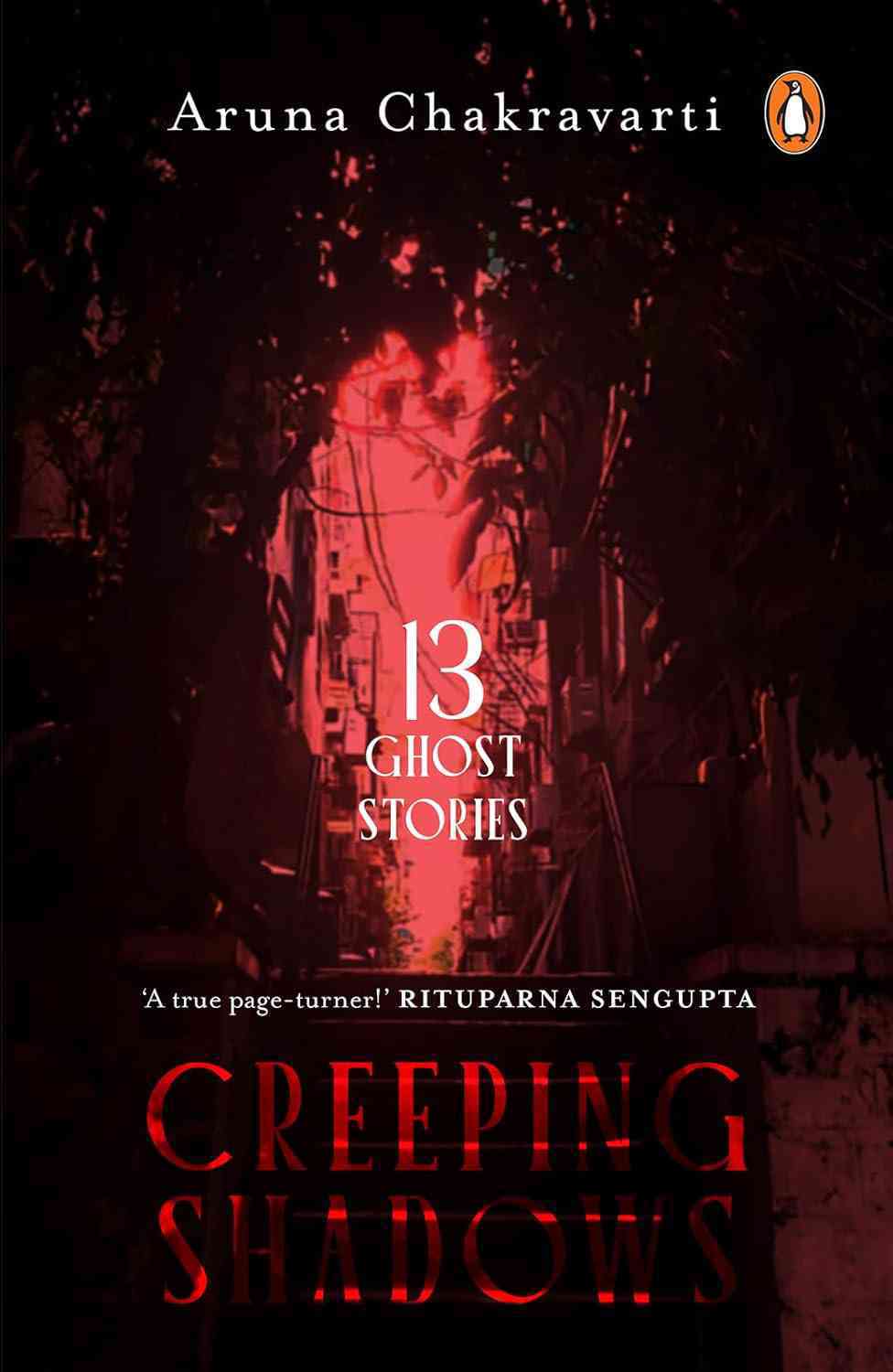
Creeping Shadows: Thirteen Ghost Stories, Aruna Chakravarti, Penguin India.
