




What if the HIV epidemic had not come about? Would sex and sexuality or issues of gender diversity have come out of the closet in India? Would they have become part of the public discourse and entered the domain of human rights in this country? Would the queer movements in India have had the same trajectory and arrived where they have?
These questions came up during a community dialogue that followed the performance of a skit called Koti Ki Atma at Café Adda Ghor in Kolkata in November 2023. The performance was a reenactment of a 20-minute, four-scene play created by NGO Integration Society and sibling queer support group Counsel Club in January 2001.3 The skit, a cross between proscenium and street theatre, used a ghost, humour and poignancy to encourage discussion on HIV prevention and testing, safer sex, self-esteem and empowerment among queer communities. At that time, non-normative genders and sexualities were still heavily stigmatised and criminalised, queer inclusion in the National AIDS Control Programme was tentative, and HIV treatment in the form of anti-retroviral therapy (ART) was at least three years away.
Between its scripting and eventual reenactment in 2023, the skit was performed only around half a dozen times, primarily at community events and HIV awareness programmes in and around Kolkata, mostly during 2001–02, and for the last time in 2013. Yet, in many ways, it was an attempt to break the silence around queer lives and make them more visible.
Two decades later, its reenactment sought to reflect and ask what this long process of breaking silence – through numerous queer initiatives across India – had achieved: Back then, what did we (as queer people and groups) expect to happen in the future? Have our expectations been met? What has changed and what has remained the same? Are there any lessons from the past for the current and future times?
The community dialogue after the performance was an exercise in collective memory that engaged 40–45 queer people and allies, some of whom had lived through the times when the skit was written. Some of the cast and crew were from the original performance, while others were new. When the discussion turned to how the HIV epidemic shaped the emergence of the queer movements, some observed that even without it, the movements would have been propelled by concerns over mental health and human rights.
In the first place, Koti Ki Atma itself was much more about gender inequity, social stigma and lack of mental well-being that make queer people more vulnerable to HIV. So, what if mental health had been a clearly understood and consciously articulated element at the centre of different queer mobilisations in the 1990s and early 2000s? What if the government too had emphasised mental health as a public health priority in the same manner as it did HIV – for the larger public as well as for the more vulnerable communities? Stories like that of Emon indicate that such a prioritisation would not have been misplaced. She is but one among a vast, unknown, often unseen number of queer people in need of mental health support.
This unknown number has always been a troubling factor. A part of me wants to know what this number might be, and even more so, what might be the number for the entire queer population of India with or without a health concern. Another part of me immediately rebels because it does not want all aspects of life to be enumerated, especially human qualities that can be so enigmatically amorphous. Live and let live, and we just might have fewer mental health concerns. Sometimes, more mundane questions race through my mind. Who exactly can be counted as queer? Those who identify as queer but embrace social norms unquestioningly? Or those who may or may not identify as queer but question binaries by doing queerthings with their gender, sexuality, relationships, work and much more? Even if this question could somehow be settled, another remains – one rooted in distrust and fear. How will we ever find out the numbers in an environment where deep-rooted stigma and discrimination compel queer people to be silent about their desires? So, when bosses in government or private organisations insist on knowing the number of, say, transgender persons in institutions, localities or regions before making budgetary allocations to “promote inclusive environments”, it is nothing short of a farce. How much more sensitisation will be needed before meaningful investments are made in trust building, which alone can lead to reliable counts and accurate budgets?
A relatively recent meta-study on the mental health concerns of queer people in India reveals the scale of the challenge, even amid limited numbers.
The study, titled What Do We Know About LGBTQIA+ Mental Health in India? A Review of Research from 2009 to 2019, looks at a variety of documents related to mental health – in all, 94 reviews and reports, viewpoints and comments, editorials, conference proceedings, and original articles published in journals, websites and other publications. One study conducted in 12 cities across India in 2016 among 11,992 MSM found that 11% of them had experienced clinical depression.
Other smaller studies revealed similar results, indicative of the situation in larger populations. A 2017 study among 20 transgender women and 10 transgender men in Imphal found that nearly a third had experienced depression, more than 40% were at current suicidal risk, and a third had attempted suicide in the past. Substance use was a common co-occurrence among the respondents to this study. A third study conducted among 33 geriatric and pre-geriatric lesbian, gay, bisexual, transgender and intersex individuals in Vadodara in 2016 found 70% had depression, 15% experienced suicidal ideation, and 45% had alcohol or tobacco dependence.
The same meta-study estimated that depression and suicide rates in queer individuals in India are higher than those in the overall population, both within India and across other developing countries. Rather than acknowledging the severity of the problem, I can already visualise the raised “I-told-you-so” eyebrows – echoes of the persistent social myth that links, or even conflates, queerness with mental health conditions.
Unfortunately, and ironically, one of the prime perpetrators of this myth continues to be our medical-education system that, in spite of recent efforts by the National Medical Commission to eliminate queerphobia from the curriculum, still relies on outdated textbooks and reference material. The mind boggles at how this situation persists despite a large body of empirical research that dismantles any correlation between non-normative genders and sexualities and psychopathology. Research in this regard dates back at least to the 1957 study by American psychologist Evelyn Hooker (The Adjustment of the Male Overt Homosexual), which clearly showed that biased research methods and questions were behind claims of homosexuality being pathological.
So, if queerness and mental health conditions are not related, why are the depression and suicide rates higher among queer people? Emon’s experiences of her mother silencing any conversation about Emon’s sexual orientation, her break-ups caused by her desire to question gender norms, or her experience of losing a job because of her gender expression, along with a host of other stresses that life threw at her, demonstrate what stigma and discrimination can do to one’s mental health.
While flipping through my notes from a 2014 qualitative study I was part of – on the impact of violence on the lives of queer people – I came across the following quote from a focus group discussion held with a mix of kothis and gay men in one of the study sites, a metropolitan city in North India: “Relentless pressure from the family, intimate partners and community around us leads to an intolerable state of mind and a variety of mental and physical self-abuse practices – physical and mental torture, binge drinking, banging head against walls, increased irritability, taking anger out on a third person, revenge mentality, confining oneself at home, irregular hours in returning home and more.”
The tortuous path from being queer to facing stigma and, further on, to experiencing mental health conditions and substance dependence has been presented in more sophisticated terms in the metastudy quoted earlier. This study forms part of a growing, if long overdue, body of research in India on how stigma, discrimination and violence lead to not just poor mental health, but also a syndemic of mental health conditions and HIV vulnerability among queer people – each reinforcing the other.
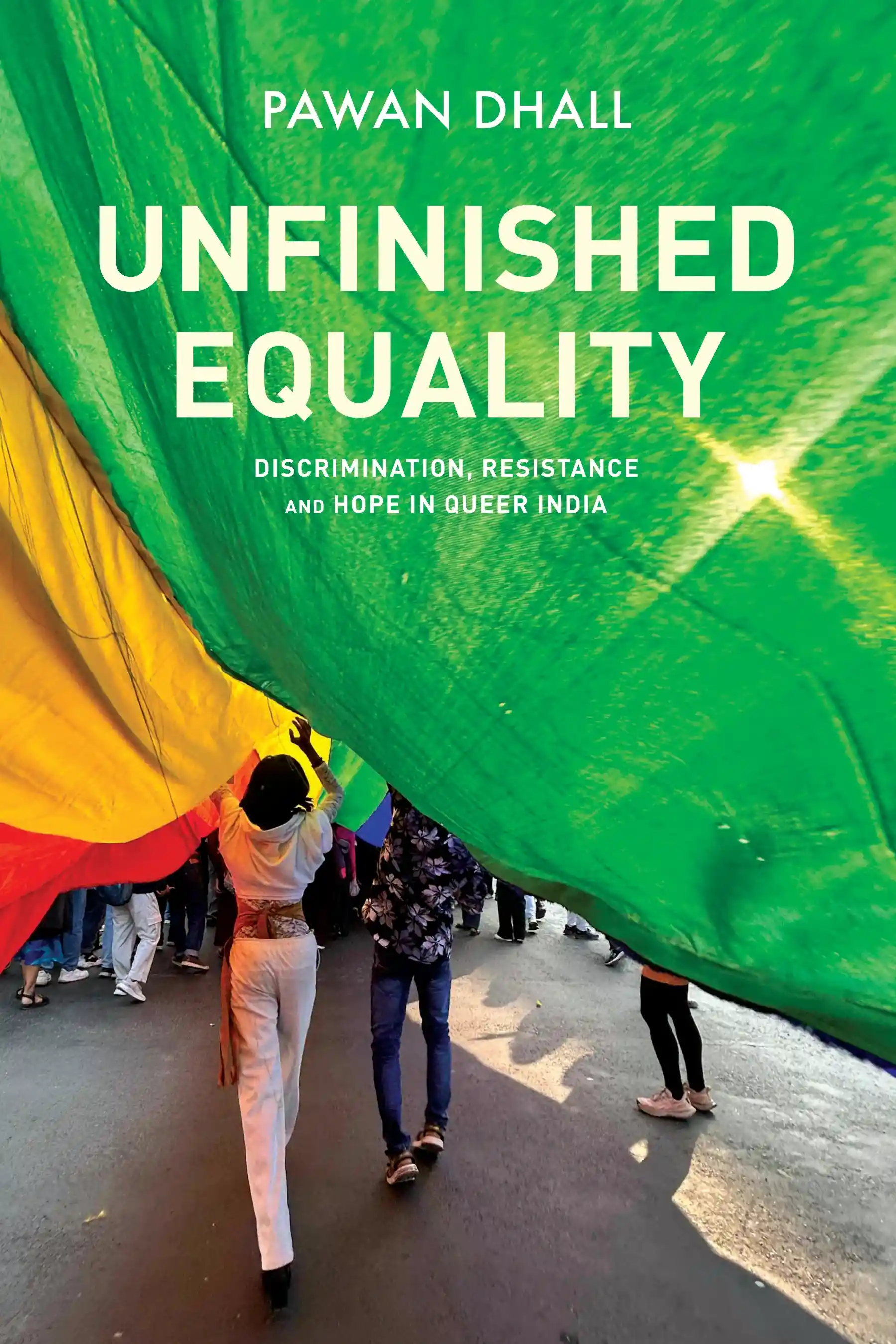
Excerpted with permission from Unfinished Equality: Discrimination, Resistance and Hope in Queer India, Pawan Dhall, Seagull Books.
