

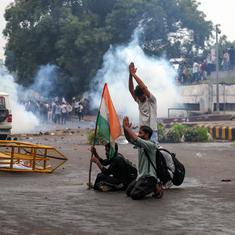


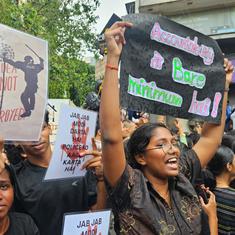

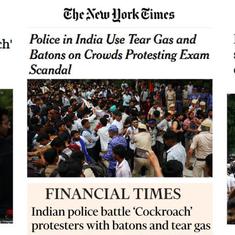
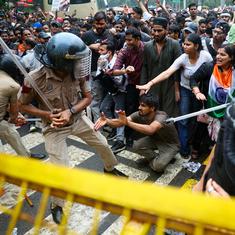

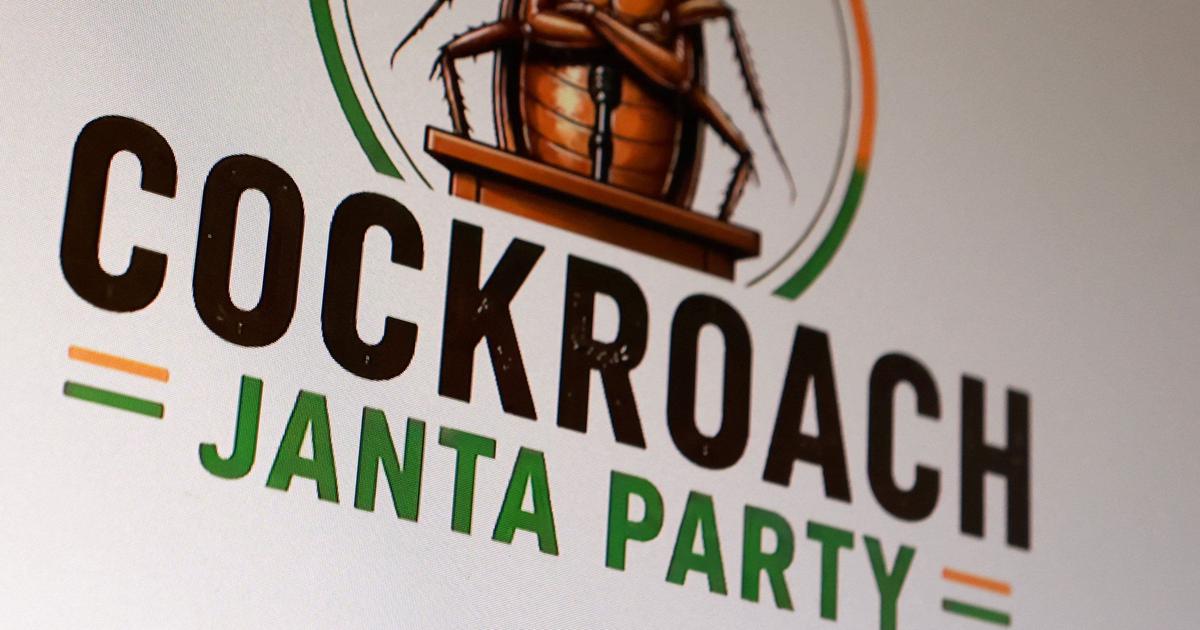
The Cockroach Janta Party, a satirical political campaign on social media, launched a protest in Delhi on Saturday to demand the resignation of Union Education Minister Dharmendra Pradhan over alleged mismanagement in conducting major competitive and board exams.
The protest is the first on-ground event of the youth-led campaign, which started as a reaction to remarks made by Chief Justice Surya Kant on May 15, allegedly comparing some unemployed youngsters to “cockroaches”. A day later, Kant claimed that he had been misquoted by sections of the media and that he had not criticised the young people in general.
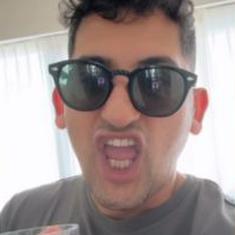
But the clarification came too late. The campaign created by Abhijeet Dipke, a 30-year-old political communications strategist from Pune, became a rage among the young. Within a week, the campaign’s Instagram account garnered more followers than the ruling Bharatiya Janata Party and the Congress combined.
The chief justice’s alleged remark were a catalyst for a section for young Indians belonging to “Gen Z” – born between the late 1990s and 2010 – to voice their grievances and channel their disillusionment against the Narendra Modi government.
The campaign came amid a confluence of problems.
Some of them were more recent. In early May, a paper leak in the National Eligibility-cum-Entrance Test for medical college admissions meant that 22 lakh candidates need to take the exam a second time. Then came allegations of mismanagement related to the Central Board of Secondary Education’s on-screen marking system.
An opinion poll conducted by CVoter on May 28 showed that 66% of the respondents want the education minister to resign. Even among those who identified as voters of the BJP-led National Democratic Alliance, 58.2% said that Pradhan should resign and that they support the dismantling of the Modi government’s National Testing Agency, which conducts the NEET.
There have also been broader grievances. Even before the war in West Asia caused economic troubles, there was anxiety about the rising cost of living, unemployment, stagnant wages, crumbling infrastructure, toxic communal politics and the most basic forms of dissent being stifled.
Dipke, who was studying in Boston, has described the Cockroach Janta Party as a platform to “bring integrity back into politics” and hold the government accountable. And so, the campaign’s immediate demand is the education minister’s resignation.
The popularity of the campaign confirms that a section of the youth may be looking for political alternatives. Another CVoter survey conducted on May 22 and May 23 showed that more than 60% of the respondents in the 18 to 34 age group believe that the Cockroach Janta Party “can influence real politics”.
Watching with circumspection
While the grievances driving the Cockroach Janta Party’s popularity are real, the campaign must be viewed with some circumspection.
Late Gen Zs may have no memory of the political developments preceding the 2014 Lok Sabha elections that through the BJP came to power, but early Gen Zs or millennials like me who were in their teens at the time remember the 2011 anti-corruption movement.
Many India’s voters, frustrated with the Congress-led coalition government at the time, bought into the idea of the movement. It eventually fizzled out. But, unbeknownst to many at the time, India Against Corruption contributed in 2014 to the rise of the Modi government – whose policies the Cockroach Janta Party is protesting against.
Some leaders of the anti-corruption movement claimed later that it had been “propped up” or harnessed by the Rashtriya Swayamsevak Sangh, the parent organisation of the BJP. Others, such as Arvind Kejriwal, went on to form the Aam Aadmi Party. Dipke has acknowledged that he was part of AAP’s social media team.
Some are seeing similarities between the India Against Corruption movement then and the Cockroach Janta Party campaign now.
It is unclear whether the Cockroach Janta Party will eventually contest elections. But if it does, whom will it hurt? This question perhaps explains why while other Opposition parties have welcomed the Cockroach Janta Party, the Congress – the largest of them – has been cautious.
Of course, new political parties or movements dislodge existing ones, but the question on many minds is: can India’s anxious cockroaches ensure that a platform to voice genuine grievances will not get hijacked by other groups?
Beyond an idealistic five-point manifesto, the Cockroach Janta Party has not defined its ideology, where it stands on the key problems India faces and how it plans to solve them. Perhaps it’s too early. But without that clarity, it remains a youth pressure group at best, and not the alternative it hopes to be.
Also read:
- Cockroach Janta Party is doomed to fade fast – unless it goes beyond meme politics
- Irrepressible and resilient, the cockroach is a political metaphor for our times
- Watch Scroll interview: Will BJP co-opt Cockroach Janta Party?
Here is a summary of last week’s top stories.
Political claims. Opposition leader Rahul Gandhi claimed that Narendra Modi would not be the prime minister a year from now as the “system that he once controlled is now shaken and collapsing internally”. He also claimed that the Bharatiya Janata Party government could attempt to suppress growing public anger by imposing “something like an Emergency”.
Gandhi further said that an “economic tsunami” will hit the country because the Modi government had removed the economic safeguards that existed earlier.
Reacting to the remarks, BJP’s publicity chief Amit Malviya said that Gandhi was unveiling “a new conspiracy theory” every few months. “The country has heard these predictions before,” said Malviya. “The problem is that none of them ever come true.”
A deadly blaze. Twenty-one persons were killed in a fire that broke out in Delhi’s Malviya Nagar area. Eight of them were Indians and thirteen foreign citizens. Seventeen persons were injured and taken to hospital.
Fissures in the Opposition. The Dravida Munnetra Kazhagam said that it will not participate in a meeting of the Opposition INDIA bloc on June 8. The decision was made as party workers were “deeply hurt by what they consider the betrayal committed by the Congress”, the DMK said.
The Congress, a long-time ally of the MK Stalin-led party, joined the coalition government led by the Tamilaga Vettri Kazhagam in the state after the Assembly polls resulted in a hung House in May.
The DMK said that while it will not attend the June 8 meet, it will continue “to raise its voice on issues affecting the welfare of the nation that may be brought forward by the other parties participating in the meeting”.
Also on Scroll last week
- Why Punjab survey on drug addiction has led to fears of undercount
- An ‘indigenous’ Assamese woman was pushed into Bangladesh. A year later, she is still stuck there
- Why Delhi University’s four-year undergraduate programme has left students in panic
- Five rejoinders: What Ramachandra Guha gets wrong about Rahul Gandhi
- Why India is not able to fully use the solar power it generates
- Delhi fire deaths highlight precariousness of ‘medical tourists’ in the city
- Mumbai is worried about water, but its control over mainland dams is depriving others
- How official heat plans are failing India’s street vendors
- ‘Hai Jawani Toh Ishq Hona Hai’ review: A dated comedy about one man with two pregnant partners
- ‘Brown’ review: Gripping series overcomes plotting holes through memorable characters
Follow the Scroll channel on WhatsApp for a curated selection of the news that matters throughout the day, and a round-up of major developments in India and around the world every evening. What you won’t get: spam.
And, if you haven’t already, sign up for our Daily Brief newsletter.
