




On June 23, 2023, fifteen Opposition parties came together in Patna, vowing to take on the ruling Bharatiya Janata Party collectively in the 2024 Lok Sabha elections. Their coalition, which has since taken the name of Indian National Developmental Inclusive Alliance, will turn three next week.
That this disparate group of parties has survived for so long is in itself an achievement, given the challenges facing any political formation that opposes the BJP. But recent developments in Indian politics make it clear that the INDIA bloc has achieved little beyond survival.
What has changed
The alliance started out primarily as a coalition of regional parties strung together by the wily Nitish Kumar, who was the chief minister of Bihar at the time. The Congress was expected to play the second fiddle in it. Three years on, it is the Congress that is firmly installed at its helm.
Kumar had ditched the INDIA bloc and gone with the BJP even before the 2024 Lok Sabha polls. Other large Opposition parties, such as the Trinamool Congress and the Dravida Munnetra Kazhagam, stand diminished after their recent defeats in May.
In West Bengal, the BJP ended Mamata Banerjee’s 15-year reign, while in Tamil Nadu, the DMK suffered a shock defeat at the hands of the film star Vijay.
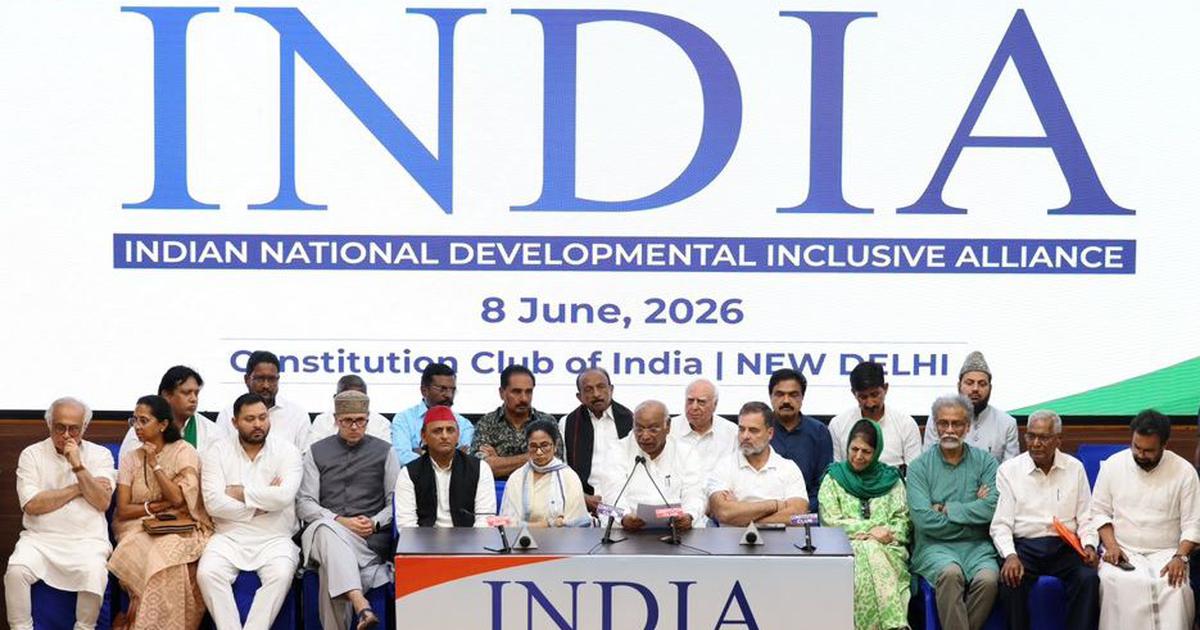
At the last meeting of the INDIA bloc on June 8, Congress leader Rahul Gandhi seemed to be embracing this change in his party’s responsibility quite enthusiastically.
“Our role is fundamentally different from yours,” he told other Opposition leaders in attendance. “Our role is to unite all of you together with love and affection.”
It is another matter that the DMK had decided to skip this meeting altogether, stung by what it characterised as Gandhi’s betrayal. The DMK had arguably been the steadiest Congress ally with its chief MK Stalin backing Gandhi as a prime ministerial candidate as early as 2018.
Still, the Congress’ five MLAs in Tamil Nadu, who had contested the elections in alliance with the DMK, extended their support to Vijay’s Tamilaga Vettri Kazhagam. As if that was not enough, Gandhi himself attended Vijay’s swearing-in ceremony in Chennai and two Congress MLAs became ministers in the new Tamil Nadu government.
The Aam Aadmi Party, too, had exited the INDIA bloc after it was voted out of power in Delhi in February 2025. Its leaders continue to chafe at the supposed role that the Congress played in its defeat.
But more than those who left the coalition, what should worry the Congress and its allies is the apparent sense of disgruntlement among those who stuck around.
The Communist parties, for example, have publicly aired their complaints against Gandhi and his party. A Left leader, who attended the June 8 meeting of the INDIA bloc, told Scroll that he found Gandhi’s speech to be “patronising” and “delusional”.
What is still the same
Even a cursory look at the political map of India is enough to conclude that the BJP’s footprint has grown since the formation of the Opposition alliance.
The Hindutva party has gained ground in states like West Bengal, Punjab and Kerala, where anti-BJP parties have thus far failed to contest unitedly. However, there is no sign that the INDIA bloc has learned its lessons from these blunders and will avoid infighting in the future.
Then there are more mundane shortcomings. For instance, the coalition had announced in September 2023 that it would set up a secretariat and appoint spokespersons to speak for the whole alliance instead of just their own parties. No such thing has been done yet.
Voters will likely take the INDIA bloc more seriously if it puts out a common manifesto ahead of the next Lok Sabha elections. That would be a far cry from what it did in 2024, when several Opposition parties put out their manifestos one by one, often making contradictory promises.
Two years ago, the coalition denied the BJP a simple majority in the Lok Sabha, thereby thwarting its stated ambitions of total domination over Indian politics. More recently, the bloc managed to defeat the delimitation bill in Parliament.
But if the alliance has to go beyond handing the BJP such occasional setbacks and have a real shot at power, it must do more than meet every two months.
Here is a summary of last week’s top stories.
Proportionate measures? The Delhi High Court upheld the Union government’s decision to ban messaging platform Telegram till the day after the undergraduate National Eligibility cum Entrance Test re-examination. The court held that the government “strictly followed the procedure” under the Information Technology Act given the “emergency nature” of the order.
In its petition challenging an order restricting access to its services in India until June 22, ahead of the NEET-UG re-examination for seats in medical colleges, Telegram had argued that the government had singled it out, violating Article 14 of the Constitution that guarantees the right to equality.
Opposing the petition, the government had claimed that the platform was becoming the new “dark web”, enabling illegal activities and linking criminals.
Relentless political manoeuvres. Six of the nine Lok Sabha MPs of the Shiv Sena (Uddhav Balasaheb Thackeray) skipped a meeting of its parliamentary party amid speculation that they may defect to Maharashtra Deputy Chief Minister Eknath Shinde-led rival faction. The meeting was attended by the other three Lok Sabha MPs of the Uddhav Sena and the party’s lone Rajya Sabha member Sanjay Raut.
Uddhav Sena MP Anil Desai said that the members who skipped the meeting will be issued a show-cause notice. Raut said that action will be taken against them if they do not respond to the notice within seven days.
The meeting was held a day after the Uddhav Sena alleged that its MPs were being offered Rs 15 crore each to join the Shinde-led faction.
What’s in a name? The United States government announced that its military’s US Indo-Pacific Command will revert to its original name, the Pacific Command. The move restores the name under which the organisational unit operated for more than seven decades.
The Department of War said that the move was intended to honour the command’s historical identity and legacy. The decision reversed a change introduced in 2018, when the US government, during Donald Trump’s first term as the president, renamed the unit as the Indo-Pacific Command.
Washington had at the time cited the growing strategic importance of the Indian Ocean region and its increasing integration with the security situation in the Pacific Ocean.
Also on Scroll last week
- How an Israeli soldier accused of war crimes in Gaza was tracked down in India
- Himanta calls Miya Muslims declaring Assamese their mother tongue a ‘fraud’. Assam writers disagree
- West Bengal to Maharashtra, party absorption threatens to disintegrate India’s Opposition
- Data analysis: How SIR deletions shaped BJP’s landslide in Bengal
- India’s food regulator flagged over 160 misleading claims. Years later, 120 are still around
- For workers in Delhi’s deadly heat, cooling zones can only offer a temporary respite
- Anand Patwardhan: ‘The Voice of Hind Rajab’ speaks to India’s buried conscience
- Asia is warming faster than global average, making regional cooperation vital, says a new report
- ‘Cocktail 2’ review: A fizz-free, tedious love triangle
- ‘Going Solo’: In a film about long-distance female cyclists, endurance and a yearning for freedom
Follow the Scroll channel on WhatsApp for a curated selection of the news that matters throughout the day, and a round-up of major developments in India and around the world every evening. What you won’t get: spam.
And, if you haven’t already, sign up for our Daily Brief newsletter.
