





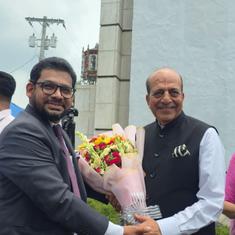

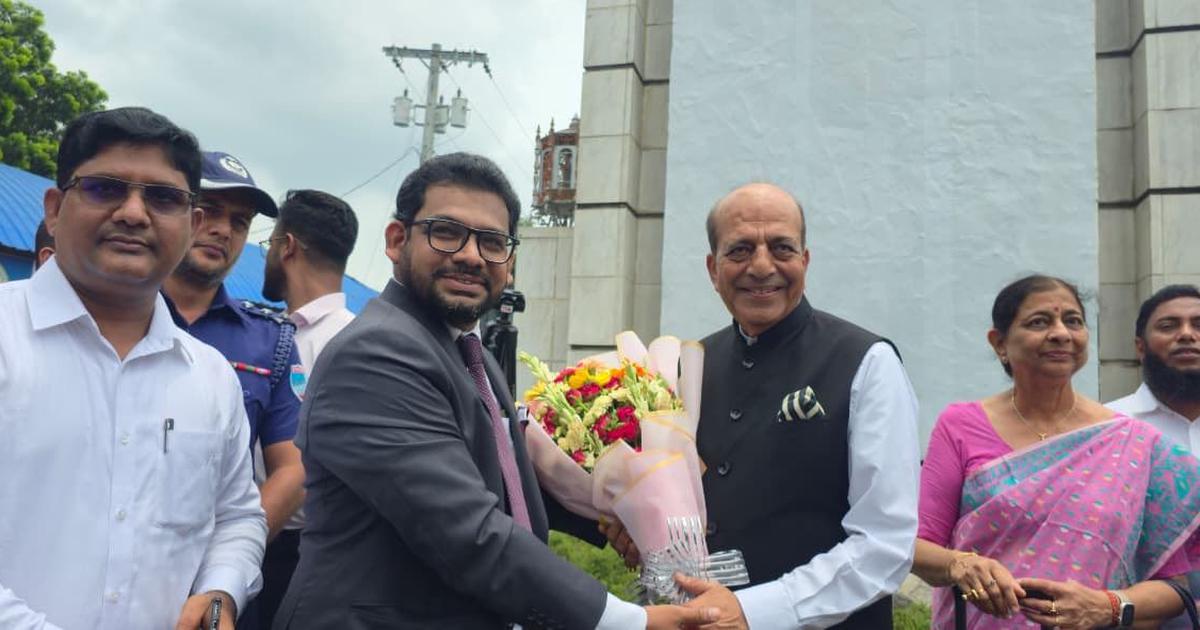
India’s newly appointed High Commissioner to Bangladesh, Dinesh Trivedi, crossed the Benapole-Petrapole land border on Friday afternoon, walking into Bangladesh by road in a gesture his office likely intended as symbolic of accessibility and warmth.
Within hours, that gesture had become the backdrop for a diplomatic controversy that is still reverberating in Dhaka.
Trivedi, a 75-year-old veteran Bharatiya Janata Party politician and former Union Railway Minister, is himself a significant appointment. He is the first politician to serve as India’s High Commissioner to Bangladesh in the 55-year history of bilateral diplomatic relations – a deliberate departure from the longstanding convention of sending career Indian Foreign Service officers to Dhaka.
He was appointed in April, succeeding Pranay Verma, who has since been named India’s Ambassador to Belgium and the European Union.
Speaking to Bangladeshi journalists at the border, Trivedi was warm and expansive. He spoke of cooperation in sports, health, education, and technology.
But it was a specific formulation that set off the uproar. Asked about border tensions and the possibility of easing restrictions on trade and travel, he said: “India and Bangladesh share the same sky, the same air, the same pain. I do not feel as though I have come to Bangladesh. Whatever is good for the 1.4 billion people of India and the 200 million people of Bangladesh – for these 1.6 billion people – is what will be done.”
The next day, Shafiqur Rahman, the Jamaat-e-Islami chief and leader of the opposition in Bangladesh’s Parliament, demanded that the government seek formal clarification from Trivedi about his remark that India and Bangladesh become one. “We request our government to address this matter sincerely,” Rahman said in a post on his official Facebook page, noting that if the High Commissioner had intended the remarks literally, “then it is certainly condemnable”.
The same day, Bangladesh’s Information Minister Zaher Uddin Swapan put forth the government’s position, framing the controversy in terms of regional architecture.
Swapan noted that SAARC – South Asian Association for Regional Cooperation — comprises 2.2 billion people. “Those who don’t want SAARC unity, if they only talk about two countries’ unity, we will look at them with suspicion,” he said. “Beyond the UN, SAARC, and Bangladesh, if anyone talks about any other framework, we will view them with suspicion.”
Bangladesh’s media amplified the controversy, with commentators comparing Trivedi’s language to “Akhand Bharat”, the ideologically-loaded formulation of an undivided India.
To understand why seemingly warm words about shared skies could provoke this reaction, it is necessary to understand the current state of the India-Bangladesh relationship and the historical sensitivities that frame how Dhaka receives New Delhi’s overtures.
Bangladesh achieved its independence through the 1971 liberation war, in which India was a crucial ally, but one that Bangladeshis fought to assert a distinct national identity.
In the Bangladeshi political imagination, the recurring anxiety has always been absorption into larger regional frameworks. When a new Indian envoy arrives and says that he does not feel as though he has crossed into another country, and frames the two populations as constituting a single 1.6-billion-strong bloc, the historical resonance is difficult to separate from the diplomatic intent.
The relationship between the two countries has also been strained since August 2024, when former prime minister Sheikh Hasina fled Bangladesh following a mass uprising and took shelter in New Delhi, where she remains.
Hasina’s presence in India has been a persistent political irritant. Bangladesh has requested her extradition under the bilateral extradition treaty, and all New Delhi has said is that the request “is being examined as part of ongoing judicial and internal legal processes”.
Against this backdrop, the relationship inherited by the current Bangladeshi government led by Prime Minister Tarique Rahman, whose Bangladesh Nationalist Party won the February elections, is one that his Foreign Affairs Adviser Humaiun Kobir has described as marked by a “tremendous deficit” accumulated over 15 years of Hasina’s rule.
That deficit, in Kobir’s telling, was the product of a relationship that was “one way, and not done with the interests of the people of Bangladesh in mind”.
There are also other disputes. For instance, the continued “push-in” operations, in which the Indian Border Security Force allegedly force across the border individuals they claim, often without documentation, are Bangladeshi.
These operations continue to take place despite being raised at the highest levels, including at the 57th Bangladesh Border Guard-Border Security Force Director General-level Conference held in New Delhi last week. A resolution on “push-in” operations was conspicuously absent from the outcome of that meeting.
Then there is the 1996 Ganga Water Sharing Treaty, which is set to expire this year. Bangladesh is seeking its renegotiation on terms it considers equitable and climate-resilient. The Teesta water treaty, long promised, remains unsigned.
Trivedi’s appointment was designed to cut through this stalemate. The Indian media read his appointment as a signal of political intent. The Hindustan Times described it as a “clear signal” that Modi was willing to send political leaders rather than career diplomats to key postings. Frontline framed it as New Delhi's admission that “the old Hasina-centric approach will no longer work”.
What routine diplomacy had failed to resolve – on push-in operations, water-sharing, and Hasina’s extradition – is likely to require sustained political will on both sides. But the opening hours of Trivedi’s tenure revealed the danger that cultural fluency can become when wielded without sufficient attention to the asymmetries of the relationship.
The Akhand Bharat comparison may be unfair to Trivedi’s personal intentions, but the fact that it was reached for so quickly in Dhaka is itself telling.
The timing made matters worse. On the same day Trivedi spoke of shared pain and borderless brotherhood, Border Security Force operations at the frontier resulted in another Bangladeshi death. That, as Bangladesh’s media observed, is the chronic contradiction at the heart of the bilateral relationship. You cannot speak of a single sky while maintaining what is regarded in Bangladesh as “among world’s most dangerous borders”.
Until India’s approach – including at the level of language and symbolism – reflects that recognition, the reset both sides say they want will remain elusive.
Jannatul Naym Pieal is a Bangladesh-based writer, researcher and journalist. He can be reached at jn.pieal@gmail.com.
