





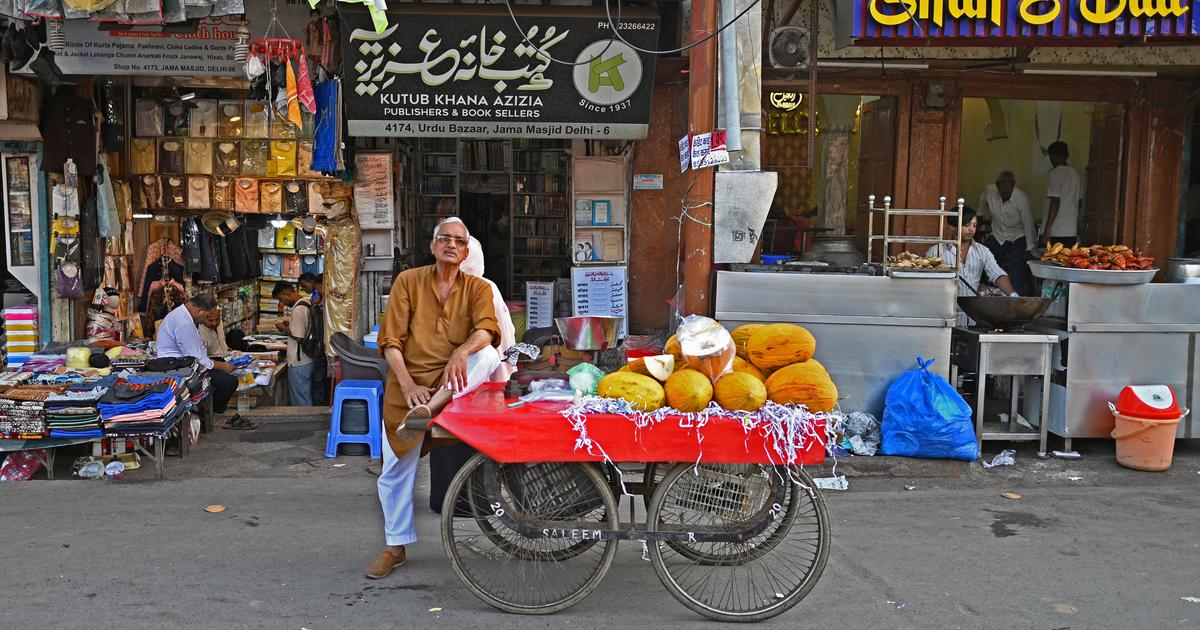
The systematic annihilation of Muslim livelihoods has been a central marker of the Modi years. This has been caused in part by the frequently violent activism of non-government formations fraternal to the Bharatiya Janata Government and affiliated to the Rashtriya Swayamsewak Sangh. What is sometimes missed is the central role in all of this of the state.
It is important to understand that what the country has witnessed – and India’s Muslim citizens have endured – under Narendra Modi’s leadership is not merely a random conglomeration, a massing of unconnected individual hate attacks on Muslim livelihoods. The years of Modi’s leadership have witnessed a conscious and catastrophic dismantling of the livelihoods and economic foundations of an already highly dispossessed community through both law and policy.
Analysts observe that “while Muslim disadvantage has been widely noted… there are few policies in place to protect them”. Such policies could include building better educational infrastructure in Muslim majority areas, training more Muslim teachers, enhancing the quantum and coverage of scholarships for Muslim children and youth, and taking strict action against discrimination. On the contrary, the effort is in the reverse direction, with many scholarship schemes for minority children either wound up or severely under-budgeted.
Worse, during the Modi era, there are many state policies that target Muslim livelihoods directly. These include hardened cow protection laws. Under-budgeting and poor public provisioning of schools, medical centres and infrastructure in settlements with high density of Muslim populations is the rule, not the exception. Bulldozers have in these years deliberately targeted Muslim properties.
But these are not all. I will speak here of examples of other state policies and laws of the union and Bharatiya Janata Party state governments which have been deleterious to Muslim livelihoods. These are laws that openly or tacitly abridge or extinguish Muslim livelihoods on the pretext of many outlandish jihad conspiracy theories; the halal ban; and changes in the waqf law. Each of these state policies and laws have had a direct inimical impact on the livelihood opportunities of Muslims, and their security and dignity at work.
Halal bans
“Halal” in Arabic means “permissible”. Aditya Menon’s thoughtful essay for The Quint reveals many flaws in the understanding of the idea of halal. Halal is widely understood by its opponents only as a way of slaughtering animals for meat, by slitting of the throat while reciting the Kalma. This is an important part of halal, but halal is a much broader concept. And in fact, the Quran describes anything that is “permissible” or “lawful” as halal and dubs what is “forbidden” and “unlawful” as haraam.
For instance, banking that earns interest or unlawfully earned wealth is haraam. Islamic Banking (that does not charge or earn interest) is halal, as is halal tourism in which hotels do not serve alcohol and provide separate swimming pools for men and women. In food items, foods and drinks containing the meat of pigs, blood, carrion (meat of an animal that is dead already), alcohol and most narcotic substances are haram. A pharmaceutical product that does not contain alcohol or pig gelatin would be certified as halal.
A significant example of state actions directly aiming to damage Muslim livelihoods is the halal bans. The Uttar Pradesh government in 2020 imposed a ban on halal-certified food products in the entire state. The Uttar Pradesh ban covered not just food products, but also drugs, medical devices, and cosmetic products with halal-certified labels.
This ban followed many agitations by Hindutva organisations against halal-certified products. A “#BoycottHalalProducts” campaign was launched around 2019 by Hindutva organisations Sanatan Sanstha and Hindu Jagruti and vigorously supported by Sudarshan News TV channel.
Sanatan Prabhat, a Hindutva group of periodicals, described halal certification as a kind of “economic jihad” aiming at the “Islamisation of India”. They maligned the meat trade as somehow linked to terror, and hoped to win the support of Sikhs who have a religious injunction against eating halal meat, as well as the Dalit Khatik community whose traditional occupation is the sale of meat. It hoped to pit both Sikhs and Khatiks against Muslims.
Menon explains that the Sikh religious bar is not just on halal, but on the meat of any animal slaughter that involves rituals (and therefore would also include Hindu animal sacrifices that are common among Nepali Hindus among others). He quotes a Sikh tweet that reflects a common sentiment among the Sikhs he interviewed: “I don’t eat halal or any other meat that has been slaughtered under a religious/belief custom/ceremony/ritual, I don’t have any problem with people eating halal or anything else, Sanghis trying to pit Sikhs against Muslims is a joke! ....”
The Tender Chicken you buy in Karnataka, which was promoted by BJP MLA @CTRavi_BJP is halal certified too... pic.twitter.com/coV7pI5SWD
— Mohammed Zubair (@zoo_bear) April 1, 2022
Ravi Ranjan Singh, a resident of Delhi’s Mayur Vihar, formerly a journalist who became a self-professed acolyte of Yati Narsimhanand was a passionate campaigner against halal. “They threaten my identity,” he declared. “...Halal is not just meat, it is everywhere...These are economic black holes which lead to economic slavery. Non-Muslims are being deprived of employment. We will all be slaved.” He accused the halal industry of “employment discrimination”, falsely claiming that it only employs Muslims for all jobs from the butchering of the meat to its sale to a customer. “They [Muslims] are forcing (halal) on us,” in hospitals, housing complexes, schools and airlines – all part of a halal nexus to keep non-Muslims out.
The protests seeking a ban on halal certification gathered momentum when many more Hindutva organisations joined it. They campaigned against state-owned Indian Railway Catering and Tourism Corporation, Air India, and others for offering halal-certified products. The campaigners argued that halal certification promotes Islamic practices and sought a ban on such products, including halal-certified meat in public institutions.
The Hindutva group Hindu Janajagruti Samiti Karnataka spokesperson Mohan Gowda also targeted the Maharashtra Tourism Development Corporation and other organisations that offer halal-certified chicken products, soft drinks, flour, and chocolate brands. It campaigned to ban halal-certified products in Karnataka, stating that animals are killed by offering them to Allah, which they found offensive to Hindu gods. Hindutva organisations also urged Hindus to eat jhatka meat, which kills animals in one strike, claiming it is less cruel than the halal method.
Bajrang Dal, Vishva Hindu Parishad and other Hindutva outfits in 2022 ran a door-to-door campaign in Karnataka asking people not to buy halal meat, reportedly with the tacit support of the ruling Bharatiya Janata Party.
The BJP national general secretary CT Ravi even called halal food “economic jihad”. During the Ugadi festival, a section of Hindus prepare non-vegetarian feasts, and the campaigners urged them to not buy meat from Muslim meatsellers. During the statewide call for boycott of Muslim traders, led by Hindutva activists, members of the Bajrang Dal physically attacked a Muslim meat seller in Karnataka’s Shivamogga district. Five men were arrested.
The Vishva Hindu Parishad demanded a legal challenge against halal certification in India, arguing that it discriminates against non-Muslims and funds terrorism. Halal and halal certification, they said, is discriminatory, economically, socially and against all non-Islamic religions.
The Adityanath government, in November 2023, lodged an FIR in Lucknow against the Halal India Private Limited Chennai, Jamiat Ulama-i-Hind Halal Trust Delhi, Halal Council of India Mumbai and Jamiat Ulama Maharashtra.
UP govt bans manufacturing, storage, distribution and sale of Halal products. pic.twitter.com/aAccIYqPgE
— Piyush Rai (@Benarasiyaa) November 18, 2023
The charges were of issuing halal certificates for some products on the basis of forged documents to exploit the religious sentiments of customers of a particular community (Muslims) for financial gains. It also spoke of companies and staff involved in an “anti-national conspiracy”, namely “funding notified terrorist organisations and organisations involved in anti-national activities” and “conspiring to incite large-scale riots by messing with public faith”.
The next day, the state government issued an order banning the manufacture, sale, storage and distribution of halal-certified products with immediate effect in the state from the view of “public health.” Food products made for export were notably excluded from this list.
Protests against halal products also spread to other parts of the country. A protest in February 2023 in Dhanbad, Jharkhand, was led by the Hindu Janajagruti Samiti and the Halal Sakhti Virodhi Kriti Samiti against halal certification. Protesters claimed that there was an increasing demand for halal products forcing Hindu business owners to obtain halal certification, even for items like sugar, oil, and cosmetics. This, they said, was part of a campaign against “Halal Jihad”.
In Kerala too matters went out of hand with right-wing groups raging against the so-called “halal invasion” in Kerala, or the supply of halal-certified jaggery to the Sabarimala temple – which they even challenged in court. Christian groups also joined the campaigns against halal-certified groups. The hostility of sections of the Christian clergy against Muslims in Kerala has long been simmering.
In January 2020, chief Cardinal Mar George Alencherry of the Syro Malabar Church issued a circular warning Christians against “love jihad” claiming that “Christian women from Kerala are even being recruited to Islamic State through this”. The Pala archdiocese’s Bishop Mar Joseph Kallarangat said that non-Muslims in Kerala are targeted with “narcotics jihad”, a project to lure women and turn them into drug addicts. Social relations were further strained in June when a group of Christian youths made several disparaging comments about the Muslim community on the conferencing app ClubHouse.
Joy Abraham, a member of the Church's Auxiliary for Social Action , said “For the last few years, Arab food culture has massively invaded the state. Being citizens of India, we cannot allow this to happen. Muslim food manufacturers are getting reservations in the name of ‘Halal’ certification while others are denied opportunities. For example, manufacturing a ‘Halal’ certified product requires the company to employ at least 10 members from the Muslim community. We are against this invasion of a particular culture,” said Joy.
This, Muslim entrepreneurs said, is a falsehood. Syed Mohamed Imran, the Operations Head of Halal India, said non-Muslim staff are recruited and trained in Halal. “Halal food means hygienic, safe, non-toxic, ethical for mankind to consume, according to the Quran”.
BJP state president K Surendran did not agree, alleging that “Halal” is “a planned attempt to divide people and create communal riots” and called for a ban on the practice of Halal certification and Halal boards at Kerala hotels. In a press conference, Bharatiya Janata Party state general secretary P Sudheer equalled “Halal” to triple talaq.
Amendments to the Waqf Act
The Lok Sabha in 2025 passed, without any prior consultation with Muslim leaders or the political opposition, far-reaching changes in the Waqf Act. The Waqf Act, 1995, allowed Muslims the right to donate property for the welfare of their community, particularly the dispossessed among them. The amendments bring these Muslim properties donated for charity, which were until now governed by the community, substantially under state control. It also brings in non-Muslim non-officials into the systems of governance of these properties.
The amendments are presented by the government as long-delayed administrative reforms that were necessary to bring transparency into the management of these vast properties, and to ensure that these are suitably deployed for the welfare of the people. The government speaks of bringing in “unified management,” “efficiency,” and “inclusiveness”.
Organisations of Indian Muslims, in India and the diaspora, however, have expressed grave disquiet over how the move was thrust upon the community without consultation, which they see as a thinly veiled bid to deprive the Muslim community of control over its legitimate assets.
Rasheed Ahmed, Executive Director of The Indian American Muslim Council, for instance, summarises these concerns. Waqf properties, he says, “support countless educational institutions, healthcare facilities, and social welfare programs that serve Muslim communities across the country. He describes the Waqf (Amendment) Act, 2025 as “a blatant attempt to strip the Muslim community of its control over waqf properties and place these institutions under state control”. The intention, he says, “is to dilute the authority of the Muslim community and weaken its ability to safeguard religious endowments”. This undermines “not only the religious autonomy of Muslims but also threatens the very purpose of waqf, which is to serve the socio-economic needs of marginalised communities”.
For the purposes of this essay, I will limit my discussion to the possible impacts the amended law could have on the livelihoods of Indian Muslims. Centrally, the law ends the autonomy of the community to manage these properties and charity endowments and brings in significant state control. What may this mean in practical terms for impoverished Muslim livelihoods? This could undermine the economic and social infrastructure that many poor Muslims rely on, making waqf-based housing, schooling, small businesses, and social support charity more precarious. This reduction of control combined with increased risk of de-waqfisation or adverse bureaucratic decisions, represents a material threat to livelihoods and communal welfare, even if the law does not explicitly label it as such.
Reducing Muslim community control over its key resources that existed in the past has roused anxieties of exposing waqf properties to estate loss, eviction, and economic marginalization. In that case, the reforms may have the intended or unintended outcome of a structural attack on Muslim livelihoods by dismantling traditional waqf-based institutions of economic support, housing, education, and charity.
Under the amended law, waqf-lands may be deemed government property if their legal status is not formally submitted within a fixed time period. Section 3A(1) stipulates that “No person shall create a waqf unless he is the lawful owner of the property.” This means that any economic activity based on informal or customary waqf such as homes, small shops or businesses becomes vulnerable to legal challenge.
Section 36(1A) requires that “from the commencement of the Act … no waqf shall be created without execution of a waqf deed.” In practice, this introduces higher legal and transaction costs for poor or uneducated waqifs and small local institutions who previously relied on oral or informal dedications. Given the informal nature of large swathes of land title in India, this threatens the security of many waqf properties. Such loss of waqf status may lead to the dispossession of communities or individuals whose livelihoods depend on those properties. These could include residents of poor housing, small businesses, small shops and markets around mosques or dargahs, schools and madrasas, and properties whose income was used to give financial support to widows and orphans.
The threats are greater in a context in which right-wing governments are dismantling even the meagre affirmative action support for the Muslim community that existed in the past, like scholarships. In such conditions, powerless members of the community can at best hope for support from within the community.
It is not my argument that the managers of waqf properties were always performing these duties in an exemplary, blameless way. But however imperfectly, this was a potential resource for the disadvantaged Muslim to access for her dignified survival. It serves an even more critical life-support mechanism for impoverished and vulnerable Muslims when the state has pulled back from its duties toward this section of citizens. The fear is that this alternate pathway to education, livelihood and social security, can now be effectively blocked or made more arduous.
Therefore, even if it is noted that Muslims face grave disadvantages in employment, there are few policies in place to protect them. Such policies could include building better educational infrastructure in Muslim majority areas, training more Muslim teachers, enhancing the quantum and coverage of scholarships for Muslim children and youth, and taking strict action against discrimination. On the contrary, the effort is in the reverse direction, with many scholarship schemes for minority children either wound up or severely under-budgeted, and the state with its laws and policies assaulting the efforts of persons of Muslim identity to earn a livelihood with dignity and safety.
Laws to prevent ‘spit jihad’
None less than a chief minister – Pushkar Singh Dhami of Uttarakhand – issued detailed guidelines to his police and health departments to prevent instances of people spitting in food. One of these is a hefty fine of up to Rs 1 lakh for this offence. Also CCTV cameras are made mandatory in their eatery kitchens and all hotel staff need to undergo a police verification. He termed the offences that the law seeks to prevent and punish as “thook jihad”.
The Uttar Pradesh chief minister also announced his resolve to bring in a tough statute to curb contamination of food and beverages with human waste, spit, inedible items or other filthy material. It would make it mandatory for food centres to display the names of their owners, for cooks and waiters to wear masks and gloves and, like in Uttarakhand, for CCTVs to be installed in hotels and restaurants.
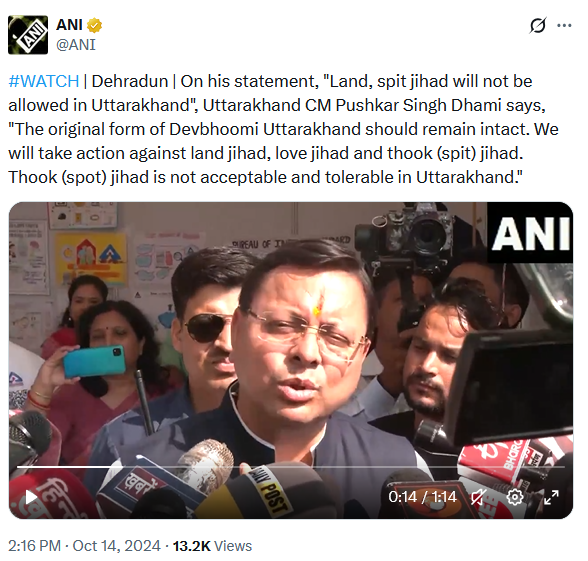
Adityanath also instructed officials that those who indulge in such jihad should be charged under non-bailable sections of the law, and punished with imprisonment and fine. He dog-whistled about other suspected jihads as well. He instructed strict action against staff working in an eatery if found to be an “intruder or an illegal foreign citizen.” This is a widely used dog-whistle for Muslims.
He should also face harsh punishment to any staff member of an eatery if he uses false names; that there should not be a single activity of adulteration of food items and beverages by “anti-social elements” through the concealment of their true identity. While opening a three-storey “floating restaurant” in Gorakhpur, Adityanath again made a dig at alleged “thook jihad”. “It’s good, at least what you get here won’t be the juice from Hapur. You won’t get rotis with spit on them. Whatever you get here, will be pure.”
Adityanath’s reference to Hapur was to the arrest of two persons – the juice stall owner and a minor – for allegedly contaminating juice with human urine. BBC reports that these government directives followed the unverified videos on social media showing vendors spitting on food at local stalls and restaurants – and one video depicting a Muslim house-help mixing urine into food she was preparing. (It is another matter that the police later found that she was of Hindu identity).
In these states, the police did not need a specific law to detain and charge people for allegedly spitting into food. BBC reports that even before the ordinance in Uttar Pradesh, the police in Barakanki arrested restaurant owner Mohammad Irshad for allegedly spitting on a roti, charging him with disturbing peace and religious harmony.
Supreme Court to Uttar Pradesh and Uttarakhand: “DO NOT FORCE THE OWNERS OF EATERIES ALONG THE KANWAR YATRA ROUTE TO DISPLAY THEIR NAMES OUTSIDE SHOPS”.
— Mohammed Zubair (@zoo_bear) July 22, 2024
SupremeCourt stays UP and Uttarakhand govt direction that eateries along the Kanwariya route should display the names of the… pic.twitter.com/m2w18kcLeB
Likewise, the Uttarakhand police arrested two hotel workers in Mussoorie – Naushad Ali and Hasan Ali – for allegedly spitting in a saucepan while making tea. They were charged with causing public outrage and jeopardising health.
Several other arrests also were made. In Gautam Buddha Nagar, police arrested a restaurant worker called Chand for allegedly spitting on rotis while making them at the eatery. In Saharanpur a minor boy was arrested for allegedly spitting on rotis while he was cooking them. The restaurant where the boy worked was also sealed, and a crime registered for promoting enmity between different grounds on the grounds of religion, etc. Again in Shamli, a juice vendor named Asif was arrested for allegedly spitting into the mosambi juice while he was squeezing the fruit with a hand-operated juicer.
In 2020, a man named Naushad was arrested for “thook jihad” by the Uttar Pradesh police in Meerut. They acted on the complaint of Hindu Jagran Manch leader Sachin Sirohi. Members of this group first assaulted him before complaining to the police that he spat into rotis. The police arrested him under the National Security Act. Later, it dropped the NSA charges and he was let off on bail. However, The Wire reports that all chapati shops refused to hire him, fearing a backlash. Naushad had always denied spitting in the food, but he spent three months in jail and then became jobless.
Conclusion
The scale, the reach and the magnitude of harm unleashed by the RSS-BJP project to annihilate Muslim livelihoods is immensely worrying. The debilitating damage to the life and livelihood chances of Indian Muslim citizens is partly the result of the spread and virulence of violence of embedded cadres of affiliates of the far-right Rashtriya Swayamsewak Sangh. The public statements of Bharatiya Janata Government leaders reflect and amplify the toxic prejudice and hate.
But behind all of this is the state backing of this project by a series of laws, policies and state actions. For me, the conclusion is inescapable. These signal what can only be described as a momentous project of vast ethnic cleaning.
I am grateful for the extensive research support of Sumaiya Fatima and Syed Rubeel Haider Zaidi
Harsh Mander, peace and justice worker and writer, leads Karwan e Mohabbat, a people’s campaign in solidarity and support to victims of hate violence. He is a visiting faculty in the South Asia Institute, Heidelberg University. His recent books are Under Grey Smoggy Skies: Living Homeless on the Streets of India’s Cities; and A Matter of Life and Death: The Unfinished Journey to Secure Healthcare for All.
