

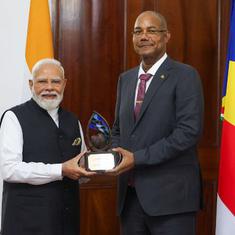

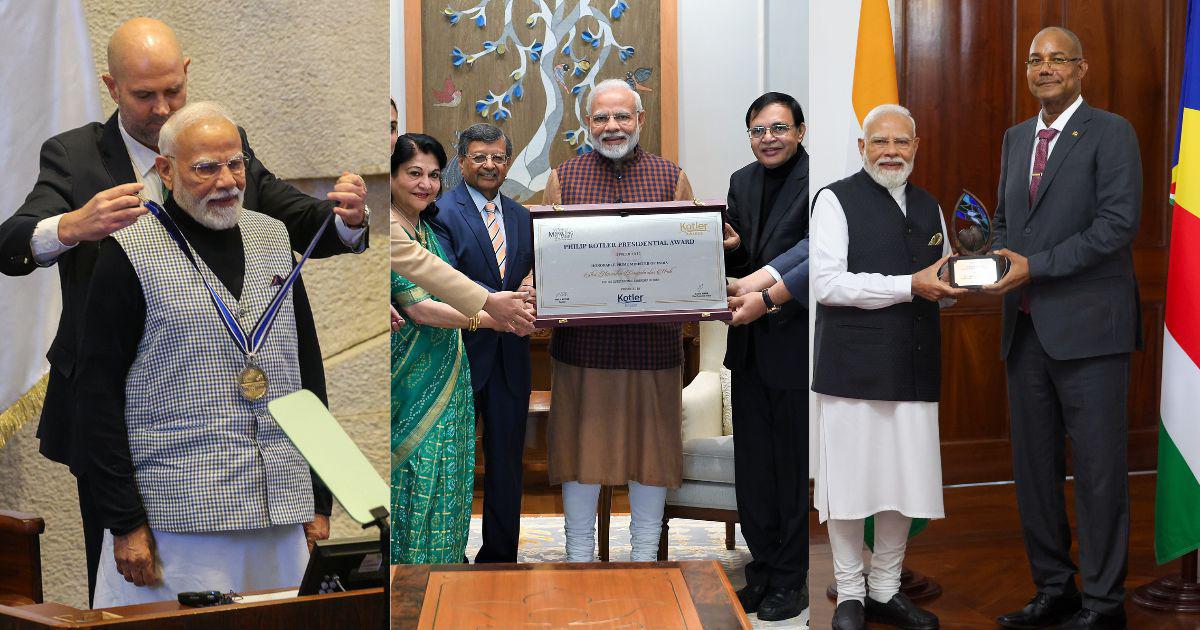
On June 28, Seychelles President Patrick Herminie draped a brand new presidential distinction round Narendra Modi’s neck: the “Guardian of the Blue Horizon”. Modi was its first recipient. He will, in all likelihood, also be its only one.
The Seychelles cabinet had approved the honour a mere three days before the ceremony. The citation was riddled with errors: “Republic” became “Repubblic”. “Seychelles” turned into “Seycheeles”.
A technology journalist reported that the certificate image carried a SynthID signature, suggesting it had been produced using an AI image generator.
Neither the Seychelles government nor India’s Ministry of External Affairs posted the citation on their official websites, a curious omission for a state honour bestowed on a sitting prime minister.
Seychelles officials later offered an explanation. Their old honours framework had become politically contentious and had been repealed by the National Assembly, forcing the government to draft a fresh system in a hurry. Modi’s visit served as the convenient occasion to launch it.
That account may well be true. However, it does not explain the typos, the apparent AI generation or why a 50-year-old nation marking its golden jubilee could not produce a clean certificate for a visiting head of government.
This was not an isolated embarrassment. Four months earlier, on February 25, Knesset Speaker Amir Ohana presented Modi with the “Medal of the Knesset” after his address to the Israeli parliament. This too was newly minted, with no prior recipients, no published regulations and, according to Israeli opposition lawmakers cited by Middle East Eye, no committee or presidential approval process behind it.
Opposition members in the Knesset accused Ohana of inventing the award for the occasion, turning the parliament into an instrument of government public relations.
A rare honour. A defining moment.
— Rekha Gupta (@gupta_rekha) February 25, 2026
Hon’ble PM Shri @narendramodi Ji has been conferred with the Speaker of the Knesset Medal, the highest honour of the Israeli Parliament.
This recognition rises above ceremony. It reflects the strength of India-Israel friendship and the enhanced… pic.twitter.com/BKWAKL11L5
These honours are part of a long list of awards that Modi has collected from foreign states over the past decade: Russia’s Order of St Andrew the Apostle, Saudi Arabia’s Order of Abdulaziz Al Saud, Bahrain’s King Hamad Order of the Renaissance and the UAE’s Order of Zayed, among them.
These longstanding state decorations have real institutional histories and have been awarded to several world leaders over the decades. But they speak less to Modi’s personal qualities than to an underlying balance sheet.
Roughly nine million Indian workers power Gulf economies with their labour and send home remittances that keep Indian households afloat, while Gulf crude supplies much of the oil consumed by India, the world’s third-largest oil consumer.
Russia, for its part, remains India’s largest arms supplier and, since 2022, its biggest source of discounted oil.
Yet the Seychelles and Knesset honours are different. They were built, apparently from scratch, around the timing of Modi’s visit and have not been awarded to anyone else since.
Why go to this trouble? The uncharitable but increasingly hard to dismiss reading is that foreign states have understood something about India’s prime minister: that ceremonial flattery earns disproportionate goodwill from Modi, which translates into real outcomes.
Modi’s Seychelles trip coincided with India extending a $125 million credit line and $50 million in grant assistance to the island nation, on top of patrol vessels, ambulances, rice and cement. Whether the award smoothened the way for the aid package or merely accompanied it is impossible to prove.
PM Modi hands over ambulances to Seychelles President Patrick Herminie pic.twitter.com/qLe37P2h1S
— Sidhant Sibal (@sidhant) June 27, 2026
The Israeli case illustrates the same dynamic. India has been Israel’s largest arms buyer for years, accounting for around a third of all weapons exported by Israel – and a flow that has continued uninterrupted through the genocide in Gaza even as several European governments faced public pressure to scale back.
Modi’s Knesset visit in February, which produced the freshly invented medal, was followed by reports of proposed defence deals worth an estimated $10 billion covering missile defence, drones and joint production. India’s Supreme Court has twice declined to intervene in petitions seeking to halt arms exports to Israel, and New Delhi has repeatedly abstained on United Nations resolutions critical of Israeli conduct in Gaza.
While none of this proves the medal bought anything, it does show a relationship in which ceremonial warmth and substantial material favour move in lockstep, with remarkably little public scrutiny of either.
Unlike established state honours, the Knesset “medal” and the Seychelles title are similar to another award conferred on Modi some years ago.
In January 2019, Modi received the inaugural “Philip Kotler Presidential Award” from the World Marketing Summit, an organisation with no published jury or disclosed selection process and was tied to an obscure Aligarh-based company. The award has never been conferred on anyone else, before or since.
In all three cases, a foreign institution invented a distinction with no known precedent and conferred it on Modi as its sole recipient. Each honour was wrapped in superlatives about leadership, vision and friendship. Yet, on closer inspection, they appeared to be something assembled specifically for the occasion.
The Kotler “award” differs only because the World Marketing Summit was a private outfit. There was no bilateral relationship to lubricate. What it shared with the other two was the absence of any discernible institutional process, and Modi’s willingness to accept the title regardless.
When amplified through official publicity and partisan media, such honours serve to sustain the image of a leader uniquely admired on the world stage, which may help explain why they are so readily accepted.
More importantly, it is the opacity surrounding these episodes that should concern anyone who cares about how Indian public money and strategic commitments are decided. Under the present dispensation, foreign and security policy runs heavily through the Prime Minister’s Office, with cabinet ministries and the diplomatic bureaucracy increasingly reduced to executing decisions taken at the very top.
When that much power sits with one office, and that office shows an appetite for ceremonial validation, foreign governments potentially gain a cheap lever. A medal costs a government almost nothing to mint, unlike a trade concession, a defence contract or a development package that would ordinarily be subjected to competitive bidding and parliamentary oversight.
A democracy should treat such episodes as a warning rather than a triumph. What did India quietly give away each time a fresh medal was hung round the prime minister’s neck? And which democratic institution, if any, exercised due diligence?
Far from being a matter of national pride, this is a matter that ought to worry every citizen who expects a democratic government to be accountable rather than merely decorated.
Vishal R Choradiya is an assistant professor with the Department of Professional Studies, Christ University, Bengaluru.
