







How can a government after 78 years of Independence deny people the right to clean drinking water? What happened to the promise of “Har Ghar Jal” – of drinking water in every home?
Since mid-May, these are the questions being raised by the residents of Chanot village in Haryana’s Hansi district. Chanot is one of the 121 villages in Hansi district, which was demarcated as a new district in December.
The protests were triggered by a new 30-km water pipeline that is being laid from the Bhakra canal to Hansi town to supply drinking water. The residents of Chanot have demanded a connection to the pipeline, which runs through the village.
The pipeline is being laid as part of the Atal Mission for Rejuvenation and Urban Transformation, or AMRUT, scheme to provide water to urban households.
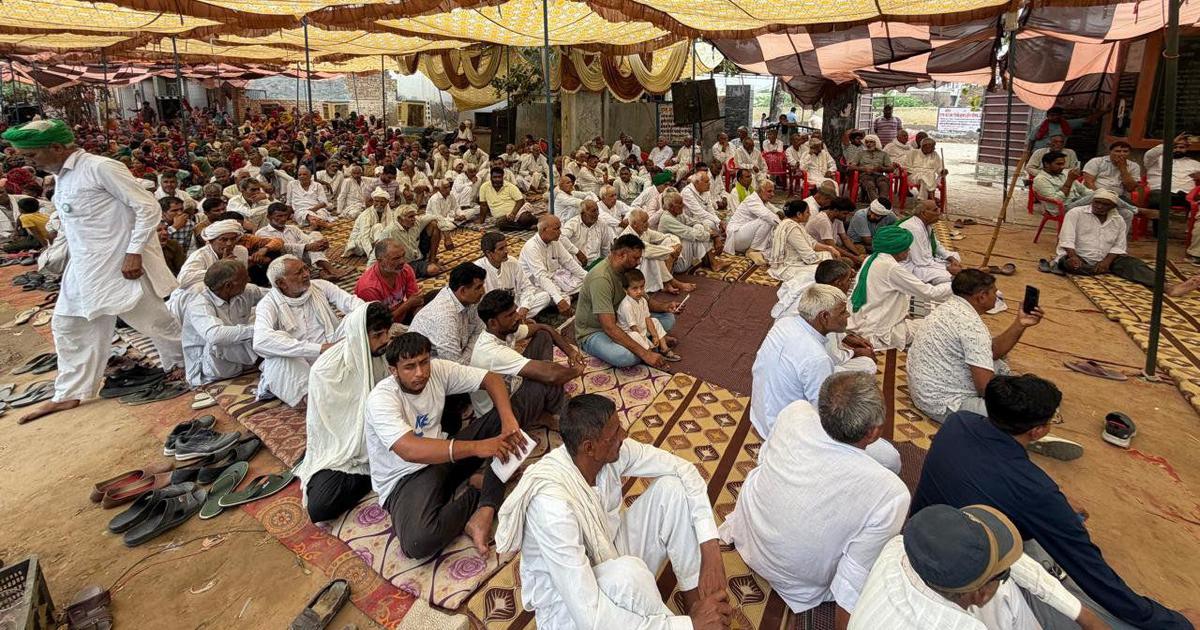
By June, about 50 residents of Chanot, including women and an octogenarian, began an indefinite fast demanding resolution of water and electricity problems.
At the protest site, plastic bottles filled with dirty yellow and black water have been strung up from a tent. Sitting under the tent, Chanot residents point to the bottles and tell news reporters, “This is the water we have been drinking for the past 20 years. The water is not even safe for our animals.”
Women, who shoulder the burden of collecting water, say they have had to rely on contaminated sources such as village tanks, groundwater and makeshift rainwater storage.
Hansi, Haryana: In Hansi, talks were held between the district administration and protesting villagers of Chainat over a water dispute. No final decision was reached
— IANS (@ians_india) June 4, 2026
Dharna Committee member, Anoop says, "We have placed our demand that the pipeline going to Hansi city should be… pic.twitter.com/nv31sNdzxO
The government has offered to lay another drinking water pipeline under the Jal Jeevan Mission meant for rural areas. However, Chanot’s residents have objected to the proposal saying that the alternative eight-kilometre pipeline will have to be powered by a motor. But due to irregular electricity supply and voltage fluctuation could disrupt water supply.
They say that a direct T-connection to the new, high-pressure urban pipeline being laid through the village will reduce overall costs.
Somesh Kumar, who claimed to be a former president of the Haryana Sarpanch Association, intervened in the protest and got a T-joint fitted to the new pipeline around June 20, said news reports. Kumar claimed the T-joint had been approved by the state government, reported The Tribune.
Days later, on the night of June 23, Hansi district officials and the police removed the T-joint on the pipeline saying it had been illegally installed. The police fired teargas shells as protests turned violent.
The khap panchayats of nearby villages and farmer leaders have voiced their support for the protest in Chanot. Leaders of the Congress and the Communist Party of India (Marxist) have also visited Chanot.
The agitation in Chanot resonates across many villages in Haryana where there is a severe shortage of water despite the elaborate network of canals from the Bhakra dam. The Bhakra Dam lies on the Sutlej River in Himachal Pradesh.
Haryana has a network of 521 canals that depend on the dam as well as tubewells. But Chanot represents the tip of the state’s water scarcity problem.
Earlier in June, the Hansi Police filed a first information report against 31 farmer leaders and protesters for blocking a road. Around the end of June, the local administration blocked social media accounts that were sharing updates and details of the protest in Chanot.
For now, the government does not seem to have any plan in place to deal with this crisis except to criminalise every legitimate protest by citizens, even if it is for the right to drinking water.
Nandita Haksar is the author of Shooting the Sun: Why Manipur Was Engulfed by Violence and the Government Remained Silent (Speaking Tiger, 2023).
