








Today, the idea of the modern nation-state is chronically susceptible to a peculiar form of institutional amnesia. Its Westphalian territorial boundaries are fragile, highly volatile accidents of history, but it treats them as ancient, predestined realities. In the popular imagination, the Partition and Indian independence are routinely reduced to high-politics drama. We are repeatedly fed a teleological romance, in books and films and web series, in which the British imperialists packed their trunks, a few men argued over maps in dusty rooms, and a sovereign democratic republic miraculously emerged, fully formed, from the ashes of empire.
For those who spend their lives and careers interrogating the structural anomalies of the Indian state, this smooth narrative has always been unsettling. My own engagement with India’s lack of social democracy has required a constant search for writers who examine the raw mechanics of power. It was this precise need that drew me to the work of the investigative journalist Josy Joseph.
Joseph’s 2016 book, A Feast of Vultures: The Hidden Business of Democracy in India, laid bare the unsparing anatomy of modern India’s corporate-political cronyism and mapped it as an entrenched, highly rational ecosystem. Five years later, The Silent Coup: A History of India’s Deep State offered a deeply constructive yet terrifying deconstruction of India’s internal security apparatus, exposing how the deep state operates entirely outside parliamentary oversight. These two earlier books were essential to understanding India's institutional apparatus, training one to excavate the surface of official press releases and constitutional pieties.
Tracing the lineage of the Deep State
Joseph’s latest work, Birth of a Nation: The Twenty-One Days That Made India, is a vital next step in diagnosing today’s political landscape. Joseph deploys the same forensic, investigative gaze he previously trained on modern billionaires and intelligence chiefs. Here he directs it backwards towards the frantic, paranoid three-week window between July 25 and August 14 in 1947. The outcome is an intellectual tour de force that shifts the historical lens away from the public positions of political leaders like MK Gandhi, Jawaharlal Nehru, or Muhammad Ali Jinnah. Instead, he takes the reader into the subterranean war rooms where the Indian subcontinent was very nearly fractured, with the possibility of breaking into an unknown, unmapped archipelago of hostile, independent fiefdoms.
Joseph’s methodological triumph lies in his brilliant selection of archives. He resists citing known, well-rehearsed speeches and memoirs that have long dominated liberal Partition historiography. Instead, he unearths long-forgotten bureaucratic files, espionage logs, and telegraph records from the newly formed State Department. Through these documents, the book both deconstructs and constructs a desperate war for existential survival. This war was waged by a small cabal of civil servants, spies, and negotiators operating under the fierce, transactional leadership of Vallabhbhai Patel and VP Menon. The historical reality Joseph exposes is deeply troubling, especially to conventional nationalist hagiography. It will thoroughly upend standard drawing-room debates. The truth he tells is that India’s birth was not a moment of uniform, celebratory consensus – instead, it was a brutal exercise in preventing immediate balkanisation.
The book sheds light on the absurd, high-stakes conspiracies previously buried in declassified folders. Examples worth citing include a British politician trying to build a yacht to smuggle 20 tonnes of gold out of the country. He does this to help a wealthy princely ruler secure independence.
In his book Joseph also traces the possibilities of alternative political alliances, especially orthodox Hindu kingdoms that actively collaborated with conservative Muslim rulers. What is interesting is that these alliances were backed simultaneously by both the Hindu Mahasabha and the Muslim League. The sole motive was to bypass accession to the Indian Union. Joseph’s text focuses on these untold structural machinations. He brilliantly reveals the possibility of a subcontinent on the brink of political collapse. Thus, the biggest lesson learned is that India’s sovereignty required aggressive engineering, trading, and enforcement in the shadows.
Stapling the map together at midnight
For readers, this raw realpolitik offers a striking historical resonance when read alongside BR Ambedkar’s contemporaneous interventions. In Ambedkar’s 1947 memorandum, States and Minorities, he had warned against compromising with the feudal tyranny of the princely states. He had argued that true democracy cannot exist with sovereign monarchies. Joseph’s archives show that the actual birth of the state required the very transactional compromises that Ambedkar feared and warned against.
For scholars of constitutional jurisprudence and governance, the most illuminating aspect of Birth of a Nation is its radical de-centring of the Thomas Carlyle’s “Great Men” theory of history. Joseph’s book explicitly paints a novel narrative of “small men who built the republic” – the steel-frame, functional, nameless machinery of the state.
He takes the case of RVMD Iyengar, an obscure civil servant who successfully operated as a deep-cover spy within the Nizam of Hyderabad’s inner cabinet. Iyengar’s operations directly disrupted the Nizam’s attempts to establish a fully independent, sovereign, weaponised enclave in the belly of the Indian subcontinent. Joseph notes that even Iyengar’s direct descendants were completely unaware of his role in intelligence, which was so monumental to India. These declassified files brought Iyengar’s role to light to his immediate family. By bringing these figures together, Joseph challenges traditional liberal frameworks of elite political rhetoric. Thus, the Indian state was not merely imagined into existence through the poetic prose of the “Tryst with Destiny” speech. It was physically coupled together by burning the midnight oil of strategic deployment of an espionage web and the raw realpolitik of institutional bureaucrats.
The book’s regional specificities offer critical insights, especially on the volatile accession of the Northeast region. Joseph meticulously documents the events in which the Governor of Assam, Sir Muhammed Saleh Akbar Hydari, saw his painstaking progress undone by local princely resistance and bureaucratic misalignments. This scenario he chillingly describes as “akin to Kashmir.” By fleshing out the messy, unfinished business of integration in other critical places such as Tripura, the Khasi principalities, and Travancore, Joseph provides crucial backward linkages and a mirror for understanding our current political crisis that has left this region in a state of perpetual crisis. Tensions such as recurring border skirmishes, ethnic clashes, and centre-state frictions that have marked the trajectory of modern India are not recent happenings. Joseph's texts reveal that they are the unresolved labour pangs of a republic forced to emerge in just 21 days.
Joseph’s prose is terse, avoids populist takes, eschews romanticism, and is driven by an underlying sense of civic urgency. He does not eulogise the surrender of hereditary power by 565 princely states. Instead, he analyses it as one of the largest structural liquidations of feudal authority in global history.
While reading this book, Ambedkar’s foundational warning on Constitutional morality kept ringing in my ears. As Ambedkar famously reminded the Indians in his Constituent Assembly speech, democracy is merely a top dressing on Indian soil that remains fundamentally undemocratic. The administrative machinery of the state is not neutral. It carries inherited biases and violent structural habits that have prevented India from forging into a true democracy in Ambedkar's sense, ie, a mode of associated living grounded in the principle of fraternity.
Read alongside Joseph’s earlier books, his new book establishes that the shadow machinery used to assemble India in 21 days hastily is the very same apparatus running the deep state today. Birth of a Nation demands that the reader not read this book as a nostalgic look at the past, but as a cautionary manifesto for safeguarding the fragile, democratic, secular union we inherit today.
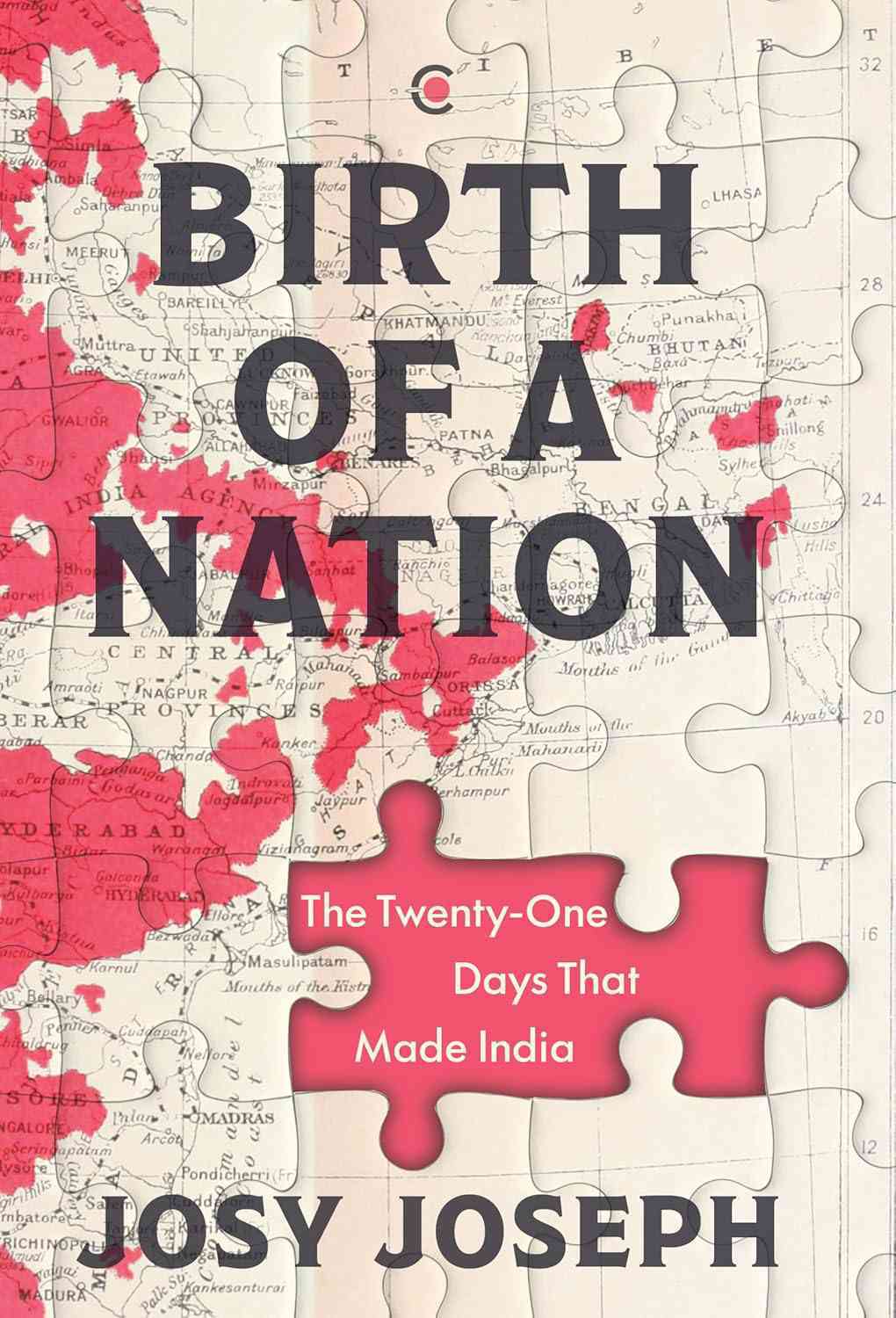
Birth of a Nation: The Twenty-One Days That Made India, Josy Joseph, Westland.
