




At around midnight on July 23, Prime Minister Narendra Modi posted an Instagram reel, in which he acknowledged that the problem of paper leaks was a “very painful” one for lakhs of students.
Modi said that the government had taken many steps to tackle the problem, including putting guilty individuals in jail, and swiftly conducting a retest to ensure that students did not lose a year. He also noted that the government would establish a fast-track court to hear the cases involving paper leaks. These courts, he had said earlier that day on X, would “ensure swift and stringent punishments” for those responsible for the leaks of exam papers.
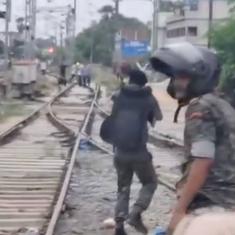
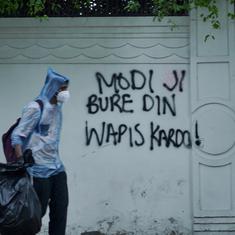
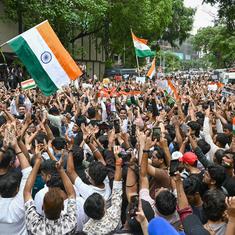
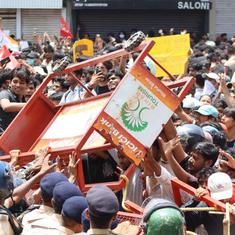
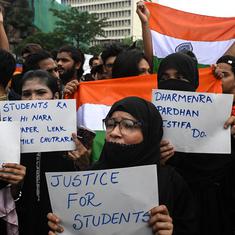
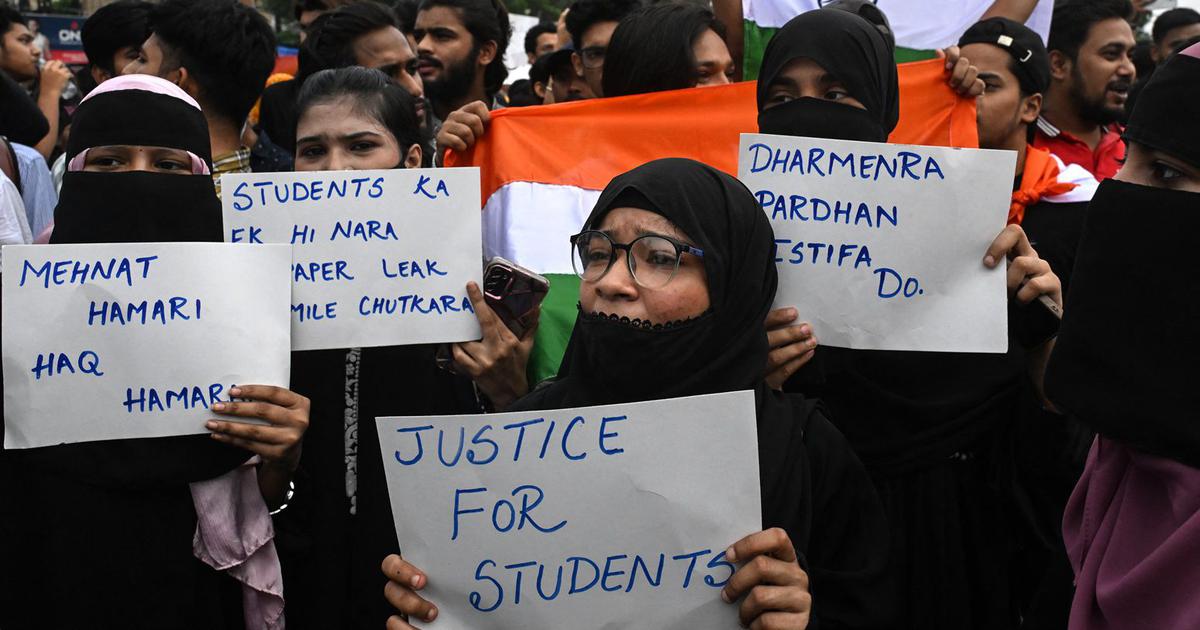
The prime minister’s response has not dampened the protests that continue to rage on across the country.
In fact, his assurance of quick trials in the paper leak cases has raised questions about the progress that has been made in earlier cases, such as connected to the 2024 leak of the NEET paper.
Many were sceptical, not least because the same day, the Central Bureau of Investigation had cleared the name of a key accused in that case, Sanjeev Mukhiya, stating that it had not found evidence against him.
Politicians were quick to seize on the irony. “You’re saying you’ll make a fast-track court, what will the fast-track court do?” Aam Aadmi Party member of parliament Sanjay Singh said to reporters. “If the CBI won’t even give evidence, you’ll save thieves, then what will happen?”
He added, “Fast-track courts are just drama, a distraction.”
VIDEO | Delhi: Reacting to Prime Minister Narendra Modi's video message on the paper leak issue, AAP MP Sanjay Singh says, "Sanjeev Mukhiya, who was arrested in connection with the 2024 NEET paper leak case, was the subject of an affidavit filed by the CBI in court just… pic.twitter.com/qnKNmLfz0d
— Press Trust of India (@PTI_News) July 24, 2026
The 2024 leaks
In May 2024, trouble broke out after the NEET exam had been held. Allegations emerged on social media that the paper had leaked before the exam, along with reports of failures of execution – some takers, for instance, received papers in a different language than their chosen one, while others were given less than the allocated time to write the exam.
At first, the government dug its heels in. As late as June 14, Education Minister Dharmendra Pradhan was denying that the paper had leaked. But within two days of this, he admitted that there had been “irregularities” in some places, and that some candidates would have to write the exam again.
Meanwhile investigations proceeded, and details of leaks and irregularities began to emerge, centred around Patna in Bihar, and Hazaribagh in Jharkhand, as well as an incident in Godhra, Gujarat. Cases that were being investigated by local police were subsequently transferred to the Central Bureau of Investigation.
The CBI traced the leak in Bihar and Jharkhand to a school in Hazaribagh, where papers had been stored. In a press release, the agency stated that “trunks containing the NEET UG 2024 question papers were brought to the school” on the morning of the exam and “the Principal and Vice Principal unauthorisedly and illegally allowed access to the room” where the papers were stored.
It noted that “a set of solvers” were given access to the papers, after which the solved papers were sold to students who had enrolled for the exam. “All the solvers, who are MBBS students from reputed colleges, have been identified and most of them arrested,” the CBI said.
By November 2024, the CBI had filed chargesheet against 45 individuals.
Two years later, the trials in the case have not begun. An analysis by Bhaskar English noted that 44 of the chargesheeted individuals are out on bail. According to the publication, one individual, Amit Prasad Maharana, who was linked to a coaching centre in Odisha, remains in jail.
The CBI also stated that it had given a list of names of students who accessed the leaked paper, as well as individuals who appeared as impersonators, to the National Testing Agency and the education ministry.
After news of the leaks emerged, several students approached the Supreme Court, some seeking a retest for all candidates. The court rejected this demand, noting that the leak was not “systemic” in nature.
The fast-track court
The lawyer Mathews J Nedumpara represented several students who took the NEET in 2024. He said he was unsurprised at the lack of progress in the cases. “I have cases from 2006 that have still not come to the trial stage,” he said. “So it is not unusual that the trial has not yet started in this case.”
Nedumpara was optimistic about Modi’s announcement of fast-track courts. “The momentum will definitely pick up,” he said.
But some research has shown that such courts struggle to meet targets – one analysis from 2024, for instance, found that as of May that year, Delhi’s fast track courts had “only disposed of 1,049 cases out of a total of 4,369 pending cases which indicates a significant lag in meeting the target”.
While acknowledging that these courts helped with faster disposal of certain categories of cases, such as those involving petty offences, it noted that the system had a weak design. “Inadequate infrastructure and low disposal rate lead to overburdened judges who are assigned other categories of cases in addition to their existing workload without the necessary support staff or infrastructure,” the report observed. “Consequently, the disposal rate of cases in these special courts slows down.”
Nedumpara, despite his optimism, also argued that Modi’s announcement missed the point of the protests. “What young people are demanding now is systemic changes in the education system,” he said.
The 2026 leaks
In the 2026 NEET leak case, the CBI has so far arrested 13 individuals, according to news reports. These include two teachers who were associated with the National Testing Agency, the head of a large coaching network in Maharashtra, and a family associated with the Bharatiya Janata Party.
Even as pressure mounts on the government to respond to protestors’ demands, which include that Pradhan resign, activists have been pointing out that the problem needs more far-reaching and systemic solutions.
Dr J Amalorpavanathan, a doctor and activist from Tamil Nadu, argued for instance that the NEET itself was fundamentally flawed, and that it had advantaged privileged students who can pay for coaching classes. He argued that as long as exams were centralised and the coaching industry swelled, and large masses of students wrote the exams, leaks were inevitable.
“What we need is for the exam itself to be cancelled,” he said. “It filters out bright students just because they don’t have the money to pay for coaching classes.”
He noted also that the protests had expanded beyond their initial focus on NEET. “The protestors are not just MBBS aspirants, students from all walks are protesting. This means there has been large-scale failure in the education system at large.”
