


Our President has spoken again. On Wednesday, he made a public statement for the fourth time in a fortnight. It is extraordinary, exclaim newspapers. But then, these are extraordinary times in which we are living.
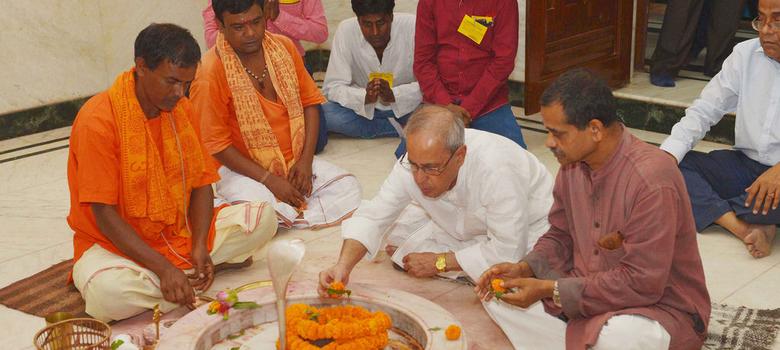
This time, as on other recent occasions, Pranab Mukherjee has chosen to speak like a Hindu, a devotee of Bhagwati, Mahamaya, Durga. His latest statement was made in Mirati in West Bengal’s Birbhum district, his ancestral place, which he visits every year during Durga Puja. The newspaper reports were accompanied by a photograph of him in traditional Puja attire, offering prayers to Durga.
Obviously, Mukherjee does not shy from being seen as a Hindu. At the same time, it is clear that he was addressing mainly Hindus, who share his vocabulary. The cosmology he is invoking is familiar to Hindus. He asked them to look at the image of Durga, the supreme deity. She does not stand alone while slaying Mahishasu: she is surrounded by Saraswati, Ganesh, Lakshmi and Kartikeya. “Look at idol of Goddess Durga, many identities co-exist: President Pranab Mukherjee,” was the headline of the Indian Express report.
Only two days before, he had spoken about Durga, the Mahamaya, who eliminates asuras, the forces of evil. He had spoken about the convergence of diverse energies and the fusion of diversities. He was probably trying to tell Hindus and Muslims and other religious groups that each of them has unique strengths, but it is only by uniting that they can they create magic, for Durga is a magical character.
The importance of difference
On Wednesday, he went further. He spoke about the commingling of Asangtir Shakti (disparate forces):
The president interpreted this as a metaphor for accepting difference: “opposing forces, different opinions…co-existence of these increase ties in society and increase society’s capacity to move forward…”
What is remarkable is that President Mukherjee did not call for integration. He does not see an underlying similarity in things that are outwardly different. Integration and pluralism do not go together. More often than not, the call to integrate is a demand for entities that are different to disintegrate, to dissolve into some greater unity or oneness.
We can see the struggle Pranab Mukherjee is going through. Presidents are not expected to meddle in the affairs of the state. They maintain a majestic distance from everyday politics. And yet, moments arise when the nation looks to them to help it navigate its way through muddy waters.
Speaking out
Presidents have to speak the language of their governments. That is their constitutional obligation. But, as journalist Seema Chishti writes, there are occasions when they have to speak to their people. And for them too, especially if a section of the people is feeling left out or pushed out.
In 2002, the enlightened KR Narayanan was President. In the first days of the Gujarat massacre, writers and artists marched to Rashtrapati Bhawan. He did not receive their memorandum personally. Repeated appeals to him to address the nation in his capacity as President to reassure India’s Muslims went unheeded. We were told that he wrote a letter to Atal Bihari Vajpayee, who was then the prime minister. We still do not know the contents of the exchange. What went public was Narayanan’s silence.
Governors hold a similar difficult position in the states. In the aftermath of the violence in Singur and Nandigram in 2007-’08, West Bengal governor Gopalkrishna Gandhi expressed his anguish. The ruling Left attacked him for this audacity.
The President, by virtue of his position as a non-partisan, has the right to be the voice of the people. It isn’t an easy job, especially when he is in a situation where the ruling dispensation lacks basic civility. Pranab Mukherjee has seen the Vice-President being crudely attacked by the leaders of the ruling party for having dared to speak his mind. He was called a divisive and sectarian Muslim.
A tightrope walk
Mukherjee is a shrewd and seasoned political hand, which is why he has chosen to speak as a Hindu. But it is not only about strategy. He is sincerely trying to find a language that is not antagonistic, which will not aggravate the already-violent discourse. His job is to temper the public sphere with good reason and infuse humaneness in the body politic.
When he first spoke about tolerance, he wondered whether India was straying from its course of democratic inclusiveness. This was in secularised language; it was still officious. But since travelling away away from Delhi, the seat of power, to his village, he has been trying to speak like a tradition-bound elder.
The president could be faulted for having invoked the image of Mahishasur Mardini Durga. The image of the asura, we know now, cannot be used the way upper-caste Hindus have been using it for centuries. The President could be called naïve and politically incorrect. But what is important is the innovative approach the president is attempting.
During this festive season, I want to thank the President for trying to evolve a religious language that is also human.
We welcome your comments at
letters@scroll.in.
This time, as on other recent occasions, Pranab Mukherjee has chosen to speak like a Hindu, a devotee of Bhagwati, Mahamaya, Durga. His latest statement was made in Mirati in West Bengal’s Birbhum district, his ancestral place, which he visits every year during Durga Puja. The newspaper reports were accompanied by a photograph of him in traditional Puja attire, offering prayers to Durga.
Obviously, Mukherjee does not shy from being seen as a Hindu. At the same time, it is clear that he was addressing mainly Hindus, who share his vocabulary. The cosmology he is invoking is familiar to Hindus. He asked them to look at the image of Durga, the supreme deity. She does not stand alone while slaying Mahishasu: she is surrounded by Saraswati, Ganesh, Lakshmi and Kartikeya. “Look at idol of Goddess Durga, many identities co-exist: President Pranab Mukherjee,” was the headline of the Indian Express report.
Only two days before, he had spoken about Durga, the Mahamaya, who eliminates asuras, the forces of evil. He had spoken about the convergence of diverse energies and the fusion of diversities. He was probably trying to tell Hindus and Muslims and other religious groups that each of them has unique strengths, but it is only by uniting that they can they create magic, for Durga is a magical character.
The importance of difference
On Wednesday, he went further. He spoke about the commingling of Asangtir Shakti (disparate forces):
“Shiva’s vahan is the bull but the bull is also the source of food for the lion which is Durga’s vahan. The snake and rat have no relationship of friendship. But the rat is the vahan of Ganesh while the snake is one of the weapons that Durga carries. The peacock and snake have a relationship of animosity, but the peacock is the vahan of Kartikeya.”
The president interpreted this as a metaphor for accepting difference: “opposing forces, different opinions…co-existence of these increase ties in society and increase society’s capacity to move forward…”
What is remarkable is that President Mukherjee did not call for integration. He does not see an underlying similarity in things that are outwardly different. Integration and pluralism do not go together. More often than not, the call to integrate is a demand for entities that are different to disintegrate, to dissolve into some greater unity or oneness.
We can see the struggle Pranab Mukherjee is going through. Presidents are not expected to meddle in the affairs of the state. They maintain a majestic distance from everyday politics. And yet, moments arise when the nation looks to them to help it navigate its way through muddy waters.
Speaking out
Presidents have to speak the language of their governments. That is their constitutional obligation. But, as journalist Seema Chishti writes, there are occasions when they have to speak to their people. And for them too, especially if a section of the people is feeling left out or pushed out.
In 2002, the enlightened KR Narayanan was President. In the first days of the Gujarat massacre, writers and artists marched to Rashtrapati Bhawan. He did not receive their memorandum personally. Repeated appeals to him to address the nation in his capacity as President to reassure India’s Muslims went unheeded. We were told that he wrote a letter to Atal Bihari Vajpayee, who was then the prime minister. We still do not know the contents of the exchange. What went public was Narayanan’s silence.
Governors hold a similar difficult position in the states. In the aftermath of the violence in Singur and Nandigram in 2007-’08, West Bengal governor Gopalkrishna Gandhi expressed his anguish. The ruling Left attacked him for this audacity.
The President, by virtue of his position as a non-partisan, has the right to be the voice of the people. It isn’t an easy job, especially when he is in a situation where the ruling dispensation lacks basic civility. Pranab Mukherjee has seen the Vice-President being crudely attacked by the leaders of the ruling party for having dared to speak his mind. He was called a divisive and sectarian Muslim.
A tightrope walk
Mukherjee is a shrewd and seasoned political hand, which is why he has chosen to speak as a Hindu. But it is not only about strategy. He is sincerely trying to find a language that is not antagonistic, which will not aggravate the already-violent discourse. His job is to temper the public sphere with good reason and infuse humaneness in the body politic.
When he first spoke about tolerance, he wondered whether India was straying from its course of democratic inclusiveness. This was in secularised language; it was still officious. But since travelling away away from Delhi, the seat of power, to his village, he has been trying to speak like a tradition-bound elder.
The president could be faulted for having invoked the image of Mahishasur Mardini Durga. The image of the asura, we know now, cannot be used the way upper-caste Hindus have been using it for centuries. The President could be called naïve and politically incorrect. But what is important is the innovative approach the president is attempting.
During this festive season, I want to thank the President for trying to evolve a religious language that is also human.
