






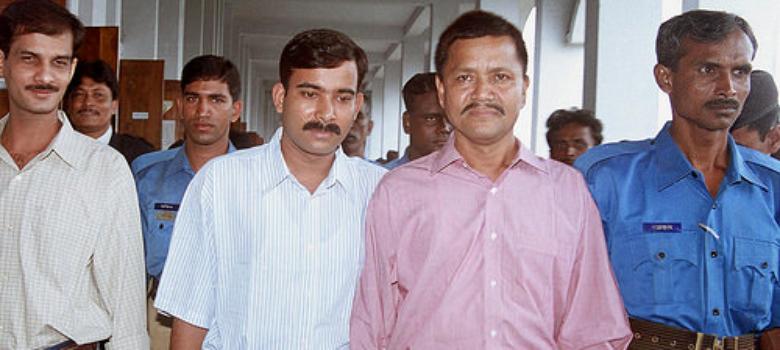
Anup Chetia, general secretary of the United Liberation Front of Asom, has been handed over to the Central Bureau of Investigation by the Bangladesh government. His return to the country on Wednesday ends a saga of 18 years, during which India and Bangladesh sparred over custody of the militant leader. It could also mark a new phase in talks between the Indian government and ULFA.
Chetia, originally known as Golap Baruah, formed ULFA in 1979 along with Paresh Baruah, Arabinda Rajkhowa, Pradip Gogoi and others who would soon become synonymous with the armed insurgency in Assam. Their aim, they said, was to establish a sovereign socialist Assam, maintaining that the territory had never been a legitimate part of India.
Chetia is wanted by the Assam Police in numerous cases of abduction, murder and extortion but he was arrested in Bangladesh in 1997 and sentenced to seven years in jail for illegally entering the country on a forged passport and possessing arms as well as foreign currencies.
Delhi-Dhaka diplomacy
Over the years, the extradition of Chetia became linked to the ebb and flow of ties between India and Bangladesh. Tensions grew after his arrest in 1997 revealed how entrenched ULFA was in Bangladesh. The militant group ran training camps there and owned thriving businesses, including hotels, clinics and soft drinks manufacturing units.
In 2003, a high court in Bangladesh ordered that Chetia be kept in custody until a decision was made on his asylum plea. The ULFA leader appealed for political asylum in Bangladesh three times, in 2005, 2008 and 2011. While India demanded that Bangladesh hand him over, Dhaka protested the two countries had no extradition treaty. For years, the question of Chetia’s return became a sticking point in diplomatic ties between India and Bangladesh.
The tide turned when Sheikh Hasina’s government in Bangladesh made a serious resolve to crack down on Islamist terrorism on its soil. Over the last few years, the growing warmth between Delhi and Dhaka has fostered close security cooperation. Both countries have agreed not to let their respective territories be used for insurgent activities across the border and India has called Chetia’s release a “confidence building measure”.
An extradition treaty was finally signed in October 2013. It allowed India and Bangladesh to exchange prisoners who had been jailed for more than one year, but it excluded political prisoners and those who sought asylum. It had been reported that Sheikh Hasina was willing to hand over Chetia in exchange for two Bangladeshi criminals in India.
Three factors stood in the way of extradition. First, Bangladesh argued that Chetia could not be returned under the treaty since he had asked for political asylum. Second, it reportedly decided to use Chetia as a political bargaining chip and refused to deport him until India ratified the Indo-Bangladesh Land Boundary Agreement. After the boundary deal was implemented this year, that obstacle was removed. Finally, in the last three years, Chetia himself has wanted to opt out of protective custody in Bangladesh. Several separatist leaders expressed their dismay over the fact that Chetia, who had asked for voluntary repatriation, should be exchanged for criminals.
Last year, it was reported that Chetia would be released under a special mechanism beyond the extradition treaty. Ultimately, it boiled down to a matter of political decision-making. This week, Chetia was handed over to Indian officials after he sent out a written application saying he wished to come back to India.
Talking to ULFA
Chetia’s willingness to return may be linked to a change in the terms of engagement between the Indian government and certain factions of the ULFA. Like other insurgent groups in the Northeast, the ULFA has split over the question of talks with the Indian government. In 2011, the pro-talks faction, led by Arabinda Rajkhowa, signed a tripartite suspension of operations agreement with the Centre and the Assam government and started a dialogue. Delhi wants Chetia to join the talks. A man once wanted for serious crimes could now become a crucial part of a peace process.
Delhi would want to present a conciliatory face to rebel leaders willing to engage with the government. The anti-talks faction, led by Paresh Baruah and Abhijit Barman, renamed itself ULFA(Independent) and set up base in Myanmar, where it developed cordial relations with the National Socialist Council of Nagaland (Khaplang), a Naga rebel faction that was recently banned by the Indian government. A new consolidation is believed to be taking place in the jungles of Myanmar. On May 4, a press release declared that a number of separatist outfits, including the NSCN(K), the ULFA(I), the National Democratic Front of Bodoland and the Kamtapur Liberation Organisation, had come together to form the United National Liberation Front of Western South East Asia. Their objective, armed struggle aimed at the liberation of “ancestral homes”.
While these groups make common cause, the Indian government would want to strengthen the constituency for talks. The return of Chetia could be a symbolic step in that direction.
