






Bihar: EC says 3 lakh voters added as per rules after poll announcement, responds to Congress’ claim
The party had questioned the rise in voter numbers from 7.42 crore to 7.45 crore in a November 13 press note issued after the completion of polling.
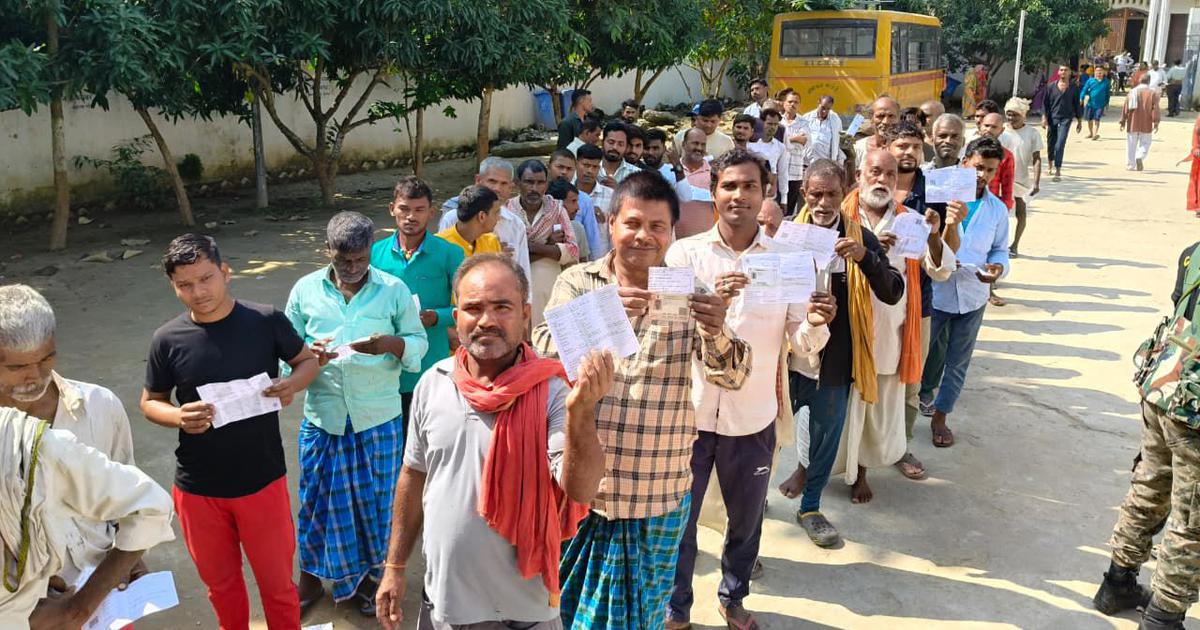
A day after the Congress flagged a jump in Bihar’s voter numbers, noting that the Election Commission had announced 7.42 crore voters on October 6 while releasing the poll schedule, but post-poll data showed the figure had risen to 7.45 crore, unidentified poll officials told PTI that three lakh voters were added to the state’s electoral roll after the publication of the final list following the special intensive revision.
Unidentified officials said that under election rules, eligible citizens can seek inclusion on the electoral roll until 10 days before the last date of filing nominations for each phase after polls are announced.
“After examining all valid applications received from October 1 until 10 days before the last date of nominations in both phases, the names of eligible voters were added so that no eligible voter is deprived of voting,” PTI quoted an official as saying.
Phase 1 nominations closed on October 17, and Phase 2 on October 20.
Officials said that the registration of new voters through Form 6 continued until a week before the nomination deadlines, PTI reported.
Polling for the Bihar Assembly elections was held on November 6 and November 11, and the results were declared on Friday.
The Opposition bloc lost the polls to the ruling National Democratic Alliance.
The Mahagathbandhan won 35 of the 243 seats. Of these, 25 were won by the Congress’ ally Rashtriya Janata Dal. The Congress won six of the 61 seats it contested, and the Communist Party of India (Marxist-Leninist) Liberation clinched two.
The Bharatiya Janata Party won 89 seats and Chief Minister Nitish Kumar’s Janata Dal (United) won 85, almost doubling its tally from the 2020 polls. Their ally Lok Janshakti Party (Ram Vilas) won 19.
A party or an alliance needs 122 seats in the 243-member Assembly to form the government.
Ahead of the polls, the special investigation of voter rolls exercise was conducted in Bihar, after which at least 47 lakh voters were excluded from the final electoral roll published by the Election Commission on September 30.
Concerns had been raised that the revision process could disenfranchise many voters.
Several petitioners had moved the Supreme Court against the exercise. On September 8, the court had directed the Election Commission to accept Aadhaar as a valid identity proof for the exercise in Bihar.
The Aadhaar card was not among the 11 documents that the poll panel had said could be submitted as proof of citizenship. Several petitioners had objected to the exclusion of Aadhaar, the most widely held ID, from the list of permissible documents, calling it “absurd”.
The poll body has maintained that the intensive revision of voter rolls is a clean up exercise to remove names of the deceased, duplicate and undocumented migrants.
The Congress and its leader Rahul Gandhi have repeatedly accused the Election Commission of large-scale vote rigging, including in the Maharashtra Assembly polls held in November 2024, alleging what they called “industrial-scale rigging involving the capture of national institutions.” The Election Commission has rejected those allegations as well.
On November 5, a day before the first phase of polling in Bihar took place, Gandhi alleged at a press conference that there was large-scale rigging in the 2024 Haryana polls. He claimed that about 25 lakh fake voters were added to the electoral rolls of the state ahead of the polls held in October 2024.
