










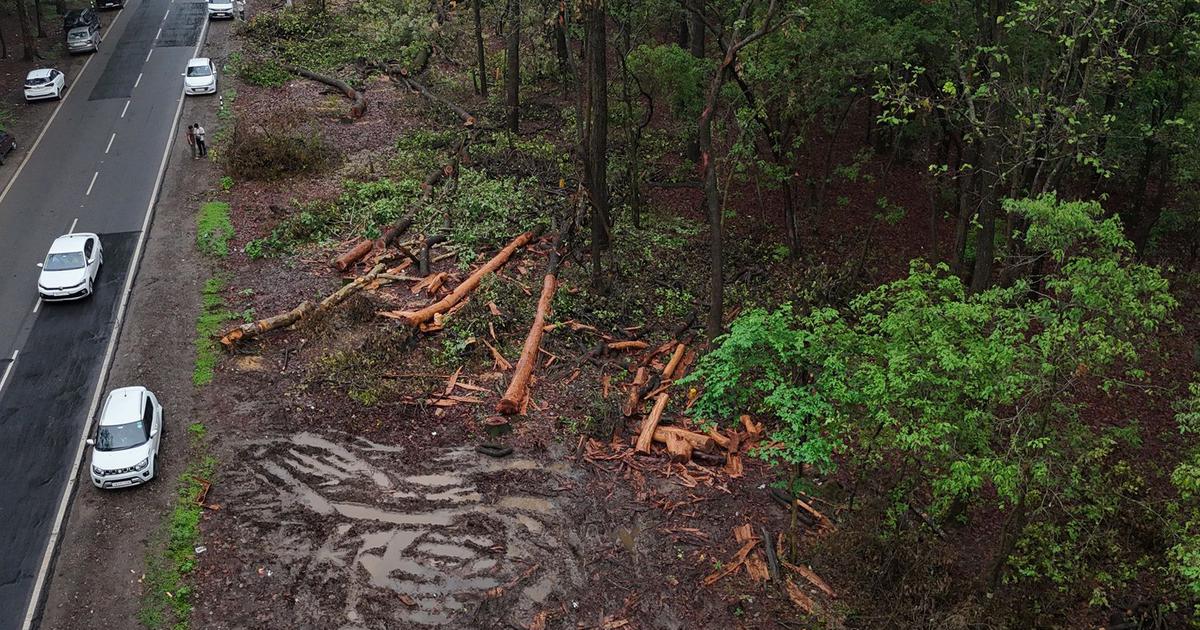
On July 7, citizens gathered along a road in Uttarakhand’s Dehradun district, near the city’s airport. They came together to protest the cutting of trees in Badkot forest range for a road-widening project.
The National Highway Authority of India announced that day that it was “taking forward” the project, which would involve widening to four or six lanes existing roads in a stretch of 20 km connecting Dehradun airport to Rishikesh.
For this, it plans to cut more than 4,400 trees, according to its 2021 proposal to the ministry of environment, forest and climate change. The proposal noted that the work would require the use of around 20 hectares of reserved forest.
The highway authority said the project aims to “strengthen connectivity between Dehradun, Jolly Grant Airport, and Rishikesh, while supporting tourism, Char Dham Yatra and the state’s growing transportation needs”.
But protestors argued that the environmental cost of the work is too high. “A lot of the trees being cut were sal trees which are almost 200 years old,” said Ashutosh Kothari, an environmentalist and advocate based in Dehradun.
Anoop Nautiyal, founder of the Social Development for Communities Foundation, in Dehradun, noted that the road expansion was part of a larger push to build infrastructure in the region. For instance, a new Delhi-Dehradun expressway was inaugurated earlier this year, and the Dehradun airport is set to expand, for which around another 90 hectares of forest in Thano forest are to be cut.
He argued that this work was ill-advised. “It’s very clear that this is all tourism-centric,” said Nautiyal. “This model is making Uttarakhand more vulnerable to climate risks and amplifying the frequency and severity of disasters.”
46,203 Hectares Forest Diverted in #Uttarakhand, 47% in #Dehradun district alone:
— Anoop Nautiyal (@Anoopnautiyal1) July 16, 2026
On #Harela, I'm reflecting on where Uttarakhand stands today. Through an RTI I filed, I found that 46,203 hectares of forest land have been diverted for development projects since the state's… pic.twitter.com/iJkmYdaCY0
But these are not the only concerns with the project. Not far from where the protestors had gathered, a group of Van Gujjars found their livelihoods at stake because of the deforestation plans.
The community is a semi-nomadic Sunni Muslim tribe that is classified as an “other backward class” in Uttarakhand and Uttar Pradesh. In the past, it has collaborated with citizen groups to protest deforestation but found that the focus of these campaigns differed from their concerns which centre primarily on the threat to forest access which the community has traditionally enjoyed.
This time, therefore, they chose a different way to oppose deforestation. A day after the protests began, the Bhaniyawala 2B-Jhakhan 2B-Rainapur Grant gram sabha in Badkot range, formed under the provisions of the Forest Rights Act, 2006, wrote to the chief secretary of Uttarakhand and Dehradun’s district magistrate, requesting him to “intervene against the illegal felling of trees” in the area.
“We have permits from the forest department to use this forest for more than 70 years. Forty-three claims under the Forest Rights Act are pending with the sub-divisional level committee,” said Noordin, a member of the community who lives in Badkot panchayat and is the secretary of the Forest Rights Committee. “Then why are we not even informed before the trees are cut in our forests?”
On July 18, Uttarakhand’s chief minister, Pushkar Singh Dhami announced that the tree felling for the highway expansion would be halted with immediate effect, and that the government would enter into a dialogue with stakeholders.
Van Gujjars, however, do not feel reassured by the announcement. Noordin pointed out that while tree cutting for the road project had been halted, “more of our permit areas might still be cut for the airport expansion”.
An urgent call
Noordin first heard about the cutting from an acquaintance in the forest department, who called him one day in the first week of July. “He told us in urgency that a contractor has come with his labour, and has started cutting down our trees,” Noordin told Scroll.
He began to walk from his home in the forest opposite the Dehradun airport. To get to the site the acquaintance had described, he then walked through a forest of kanju trees, whose leaves are important fodder for the buffaloes he raised.
This part of the forest, which Noordin and around 50 other Van Gujjar families use, is known as Bhaniyawala 2B. It flanks the first 5-km stretch of the road which is being expanded – the highway authority proposes to cut a total of 123 trees in this stretch.
When Noordin arrived at the site, he realised they could not do much to prevent the felling. “We tried stopping them, but they told us to take the matter to higher authorities,” Noordin said. “In over two days, they cut around 30 to 40 trees.”
A long history
Van Gujjars in the region have a connection with the forest that traces back more than a century.
Pranav Menon, a PhD candidate at the University of Minnesota’s anthropology department, whose work focuses on Uttarakhand’s Van Gujjars, told Scroll that the earliest archival records he found of the community in the region date back to 1820, and are from Saharanpur. “In Badkot, I found annual migration of Gujjars which lays down their routes across different forest ranges,” he said. “That dates to the 1890s.”
The community rears the indigenous Gojri buffaloes – families in Badkot panchayat own between eight and ten buffaloes each, while a few also rear cows. Historically, they have migrated between the mixed deciduous forests of the Shiwalik ranges and the lower Himalayas to alpine meadows of the upper Himalayas, which allowed the cattle to graze on a variety of fodder. In recent years, the extent of their migration has reduced, but the community still moves across distances of between 25 and 30 km to graze the animals and lop trees for fodder.
This movement and use of the forest has government sanction – members of the community obtain permits from the state forest department, paying fees that vary depending on the number of buffaloes they own.
For instance, a receipt from 2022 that one member of the community showed Scroll granted permission to a Van Gujjar from “Badkot range, Dehradun” to “graze their cattle in Bhaniyawala 2B for the year 2021-22” in exchange for Rs 540.
As further evidence of their historical links to the forest, the Van Gujjars also point out that official records confirm that their ancestors lived in the range before Independence. In the letter to the Uttarakhand’s chief secretary and Dehradun’s district magistrate, they wrote that their ancestors “have been residing in the Barkot range as specified in the working plans of Dehradun Forest Working plan 1924-25, 1932-33, and 1945-46,” referring to documents that are prepared by the forest departments, and serve as scientific blueprints to manage forest resources.
A shrinking area
Over time, the forested areas in the Badkot range covered under Van Gujjars’ permits have seen a decline.
In the early 2000s, the Uttarakhand government diverted a portion of the forest around Bhaniyawala 2B to resettle families whose homes were being submerged by the Tehri dam and hydropower project. In total, 11 settlement colonies were built in Dehradun, including in Athoorwala, a village adjacent to the Badkot forest range. For this work, “forests which included our permit areas were cut”, Noordin said.
Noordin estimated that only about one-fourth of the forest that the community was earlier permitted to graze in is now available to them.
Van Gujjar communities elsewhere also face this problem. In Shivpuri, near Rishikesh, for instance, Van Gujjars have lost land to the construction of a railway line that will connect Rishikesh to Karnaprayag. “Around 2018, the forest department cut the forests that we had permits in for the railway project,” said Gami Gujjar, president of the Forest Rights Committee of Sindhan Top in Shivpuri. “Since then, the department has not been issuing us permits to graze. We are buying fodder.”
Menon noted that because many in the community now rely on market systems for fodder, they have begun to accrue debt. Further, the shrinking of permit areas has increased conflicts amongst Van Gujjars. “If buffaloes from one family end up grazing in areas that another family usually uses, or one lops trees of another family, this causes problems,” he said. “This did not happen earlier since there was a bigger range of permits”.
Noordin noted that a lack of access to forests “will harm us, our animals, and the coming generations”.
The question of forest rights
A 2009 letter from the environment ministry to all states instructed that deforestation work could only be carried out in a particular area after the process of settling all forest rights claims, under the Forest Rights Act, had been completed in it. Further, it noted, such work could only proceed after all gram sabhas in the forest had given their consent to the work.
Van Gujjars in Badkot allege that this process was violated in Badkot.
Noordin and Menon noted that the Van Gujjar community in their gram sabha in Badkot had filed individual and community forest rights claims under the Forest Rights Act last year. They are currently pending with the sub-divisional level committee, after whose approval it will be sent to the district level committee for a final approval.
Yet, the proposal that the highways authority submitted in 2022 claimed that the project was not acquiring forest land that belonged to any Adivasi or forest-dwelling communities and that the forest rights of such communities were not being violated.
In the July 8 letter, the gram sabha made it further clear that they had “not granted consent to the expansion project, either in whole or in part, till their rights could be settled or they were offered suitable rehabilitation”.
“It feels like they are making us go around in circles,” said Noordin. “Information should come to us through our forest rights committee so that at least we can put our point of view in front of the government.”
Scroll emailed queries to the highway authority and the state forest department about the Van Gujjars’ concerns with the project, and of their assertions about statutory processes being violated. This story will be updated if they respond.
