










Fix MGNREGA’s shortcomings rather than repealing Act: Scientists, academics to Centre
The 2025 Viksit Bharat-Guarantee for Rozgar and Ajeevika Mission (Gramin) Act is premised on a ‘misreading’ of several problems with the old Act, they said.
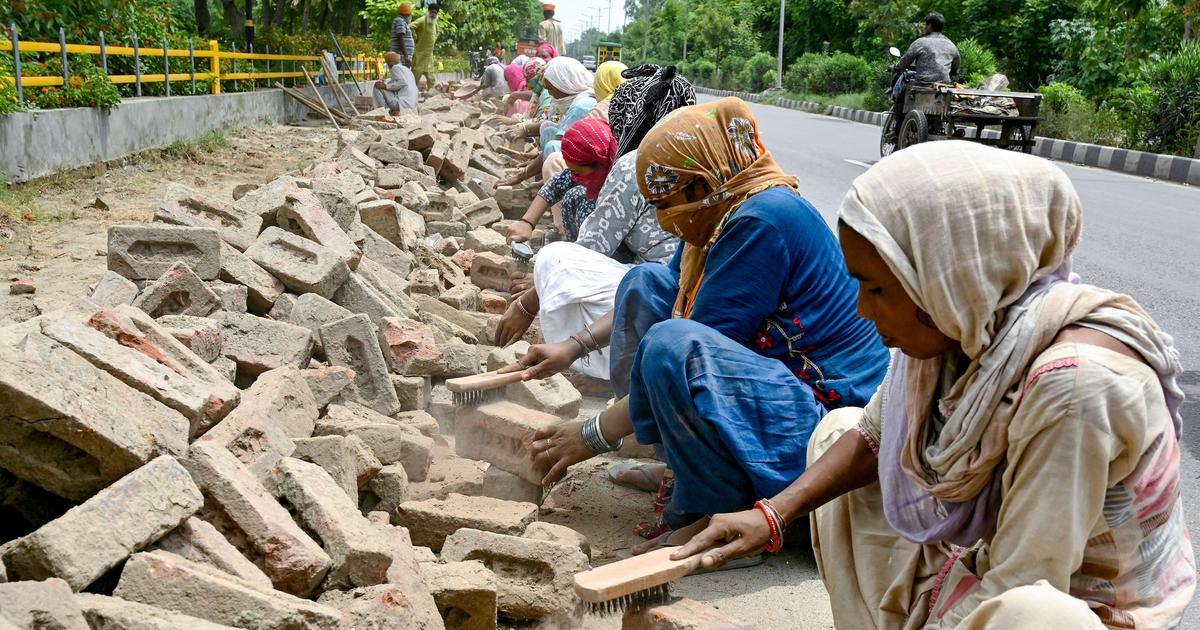
Over 300 scientists, academics, civil society organisations and field functionaries on Monday urged the Union government to undertake ground research and consultations to fix shortcomings in the Mahatma Gandhi National Rural Employment Guarantee Act, rather than repealing the law.
In an open letter, the 355 signatories said that the 2025 Viksit Bharat-Guarantee for Rozgar and Ajeevika Mission (Gramin) Act, which replaced the MGNREGA, was premised on a “misreading” of several problems.
The new law also resorts to solutions that will undo two decades of “radical empowerment” that the MGNREGA had brought about, the letter said.
The 2025 VB-G RAM G Bill was given assent by the president on December 21, two days after it was passed by Parliament amid protests by Opposition parties.
The MGNREGA was introduced in 2005 by the Congress-led United Progressive Alliance and aimed at enhancing the livelihood security of households in rural areas. The scheme guaranteed 100 days of unskilled work annually for every rural household that wants it, covering all districts in the country.
Under the new law, the number of guaranteed workdays will increase to 125, while states’ share of costs will rise to 40%. The Union government will continue to bear the wage component, with states sharing material and administrative expenses.
The legislation has drawn criticism from economists and labour rights experts. On Saturday, the Congress also said that will launch a nationwide protest from January 5 to demand the repeal of the VB-G RAM G Act.
In the letter on Monday, the signatories said that the discovery of problems with the MGNREGA that may have prompted the new bill was “incomplete”, adding that a more grounded problem analysis of the old legislation would lead to solutions that continue to empower communities in a rights-based and inclusive manner.
Demand-driven operation
One of the problems stated about the MGNREGA was that its open-ended demand-driven design no longer aligned with contemporary rural realities as livelihoods had become more diverse and digitally integrated, the letter said.
The signatories said that the solutions given in the VB-G RAM G Act aimed to use a normative approach where geospatial technology and Artificial Intelligence-based mechanisms would be used to determine where, how much and for what to allocate funds.
However, the letter said that “geospatial technologies and AI-based mechanisms of today cannot, and perhaps never will, capture the full complexity of social-ecological systems”.
It added: “These systems are shaped not only by physical landscapes, but by seasonal labour practices, customary and informal rights, local histories of degradation and repair, community priorities, and negotiated trade-offs that are often invisible to remote sensing and algorithmic inference.”
While data-driven digital systems can provide decision support, they remain informationally incomplete and must be augmented by local knowledge and community volition, the signatories said.
The demand-driven nature of MGNREGA was a revolutionary construct that arose from its rights-based employment guarantee mandate, the letter said, adding that it provided a crucial space for local democracy to operate.
“A normative design erodes such spaces from where democracy is born ground-up and places the burden of proof on the poor to come up with an alternative allocation rather than start by listening to them from the outset,” the signatories said.
The correct approach would be to preserve the “open-ended demand-driven nature” of the MGNREGA, the letter said.
Misappropriation of resources
The signatories also said that another problem stated for repealing the MGNREGA was that there was misappropriation of resources such as work not being found on the ground, expenditure not matching physical progress, use of machines in labour-intensive works and frequent bypassing of digital attendance systems.
The VB-G RAM G Act aims to add on to existing mechanisms like the National Mobile Monitoring Software application, which takes real-time attendance of workers, and geotagging of structures with biometric-based authentication of workers, field functionaries and transactions, it added.
Other mechanisms include a weekly public disclosure of key metrics, muster rolls, payments, sanctions, inspections, and grievances.
However, while leakages and misuse must be addressed, treating misappropriation primarily as a monitoring or authentication failure misreads the underlying causes, the signatories said.
“The fact is that misappropriation arises in scenarios where the communities in need of meaningful work and assets are unable to engage effectively with MGNREGA,” it added.
The signatories said that the correct approach would be to make sure that mechanisms are built to facilitate and improve participation from especially marginalised groups and expand access to the radical transparency.
“This is already a key feature of MGNREGA to counter local power elite and lower bureaucratic corruption, leading to MGNREGA being used to create durable and meaningful rural assets rather than leading to ghost works or wasted resources,” they said.
Labour availability
Another problem that was cited for repealing the MGNREGA was that it led to a lack of labour availability during peak seasons of sowing and harvesting, the letter said. The VB-G RAM G Act allows setting aside 60 days in a year when employment will not be provided, it noted.
However, the assumption that the MGNREGA competed with agriculture for labour did not hold under current rural labour market conditions, the signatories said.
“MGNREGA wage rates are significantly lower than prevailing agricultural wages, often by as much as 40-50 percent,” they said. “Rational workers do not substitute higher-paying farm work for lower-paid MGNREGA employment during peak seasons.”
In practice, the old legislation functioned as a fallback, not a primary employment option, the letter said, adding that it was used when farm work was unavailable, uncertain, or exploitative.
It added that the MGNREGA could be a fulcrum to create “rural livelihoods by going beyond just unskilled labour work to skilled labour like community-based monitoring of natural resources such as water bodies and forests, data collection about water quality, efficient and equitable water distribution from irrigation systems, and so on”.
Other concerns
The letter also noted that under the MGNREGA, the Union government contributed 90% of the funds and 10% came from the states. Under the new Act, the “Centre to State ratio of funds has been altered to 60:40”.
The new Act also states that “expenditure by a state in excess of its normative allocation shall be borne by the state government”. The signatories said that these clauses could lead to “political favouritism” towards some states.
They added that research and consultations with civil society organisations and groups who have been working with the old Act should be undertaken at the earliest to build a “ground-up understanding of where, when, why MGNREGA works, and to find ways to create such environments everywhere”.
