










Hundreds of flights cancelled from Indian airports after US-Israel attack on Iran
The DGCA has advised all airlines to avoid Iran, Iraq, Israel, Jordan, Lebanon, Kuwait, Saudi Arabia, the UAE, Bahrain, Qatar and Oman.
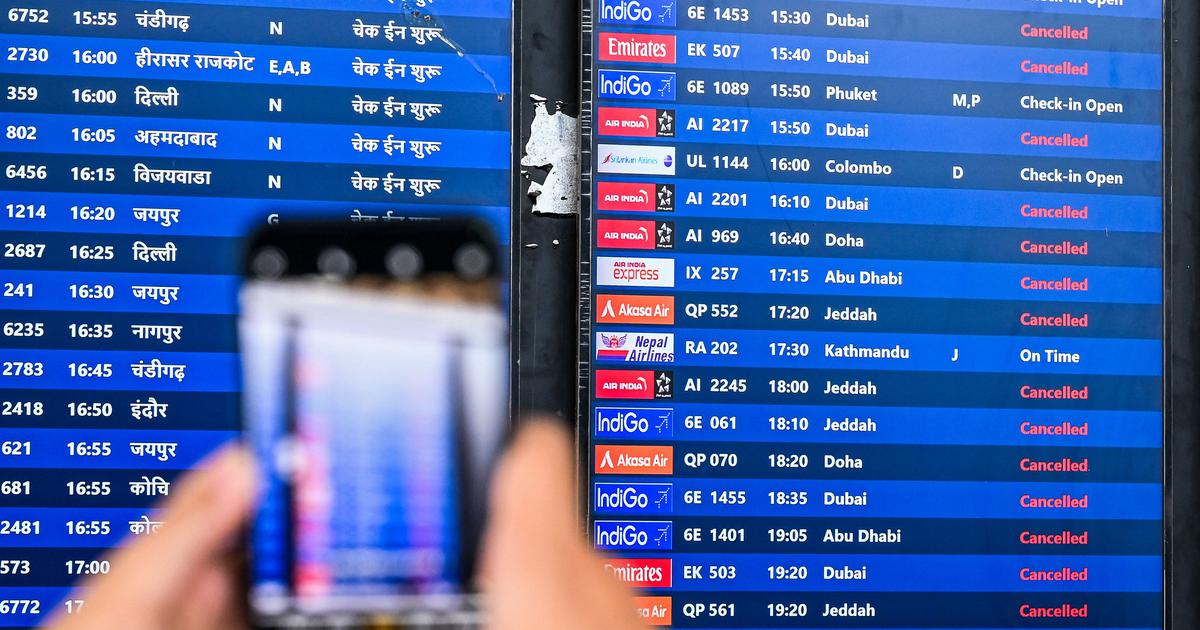
Flight operations to and from West Asia remained disrupted on Monday, with about 100 flights cancelled from Delhi, 30 from Chennai, 50 from Bengaluru, 45 from Kochi and 20 from Thiruvananthapuram, reported The Times of India.
This followed Iran’s retaliatory strikes after a joint Israel-United States military operation on Tehran on February 28.
On Sunday, Indian airlines cancelled around 350 flights.
This was in addition to the complete suspension of flights by all Indian carriers to 11 countries in West Asia.
The Directorate General of Civil Aviation has issued an urgent safety advisory for all airlines to avoid Iran, Iraq, Israel, Jordan, Lebanon, Kuwait, Saudi Arabia, the United Arab Emirates, Bahrain, Qatar and Oman.
The Ministry of Civil Aviation advised passengers to check their flight status with airlines before heading to airports.
Several international airlines have also suspended operations in parts of the region or are taking alternative routes to bypass West Asian airspace.
The closures have hampered flight operations globally, particularly due to disruptions at major transit hubs such as Dubai, Doha and Abu Dhabi, leaving thousands of passengers stranded in West Asia and parts of Europe, The Indian Express reported.
Indian carriers had already been avoiding Iranian airspace in recent weeks. But the larger West Asian corridor is important not only for their operations in the region, but also for overflights to Europe and North America.
On Sunday, the Ministry of External Affairs said that foreign nationals in India who have had to alter their travel plans due to the situation in West Asia and require visa extensions or need to regularise their stay should contact their nearest Foreigners Regional Registration Office.
The conflict
On Saturday, Israel and the US launched a joint operation to “degrade the capabilities” of the Iranian government. Iran retaliated to the attacks and said that the US-Israeli operation had begun while the nuclear negotiations were on.
The attacks came amid tensions between the three countries over Tehran’s nuclear programme. Israel has been claiming that Iran is “closer than ever” to obtaining a nuclear weapon, which could alter the regional security balance. Washington acts as a guarantor of Israel’s security.
Iran has long maintained that its nuclear programme is for civilian purposes.
However, amid fears of a potential attack, with a heavy US military deployment off its coast in recent months, Tehran had been forced to reopen negotiations with Washington about its nuclear programme.
On Sunday, Iranian Supreme Leader Ayatollah Ali Khamenei was killed in the US-Israeli military operation. His killing further escalated an already volatile situation in the region.
On Monday, the Lebanese militant group Hezbollah said it had fired rockets and drones at Israel in response to Khamenei’s killing, with the Jewish nation responding with a barrage of strikes in Lebanon.
Also Read:
Top updates: Israel strikes Lebanon after Hezbollah fires missiles across border
‘Nobody could sleep last night’: Indian workers on edge as Iran attacks Dubai, Doha
